Home / Survive / Emergency food: what to buy, in what order
Buying guide · food
Emergency food: what to buy, in what order
Start with three days of food you already eat that needs no fridge and ideally no cooking. Then build out with long-life pouches or buckets for a longer disruption.
By the Civilian Survival Handbook team · Updated 19 November 2026 · Checked against the official sources listed at the end.
The official baseline
The GOV.UK Be Ready checklist asks every household to hold non-perishable food for 3 days: food with a long shelf life that does not need refrigeration or cooking, such as tinned meat, fish or vegetables, dried fruit and nuts. It says it is best to buy food you would usually eat.
That is the floor, not the ceiling. Preppers plan for the case where three days becomes two weeks.
Step 1: the no-cook shelf (days 1 to 3)
- Tinned fish, meat, beans and vegetables you actually eat (and a manual tin opener).
- Crackers, oatcakes, peanut butter, dried fruit, nuts, cereal bars.
- Long-life milk or plant milk, and ready-to-feed baby formula if you need it (GOV.UK notes you may not be able to boil water for powdered formula).
- Pet food.
Put the date you bought it on the shelf and check every six months, as the official checklist suggests.
Step 2: freeze-dried and dehydrated pouches (days 4 to 14)
Freeze-dried meals are light, keep for a long time and only need hot water. They are what campers and expedition teams use. The catch: you need a safe way to boil water, which in a blackout means a camping stove used outdoors or in a well-ventilated space, never a barbecue indoors.
Read each maker's stated shelf life and calories on the pack; they vary a lot between brands and meals.
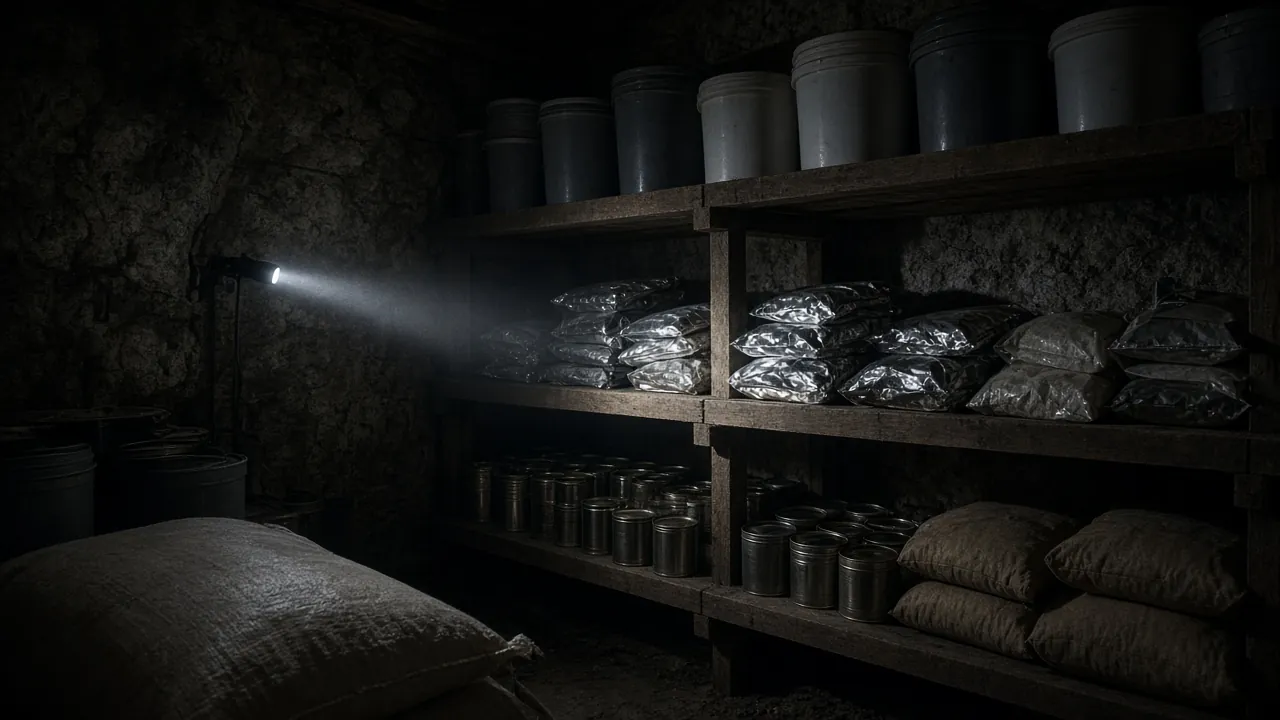
Step 3: long-life buckets (weeks)
Buckets bundle dozens of servings into one stackable container. They suit people with storage space who want to cover weeks in one purchase. Check the serving size and calories per day carefully: a bucket advertised by servings may not feed an adult for as many days as it sounds.
What not to do
- Do not buy a mountain of dry rice and pasta if you cannot cook without electricity. Induction hobs and electric ovens die in a power cut.
- Do not rely on the freezer: keep it shut in a power cut and follow the GOV.UK food safety in a power cut advice.
- Do not forget water. Food you have to rehydrate needs it.
UK and US brands
In the UK, look at Emergency Food Storage UK, Expedition Foods and Firepot, or a retailer like Base Camp Food that stocks several brands. In the US, Mountain House, Valley Food Storage, Wise Company, Augason Farms and My Patriot Supply are the big names. Links are in the store.
Quick answers
How much emergency food should I keep in the UK?
Official UK advice is non-perishable food for at least 3 days that needs no fridge or cooking. Many households then build towards a week or two.
Do I need freeze-dried food?
No. Tins and dry food you already eat cover the first days. Freeze-dried pouches are useful for longer disruptions and grab bags because they are light and keep a long time.
General information, not professional advice. In an emergency call 999 (UK) or 911 (US). Store links are plain links; we do not earn from them today.