In short: Emergency preparedness for a US household comes down to a few calm steps: know which hazards affect your area, make a family emergency plan, build a supply kit with water, food, light, a radio and medicines, and make sure you can receive official alerts. Ready.gov suggests storing at least one gallon of water per person per day for several days; CDC says at least three days, and two weeks if possible.
Key facts
- Ready.gov suggests five questions to discuss with your household: how you'll get alerts, your shelter plan, your evacuation route, your communication plan, and whether your kit needs updating. Source
- Ready.gov's basic kit starts with one gallon of water per person per day for several days, for drinking and sanitation, plus at least a several-day supply of non-perishable food. Source
- CDC says to store at least 1 gallon of water per person, per day for 3 days, and to try to store a 2-week supply if possible. Source
- You are not charged for receiving Wireless Emergency Alerts (WEAs), and there is no need to subscribe. Source
- NOAA Weather Radio broadcasts continuous weather information from the nearest National Weather Service office, 24 hours a day, 7 days a week. Source
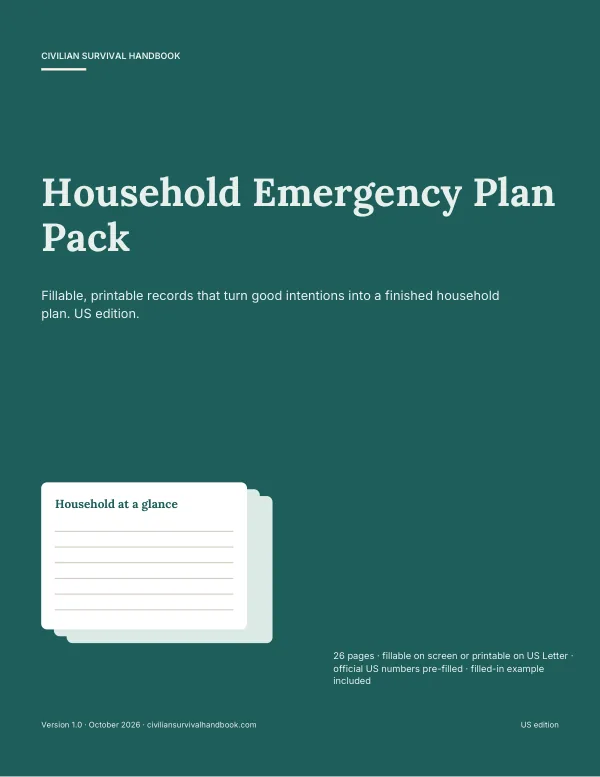 Want this written down for your home? Household Emergency Plan — US edition — printable, $7.99.
If recent news about storms, wildfires, power outages or wider world events has you worried, you're not alone, and you're not powerless. US federal agencies such as FEMA, through Ready.gov, ask every household to prepare in simple, practical ways. This guide pulls that official advice together in one place, without the noise. Our approach is simple: prepared, not panicked.
What does emergency preparedness actually mean?
For most households, preparing means four things you can do over a few weekends:
- Know your hazards. Ready.gov's first piece of advice is to know what disasters and hazards could affect your area — hurricanes on the coast, tornadoes in the Plains, wildfire in the West, winter storms in the North, flooding almost anywhere.
- Make a plan. Decide how your household will get alerts, where you'll shelter, how you'd evacuate and how you'll reach each other.
- Build a kit. Keep enough water, food and basic supplies to look after yourselves for several days.
- Get alerts. Make sure at least one device and one radio in your home can receive official warnings.
None of this requires special equipment or a big budget. Ready.gov's low and no cost tips suggest you build your kit over time and start with items you may already have at home.
What does Ready.gov recommend for a family plan?
Ready.gov's Make a Plan page suggests sitting down with your household and talking through five questions:
- How will we receive emergency alerts and warnings?
- What is our shelter plan?
- What is our evacuation route?
- What is our family or household communication plan?
- Does our emergency preparedness kit need updating?
It then asks you to tailor the plan to your household — ages, dietary and medical needs, disabilities or access and functional needs, languages spoken, pets or service animals, and school-aged children — and to write it down and practice it.
The free official way to write it down is Ready.gov's fillable Make a Family Emergency Plan form. Our family emergency plan guide walks through each section with a filled-in example.
What goes in a basic emergency kit?
Ready.gov's basic disaster supplies kit starts with water — one gallon per person per day for several days, for drinking and sanitation — and at least a several-day supply of non-perishable food. CDC is more specific: store at least 1 gallon of water per person, per day for 3 days, and try to store a 2-week supply if possible. That three-day minimum is where the popular "72-hour kit" idea comes from.
The rest of Ready.gov's basic list includes a battery-powered or hand crank radio and a NOAA Weather Radio with tone alert, a flashlight, a first aid kit, extra batteries, a whistle, a dust mask, a manual can opener, local maps, and a cell phone with chargers and a backup battery.
Our pages turn this into tick-box lists:
- 72-hour kit checklist — what to keep at home, plus extras for babies, pets and medicines.
- Go bag checklist — what to grab if you're told to evacuate, including documents and a car kit.
How do I get emergency alerts in the US?
You don't need to buy anything special to receive the most important warnings. Ready.gov's emergency alerts page describes the main official channels:
| Alert channel | What it is | What you need to do |
|---|---|---|
| Wireless Emergency Alerts (WEA) | Text-style alerts sent to phones in an affected area by authorities such as state and local public safety officials, the National Weather Service and the President | Nothing to sign up for; check your phone's settings, as some models require you to enable WEAs |
| Emergency Alert System (EAS) | National warning system on TV and radio; also used for weather and local incident information | Keep a battery or hand crank radio |
| NOAA Weather Radio | Radio network broadcasting warnings, watches and forecasts from the nearest National Weather Service office, 24/7 | A weather radio, ideally with a tone alert |
| FEMA App | Free app with National Weather Service alerts for up to five locations and help finding a nearby shelter | Download from your app store |
Ready.gov says WEAs look like text messages but come with a unique sound and vibration repeated twice, and that you are not charged for them. If you aren't receiving them, check your settings, then your wireless provider.
The National Weather Service says NOAA Weather Radio has more than 1,000 transmitters covering all 50 states, adjacent coastal waters, Puerto Rico, the US Virgin Islands and the US Pacific Territories. It also carries some non-weather emergency alerts through the EAS.
FEMA describes the FEMA App as free, available in English and Spanish, and able to send real-time National Weather Service alerts for up to five locations nationwide — useful if you want to follow an elderly parent's area as well as your own.
Ready.gov's evacuation guidance also suggests you sign up for alerts from your local emergency management agencies and the National Weather Service. Your county or city emergency management website is the place to check how to sign up locally.
Where should I start if I have one weekend?
Pick the smallest useful step:
- Check that Wireless Emergency Alerts are switched on for every phone in the home
- Fill in Ready.gov's plan form and email the PDF to everyone in the household
- Choose an out-of-town contact and a meeting place outside your neighborhood
- Buy or set aside water: 1 gallon per person per day for at least 3 days
- Gather a flashlight, batteries, a radio, a first aid kit and a manual can opener in one place
- Ask your pharmacist or doctor how to keep a small spare supply of regular medicines
- Put copies of key documents somewhere safe — a waterproof container or secure cloud storage
Our US preparedness guides
- Family emergency plan — meeting places, out-of-town contact, kids, pets and disabilities, with an example.
- 72-hour kit checklist — Ready.gov's basic supplies list as a checklist.
- Go bag checklist — for evacuations, including documents and a car kit.
- Power outage preparedness — staying safe and comfortable when the lights go out.
- Hurricane preparedness — for coastal and Gulf households.
- Emergency binder — what documents to keep together.
Limitations
This is general information based on Ready.gov, FEMA, CDC and National Weather Service guidance, not professional advice. In an emergency, follow instructions from local officials and call 911 if life is at risk. Hazards, evacuation zones and alert systems differ by state, county and city, so check your state and local emergency management agency for advice specific to where you live.
Turn this guide into a written plan
Instant PDF · fill in on screen or print · 30-day refund.
Frequently asked questions
What are the basic steps of emergency preparedness?
Learn which hazards could affect your area, make a household emergency plan, build a supply kit, and make sure you can receive official alerts. Ready.gov's Make a Plan page walks through meeting with your household, assessing your needs, writing the plan down and practicing it.
How much water should I store for an emergency?
Ready.gov says at least one gallon per person per day for several days, for drinking and sanitation. CDC gives a minimum of 3 days and suggests a 2-week supply if possible, with more for pregnant women, people who are sick, pets or hot climates.
Do I need to sign up for Wireless Emergency Alerts?
No. Ready.gov says you are not charged for WEAs and there is no need to subscribe, although some phone models require you to enable them in settings.
What is NOAA Weather Radio?
It's a network of radio stations broadcasting continuous weather information and official warnings from the nearest National Weather Service office, 24 hours a day. It also carries some non-weather emergency alerts through the Emergency Alert System.
Is there a free official family emergency plan?
Yes. Ready.gov has a fillable Make a Family Emergency Plan form at ready.gov/plan-form, which you can email to yourself as a PDF. Ready.gov says the information is not saved, stored or shared by any government agency.
Sources
- Ready.gov — Make a Plan
- Ready.gov — Build a Kit
- Ready.gov — Emergency Alerts
- Ready.gov — Disasters and Emergencies
- Ready.gov — Make a Plan Form
- Ready.gov — Low and No Cost Preparedness
- CDC — How to Create an Emergency Water Supply
- National Weather Service — NOAA Weather Radio
- FEMA — Mobile Products (FEMA App)