In short: The Priority Services Register (PSR) is a free service in England, Scotland and Wales that gives extra help when your power, gas or water is affected. You may be eligible if you are of pensionable age, have children aged five or under, have a health condition or reduced mobility, or are medically dependent on electricity, gas or water.
Free tool: make your household emergency plan in about 10 minutes — your power network from your postcode, contacts, meeting points and a kit list, printed on one page. Works offline.
Key facts
- The Priority Services Register is free and available in England, Wales and Scotland; Northern Ireland has Customer Care Registers instead. Source
- You can ask to join if you've reached State Pension age, are pregnant or have young children, have a disability or long-term condition, or have had a recent change in circumstances such as bereavement. Source
- Your energy supplier and network operator each keep their own register, and if you switch supplier you need to ask your new supplier to add you. Source
- Network operators must offer PSR customers extra help in power cuts, such as battery packs, but being on the register brings no extra compensation payments. Source
- Water companies in England and Wales offer free priority services, including emergency water supplies; you register with your water company. Source
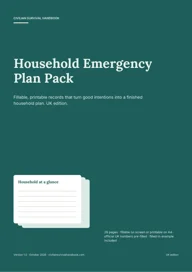 Want this written down for your home? Household Emergency Plan Pack — printable, £6.99.
The Priority Services Register (PSR) is one of the most useful things a household can sign up for, and many people who qualify have never heard of it. It costs nothing, takes a few minutes, and means your energy and water companies know to give you extra help — especially during a power cut or water outage. This guide explains who qualifies, what you get, how to join, and how it works in Northern Ireland.
What is the Priority Services Register?
The PSR is a list kept by each energy supplier and each network operator of customers who need extra support. GOV.UK's Be Ready guidance describes it as a free service for people with additional needs, available in England, Wales and Scotland, with Customer Care Registers being the equivalent in Northern Ireland. Registered customers usually get advance notice of planned power cuts and priority support in an emergency.
There isn't one single national register. As Ofgem explains, your supplier and your network operator each keep their own. Water companies run separate priority services schemes too.
Supplier vs network operator — why it matters
- Your energy supplier (for example British Gas, Octopus Energy or EDF — whoever sends your bill) runs a register for billing, meter and account help.
- Your network operator (the company that runs the cables in your area — National Grid is one example — regardless of who you pay your bills to) runs a register for help during power cuts.
Ofgem says network operators must offer PSR customers extra help for planned and unplanned power cuts, such as battery packs, though the help varies by company (Ofgem). That's why it's worth making sure you're on both.
Who qualifies for the Priority Services Register?
According to Ofgem, you can ask to join if you:
- have reached State Pension age
- are pregnant or have young children
- struggle with speaking or reading English
- have a disability or long-term condition, including:
- mental health conditions
- conditions affecting your sight, hearing or sense of smell
- conditions that mean you use medical equipment that needs a power supply
- have had a recent change in circumstances — for example, you're recovering from an injury or a hospital stay, you've been bereaved, or you've lost your job
Citizens Advice adds examples such as having children under 5, having no sense of smell or struggling to smell gas, finding it hard to answer the door or get help in an emergency, and returning to independent living after residential care.
Needs can be temporary. If you're unsure, ask — the company will tell you whether it can add you.
What do you get on the PSR?
The exact services vary by company. Ofgem and Citizens Advice list help such as:
| Type of help | What it means |
|---|---|
| Priority support in an emergency | You're prioritised if something goes wrong with your supply |
| Advance notice of planned power cuts | Wherever possible, so you can plan around them |
| Extra help during power cuts | Ofgem gives battery packs as an example; Citizens Advice mentions welfare checks or hot meals |
| Password scheme | Callers and visitors from the company use an agreed password or ID so you know they're genuine |
| Nominated contact | A family member or carer can receive bills and communications |
| Accessible bills | Large print or braille |
| Meter help | Regular meter readings, or moving a prepayment meter you can't safely reach |
| Gas reconnection help | Help getting your gas back on if needed |
One thing the PSR does not do: Ofgem is clear that PSR customers don't get extra compensation payments for power cuts. The benefit is help and information, not money. (For compensation rules, see our power cuts guide.)
Is the Priority Services Register free?
Yes. Be Ready describes the PSR as free, and the Met Office also calls it a free service. Water companies' priority services are free too (CCW). No one should ask you to pay to join — if they do, be suspicious.
How to join the Priority Services Register
Step 1: Contact your energy supplier
Ofgem says to contact your supplier directly — online, in writing or by phone — and give as much information as you can about your needs. Contact details are on your supplier's website or your energy bill. Most suppliers, including the large ones, have a PSR or "extra help" form in their online account or app. We haven't listed supplier phone numbers here; use the number on your own bill or account so you know it's genuine.
If you have different suppliers for gas and electricity, contact each one.
Step 2: Contact your electricity network operator
Your network operator runs its own register. If you don't know who it is, the Met Office points to the Energy Networks Association's postcode lookup, and in Great Britain you can call 105. Ofgem says network operators also take requests online, in writing or by phone.
Step 3: Ask about sharing with your water company
Devon County Council's guidance (October 2026) says you can register once through your local electricity network operator and your details can then be shared with participating companies, including your energy supplier, gas network and water company. Arrangements vary, so when you register, ask whether your details will be shared with your water company and other utilities — and if you're unsure, register with your water company directly.
Step 4: Register with your water company
Water companies in England and Wales offer their own free priority services, and CCW (the water consumer body) says anyone can register. Help can include:
- emergency water supplies during an interruption
- password scheme and staff ID checks
- a nominated contact
- help reading the water meter
- large print, braille, audio and other-language documents
- text relay, interpreter and Welsh language services
To join, contact your water company. In Scotland, that's Scottish Water. Our water guide covers what to store at home in case of an outage.
How do I check if I'm on the Priority Services Register?
There's no single online lookup. Citizens Advice suggests asking each of these directly whether you're on their register and what support they can offer:
- your energy supplier (or both, if gas and electricity are separate)
- your electricity network operator
- your gas network operator
- your water company
Citizens Advice says it's worth calling if you don't hear anything within 2 weeks of applying.
Keep it up to date
- If you switch supplier, Ofgem says you'll need to ask your new supplier to add you to its register.
- If your needs change — new medical equipment, a new baby, someone moves in or out — tell each company.
- Some companies check in periodically to confirm your details, so don't ignore a genuine request to update your record. If you're unsure a call is genuine, hang up and ring the number on your bill.
Write down your PSR details, including any password you agree, in your household emergency plan and keep them with your emergency contacts list.
Northern Ireland: Customer Care Registers
Northern Ireland doesn't use the PSR name. Be Ready says the equivalent is Customer Care Registers.
NIE Networks, which runs the electricity network in Northern Ireland, has a Customer Care Register for people who rely on electricity for healthcare needs — for example, medical equipment at home such as specialised mattresses, feeding systems or lifting equipment. NIE Networks says registered customers get:
- priority handling of their call during a power cut
- regular contact with updates during a power cut
- at least three days' notice of a planned interruption, including how long it will last
- the option to nominate a relative, neighbour or friend as an alternative contact
You can sign up online, via WhatsApp or Facebook Live Chat, by calling the NIE Networks helpline on 03457 643 643, or by posting the registration form. NIE Networks says the same form can also register you with the NI Water Customer Care Register. It's also worth asking your electricity supplier what extra support it offers.
Who should you sign up?
It's worth thinking beyond yourself. Do you have a parent over State Pension age, a relative who uses powered medical equipment, or a neighbour who'd struggle in a power cut? You can help them contact their supplier and network operator — with their agreement — and make sure the right people are named as contacts.
Limitations
This page is general information based on guidance from Ofgem, GOV.UK, Citizens Advice, CCW and network operators. It isn't professional advice, and each company's services differ — always check with your own supplier, network operator and water company. Arrangements vary between England, Scotland, Wales and Northern Ireland. In an emergency where life is at risk, call 999.
Turn this guide into a written plan
Reading helps. Writing it down is what makes it work when the phones are flat. Start with the free plan builder, or get the full printable version:
Your whole household planHousehold Emergency Plan Pack£6.99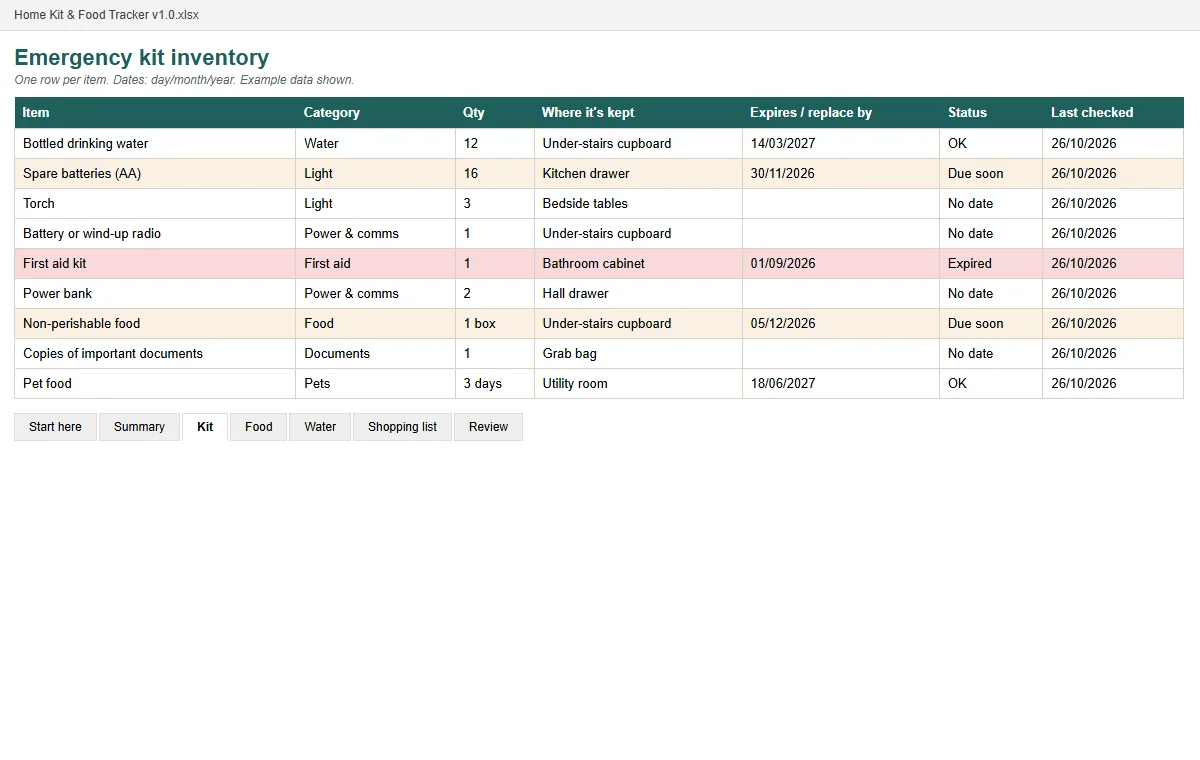 Bundle · £15.97 separatelyPrepared, Not Panicked bundle£9.99
Real pages shown before you buy · instant PDF · one-off price · 30-day refund.
Get the free 72-hour UK household checklist
Tick-box lists for each part of a UK home emergency kit, plus the key numbers on one page. Enter your email and we'll take you straight to the download.
That email address doesn't look right — please check it and try again.
We'll also email you when we publish new guides — occasional, never daily. Unsubscribe any time. See our privacy notice.
Frequently asked questions
Is the Priority Services Register free?
Yes. GOV.UK's Be Ready guidance describes the PSR as free, and water companies' priority services are free too.
Who qualifies for the Priority Services Register?
Ofgem lists people who have reached State Pension age, are pregnant or have young children, struggle with speaking or reading English, have a disability or long-term condition (including mental health conditions and reliance on powered medical equipment), or have had a recent change such as a hospital stay, bereavement or job loss.
Do I need to join with my supplier and network operator separately?
Ofgem says each keeps its own register, so ask both. Some councils' guidance says your details can be shared between participating energy and water companies, but confirm this when you register.
How do I check if I'm on the Priority Services Register?
Ask your energy supplier, electricity network operator and gas network operator directly. Citizens Advice suggests chasing if you don't hear back within 2 weeks.
What happens to my PSR registration if I switch energy supplier?
Ofgem says you'll need to ask your new supplier to add you to its Priority Services Register.
Is there a Priority Services Register in Northern Ireland?
Northern Ireland has Customer Care Registers instead. NIE Networks runs one for people who rely on electricity for healthcare needs, and its form can also register you with NI Water.
Sources
- Ofgem — Join your supplier's Priority Services Register
- Ofgem — Check if you can get a payment for a power cut
- Be Ready (GOV.UK) — Power cuts
- Citizens Advice — Tell your supplier if you need extra support
- CCW — Extra free help: priority services
- Devon County Council — Are you eligible to join the Priority Services Register?
- NIE Networks — Customer Care Register
- Met Office — What to do in a power cut