In short: A family emergency plan records how your household will get alerts, where you'll shelter, how you'd evacuate, and how you'll reach each other if separated. Ready.gov's free fillable Make a Family Emergency Plan form covers family contacts, school and work plans, emergency contacts, meeting places and medical information. Choose an out-of-town contact, agree meeting places near and away from home, and practice at least once a year.
Key facts
- Ready.gov suggests discussing five questions: how you'll receive alerts, your shelter plan, your evacuation route, your household communication plan, and whether your kit needs updating. Source
- Ready.gov's Make a Plan Form creates a Family Emergency Communication Plan you can email as a PDF; Ready.gov says the information is not saved, stored or shared by any government agency. Source
- Ready.gov advises picking someone out of town as a contact, because they may be easier to reach in a disaster. Source
- Ready.gov's communication plan guide says a text message may get through when a phone call will not, because it needs far less bandwidth. Source
- Ready.gov recommends reviewing, updating and practicing your Family Emergency Communication Plan at least once a year, or whenever information changes. Source
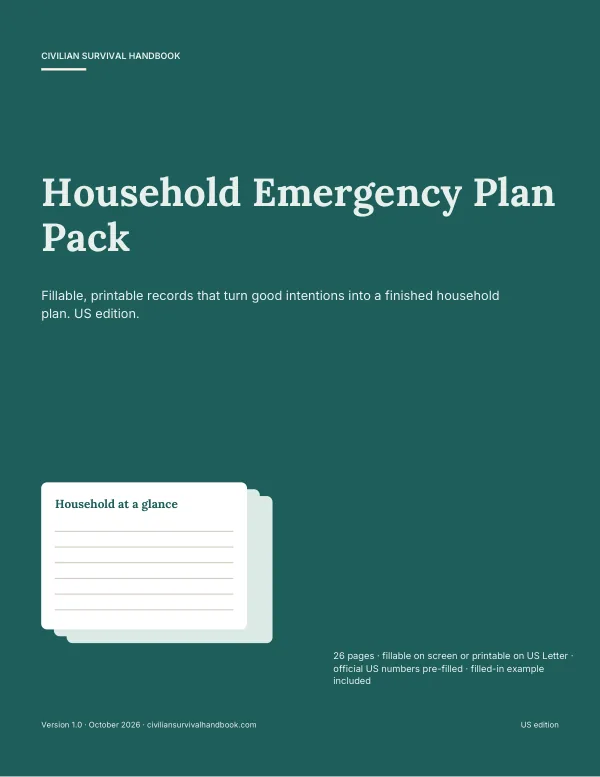 Want this written down for your home? Household Emergency Plan — US edition — printable, $7.99.
If the news has you thinking "what would we actually do?", a family emergency plan is the most useful answer — and it costs nothing. Ready.gov's planning guide starts with one question: what if something happens and you're not together? A plan means everyone knows how to get alerts, where to go, and how to reach each other. This guide follows Ready.gov's Make a Plan advice and its free fillable form, with a filled-in example at the end.
What is a family emergency plan?
It's a short written record of how your household will handle an emergency. Ready.gov suggests you meet with your household and talk through five questions:
- How will we receive emergency alerts and warnings?
- What is our shelter plan?
- What is our evacuation route?
- What is our family or household communication plan?
- Do we need to update our emergency preparedness kit?
Then you tailor it to your household — ages, dietary and medical needs, disabilities or access and functional needs, languages, cultural and religious considerations, pets or service animals, and school-aged children — write it down, and practice it.
Where can I get a free family emergency plan template?
The free official option is Ready.gov's fillable Make a Family Emergency Plan form. You fill it in online and can email it to yourself as a PDF. Ready.gov says the information you provide is not saved, stored or shared by any government agency.
The form has these sections:
| Section | What you record |
|---|---|
| Household Information | Home phone and address |
| Family Members | Name, cell phone, other phone or social media, email, important medical or other information |
| Emergency Plans | Schools, childcare, caregivers and workplaces: address, emergency or hotline number, website, pick-up plan |
| Emergency Contacts | Name, cell, home phone, email, address |
| Emergency Meeting Places | Location and instructions |
| Medical Information | Poison control, doctor, pediatrician, allergies and prescriptions, insurance and policy number, assistive devices, veterinarian |
Ready.gov also offers a Family Communication Plan fillable card — a wallet-sized version.
How do we choose an out-of-town contact?
Ready.gov's advice is to pick the same person for each family member to contact, and to pick someone out of town because they may be easier to reach in a disaster. Its communication planning guide explains that local phone lines can be jammed, so a long-distance call may be easier than calling across town.
Good practice from the same guide:
- Text first. A text message may get through when a call won't, because it needs far less bandwidth. Texts may also send automatically once capacity is available.
- Keep messages short. Ready.gov's example is "I'm OK. At library."
- Set up an "ICE" contact. Store at least one emergency contact under "In Case of Emergency" or "ICE" in every phone.
- Make a group list in everyone's phone of the people you'd need to reach.
- Write numbers down. Paper copies help if a phone is lost or the battery dies.
Ready.gov's Get Tech Ready page adds: have an emergency charging option for phones, and keep contacts updated and synced across your devices.
Where should our meeting places be?
Ready.gov's planning guide suggests four types of meeting place. Make sure they're accessible for everyone in the household, and think about animal-friendly locations if you have pets or service animals.
- Indoor: where to go for protection in a tornado, hurricane or other high-wind storm — a small, interior, windowless room such as a closet or bathroom on the lowest level of a sturdy building, or a safe room or storm shelter.
- In your neighborhood: where to meet if you have to leave home because of a fire or other emergency — a big tree, the mailbox at the end of the driveway, a neighbor's house.
- Outside your neighborhood: where to meet if you can't get home — a library, community center, house of worship or family friend's home.
- Outside your town or city: where to reunite if you can't get home or your community is told to evacuate — often a relative's or friend's home. Make sure everyone knows the address and how they'd get there.
Ready.gov's evacuation page also suggests choosing destinations in different directions, so you have options.
What about kids and schools?
A disaster can happen during school or work hours, so Ready.gov's guide says you need to know your school's and workplace's emergency plans and how to stay informed. It suggests you:
- Discuss the school's plan with your children and tell them who could pick them up
- Sign household members with phones up for alerts from their school, workplace or local government
- Tell children without phones to follow instructions from a responsible adult, such as a teacher or principal
- Make sure everyone, including children, knows how and when to call 911 — only for a life-threatening emergency
- Give each child a paper copy of the plan for their backpack
How do we include pets?
Ready.gov says that if local officials ask you to evacuate, your pet should evacuate too. It notes many public shelters and hotels don't allow pets inside, so identify a safe place you could take them ahead of time. Also:
- Have your pet microchipped and keep contact details current
- Keep copies of registration and key records in a waterproof container and electronically
- Keep a recent photo of you with your pet to help prove ownership
- Add your vet to the Medical Information section of your plan
How do we plan for family members with disabilities?
Ready.gov's disability guidance suggests:
- Create a support network of people who can help you in a disaster
- Keep a current list of prescriptions, including dosages and allergies
- Plan how you'll communicate if your equipment isn't working
- Ask your power provider about being on a list for priority power restoration
- Ask your city or county emergency management agency whether it keeps a voluntary registry
Ready.gov's planning guide also suggests including relay service details for household members who are Deaf, hard of hearing or have a speech disability.
Example: a filled-in family emergency plan
The Rivera family below is fictional, an example of how a completed plan might look.
Household: Maria and Dan Rivera, Sofia (9), Leo (4), and Pepper the dog.
| Plan item | Example entry |
|---|---|
| Alerts | WEAs enabled on both parents' phones; weather radio in the kitchen; county text alerts set up |
| Shelter (high winds) | Downstairs hall closet |
| Neighborhood meeting place | The mailbox at the end of the Kims' driveway, two doors down |
| Out-of-neighborhood meeting place | Lincoln Branch Library, front entrance |
| Out-of-town meeting place | Aunt Rosa's house, 90 miles north (address written on each card) |
| Out-of-town contact | Aunt Rosa — everyone texts her first: "I'm OK. At [place]" |
| School | Sofia's elementary school — parents read the school's pick-up plan; neighbor Mrs. Kim is authorized to collect |
| Childcare | Leo's preschool — same pick-up list as school |
| Medical | Dan: daily inhaler, penicillin allergy; doctor and pharmacy numbers written in |
| Pet | Pepper: microchipped; vet number in plan; pet-friendly motel 40 miles east noted |
| Evacuation routes | Route A north to Aunt Rosa's; Route B east to the motel |
| Practice | Every spring, plus whenever numbers change |
How often should we update the plan?
Ready.gov recommends reviewing, updating and practicing your plan at least once a year, or whenever information changes. Practice ideas from the guide:
- Everyone texts the out-of-town contact and sends a group text
- Gather at your indoor and neighborhood meeting places
- Talk through how each person would reach the farther meeting places, including by public transportation
- Ask everyone to recite key numbers from memory — then see why paper copies matter
- Afterward, talk about what worked and print fresh copies if anything changed
Once your plan is done, build the supplies to go with it: see our 72-hour kit checklist and go bag checklist, and keep copies of key papers in an emergency binder. Our US preparedness hub has the full set.
Limitations
This is general information based on Ready.gov and FEMA guidance, not professional advice. In an emergency, follow instructions from local officials and call 911 if life is at risk. Evacuation zones, school procedures and local alert systems differ by state, county and district, so check with your school and your local emergency management agency.
Turn this guide into a written plan
Instant PDF · fill in on screen or print · 30-day refund.
Frequently asked questions
What should a family emergency plan include?
Ready.gov's form covers household information, each family member's contacts and medical notes, emergency plans for schools, childcare and workplaces, emergency contacts, meeting places, and medical information such as doctors, allergies, prescriptions, insurance and the vet.
Is there a free official family emergency plan template?
Yes. Ready.gov's fillable Make a Family Emergency Plan form at ready.gov/plan-form is free to use and lets you email the finished plan as a PDF.
Why have an out-of-town contact?
Ready.gov says someone out of town may be easier to reach in a disaster. Its planning guide explains that a long-distance call can be easier than calling across town when local lines are jammed.
How many meeting places do we need?
Ready.gov's planning guide suggests an indoor safe spot for high-wind storms, a place in your neighborhood, a place outside your neighborhood, and a place outside your town or city.
How often should we practice the plan?
Ready.gov recommends reviewing, updating and practicing the plan at least once a year, or whenever your information changes.
What if a family member has a disability?
Ready.gov suggests creating a support network of people who can help, keeping a current medication list, planning how to communicate if equipment stops working, and asking your power provider about priority restoration for power-dependent equipment.
Sources
- Ready.gov — Make a Plan
- Ready.gov — Make a Plan Form
- Ready.gov — Create Your Family Emergency Communication Plan (America's PrepareAthon!, July 2015, PDF)
- Ready.gov — Ready Kids: Make a Plan
- Ready.gov — Get Tech Ready
- Ready.gov — Evacuation
- Ready.gov — Pets and Animals
- Ready.gov — People with Disabilities