In short: A good wind-up radio for a UK home should receive FM (and ideally DAB+), have more than one way to power it — hand crank plus USB or batteries — and a built-in torch. Treat any phone-charging feature as an emergency top-up, not a full charge, and don't buy one for long wave Radio 4, which closed in June 2026.
Key facts
- The government's Be Ready checklist includes an FM radio (battery or wind-up) and suggests writing down the frequencies of stations you use for news. Source
- BBC Radio 4's long wave service on 198 kHz closed on 27 June 2026. Source
- To receive DAB+ stations you need a DAB+ enabled radio; many older DAB radios only receive DAB. Source
- In an IP rating, the first numeral (0–6) rates protection against solids and dust; the second (0–9) rates protection against liquids. Source
- Trevor Baylis came up with the idea for the wind-up radio in 1991. Source
 Want this written down for your home? Household Emergency Plan Pack — printable, £6.99.
A wind-up radio is one of the simplest things you can add to a household emergency kit. It doesn't need the mains, broadband or a phone signal, and it keeps you hearing local news and official advice during a power cut, storm or flood. This is a buyer's guide, not a product review: we have not tested any radios, so instead of recommending brands we explain which features matter, what the marketing terms mean and what to be wary of.
Why have a wind-up radio at all?
Official UK preparedness guidance consistently includes one. The government's Be Ready checklist lists an FM radio (battery or wind-up) and suggests writing down the frequencies of national or local stations you use for news. Ready Scotland suggests a battery-operated radio with spare batteries or a wind-up radio, and nidirect includes a battery-powered or wind-up radio in its emergency flood kit.
Radio matters because broadcasters play a big part in emergencies. The BBC says its nations and local radio network has resilience planning so it can stay on air during a crisis. For more on keeping in touch, see our communication guide.
A small piece of history: the wind-up radio is credited to British inventor Trevor Baylis. The Open University notes he had the idea in 1991 after watching a TV programme about AIDS in Africa, where many people had no electricity or affordable batteries to hear health information.
Which bands should a wind-up radio have?
FM — essential
FM is the band to prioritise. It is simple to tune, widely broadcast and carries BBC local radio, national BBC stations and commercial stations. Be Ready specifically names an FM radio.
DAB and DAB+ — useful, but check the label
A wind up DAB radio gives you more stations and clear sound where coverage is good. The catch is the format. Digital Radio UK explains that DAB+ is an upgraded version of DAB, and that to receive DAB+ stations you must have a DAB+ enabled radio — many older DAB sets only receive DAB. When buying, look for:
- "DAB+" stated clearly in the specification, or
- the Digital Radio Tick Mark, which shows the radio receives DAB, DAB+ and FM.
A DAB+ set that also has FM gives you a simple fallback if digital reception is weak where you are.
Long wave — don't buy for Radio 4
Many people remember Radio 4 on long wave as the emergency station. That service has gone: BBC Radio 4's long wave service on 198 kHz closed on 27 June 2026, with the Droitwich, Westerglen and Burghead transmitters closing that day. Radio 4 is still available on FM and DAB. A radio with LW or MW isn't a problem, but don't pay extra for long wave or choose it over good FM reception.
How should it be powered?
The best emergency radios have more than one power source, so you're never relying on just one.
| Power option | Good for | Watch out for |
|---|---|---|
| Hand crank (wind-up) | Works with no batteries or sun | Tiring for long listening; gives short bursts of playback |
| Solar panel | Slow top-up on a windowsill | Small panels charge slowly, especially in UK winter |
| USB charging | Keeping the internal battery full day to day | Needs mains or a power bank to charge |
| Standard AA/AAA batteries | Long, reliable listening; easy to stock | Check it accepts ordinary batteries, not only a sealed pack |
Look for a radio that takes standard batteries as well as cranking, so you can listen for hours on batteries and keep the crank in reserve. Whatever you choose, fully charge it when you buy it and check it every few months.
Can a wind-up radio charge my phone?
Many radios are sold as a wind up radio with phone charger, with a USB socket on the side. That feature can be genuinely useful, but be realistic:
- Cranking produces only a small amount of power. A few minutes of winding typically gives a phone a small top-up — enough, perhaps, to send a message or make a short call — not a full charge.
- The radio's internal battery is usually small compared with a phone battery, so even a fully charged radio won't refill your phone.
- A charged power bank is far better for phones. Be Ready lists a charged power bank alongside the radio for exactly this reason.
So treat phone charging as a last-resort extra, not the main reason to choose a model. Manufacturers should state their battery capacity and charging output; if a listing makes big claims without figures, be cautious.
Other features worth having
- Built-in torch: a bright LED torch is very handy in a power cut. Be Ready notes torches are safer than candles. A radio torch is a bonus, not a replacement for a separate torch.
- Simple controls: large buttons and a clear dial help in the dark and for older users. Preset buttons let you save your local BBC station.
- Headphone socket: saves battery and lets you listen without waking others.
- Size and weight: a compact radio fits in a grab bag; a larger one may have a better speaker.
- Battery indicator: shows how much charge is left.
- Carry handle or strap: useful if you need to leave home quickly.
What do IP ratings mean?
Some radios carry an IP (Ingress Protection) rating such as IPX4 or IP65. The IEC, which created the system, explains that the code has two numerals:
- First numeral — solids and dust: a scale from 0 (no protection) to 6 (no ingress of dust).
- Second numeral — liquids: a scale from 0 (no protection) to 9 (high-pressure hot water from different angles).
Higher numbers mean more protection. If you might use the radio outdoors or near floodwater, a water rating is useful — but "water-resistant" without a rating tells you very little. The full test conditions are set out in the standard IEC 60529.
Comparison: features by use case
| Your situation | Must-have features | Nice to have |
|---|---|---|
| Basic home kit (most households) | FM, crank + AA batteries, torch | DAB+, USB charging |
| Flat or city home with good DAB | FM + DAB+ (Tick Mark), USB and batteries | Presets, headphone socket |
| Rural or patchy reception | Strong FM reception, telescopic aerial, batteries | Solar panel |
| Older or less mobile user | Large buttons, clear display, AA batteries, loud speaker | Simple crank, carry handle |
| Grab bag / leaving home | Compact, light, crank, torch | IP water rating, strap |
| Flood-risk home | IP water rating, crank + batteries, torch | Solar panel |
What to avoid
- No FM band: don't rely on a radio that is DAB-only or internet-only.
- DAB without the "+": older DAB-only sets won't receive DAB+ stations.
- Sealed batteries only: if the internal battery fails or runs flat, you're down to cranking.
- Exaggerated charging claims: be wary of listings promising to fully charge a phone from cranking.
- Paying for long wave: Radio 4 is no longer on LW.
- Vague "waterproof" claims: look for a proper IP rating instead.
- Leaving it in the box: charge it, tune your local stations and test it every few months.
Quick set-up checklist
| Task | Done? |
|---|---|
| Charge the internal battery fully | ☐ |
| Fit fresh batteries (and store spares) | ☐ |
| Find and save your local BBC and commercial FM stations | ☐ |
| Write the frequencies on your kit checklist | ☐ |
| Try the crank and torch | ☐ |
| Store it with your 72-hour kit | ☐ |
| Add a reminder to test it every few months | ☐ |
Limitations
This guide is general information, not professional advice, and it is not a product test — check each manufacturer's specification before buying. Broadcast services and frequencies vary by area and can change. In an emergency, follow official instructions from the emergency services and your local council, and call 999 if life is at risk. Preparedness advice is published separately for England, Wales, Scotland (Ready Scotland) and Northern Ireland (nidirect).
Turn this guide into a written plan
Reading helps. Writing it down is what makes it work when the phones are flat. Start with the free plan builder, or get the full printable version:
Your whole household planHousehold Emergency Plan Pack£6.99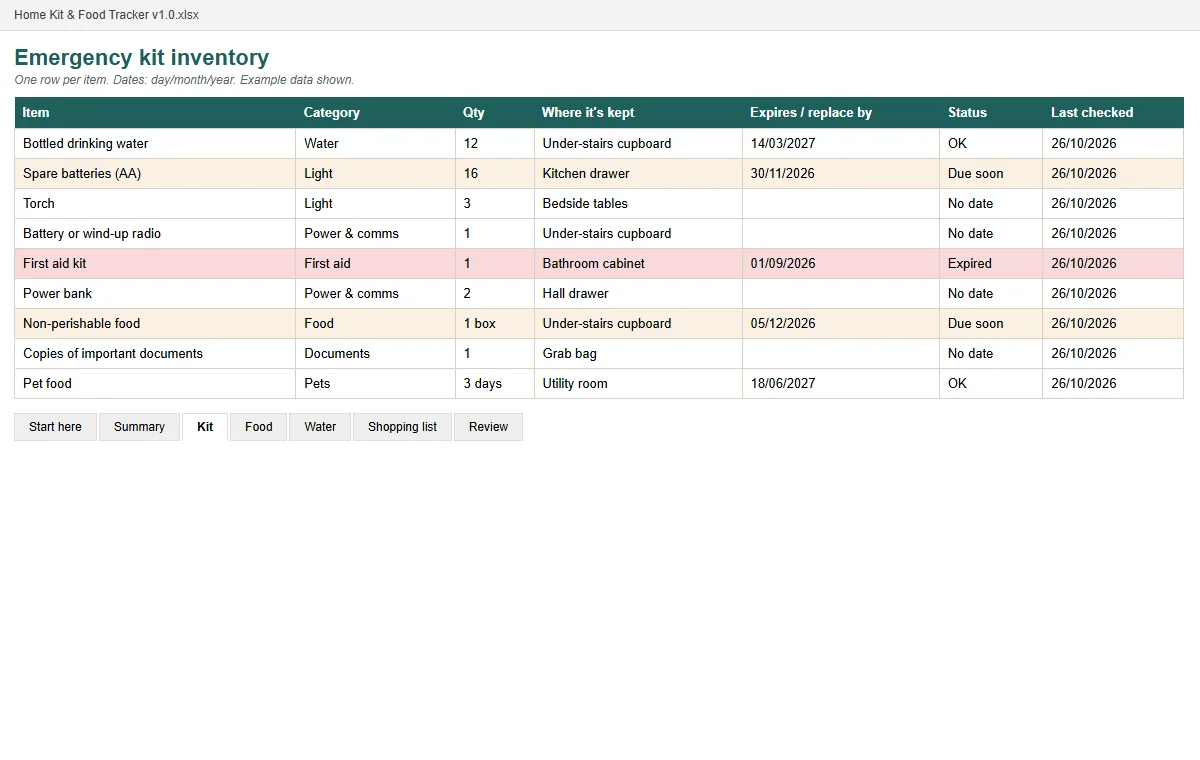 Bundle · £15.97 separatelyPrepared, Not Panicked bundle£9.99
Real pages shown before you buy · instant PDF · one-off price · 30-day refund.
Get the free 72-hour UK household checklist
Tick-box lists for each part of a UK home emergency kit, plus the key numbers on one page. Enter your email and we'll take you straight to the download.
That email address doesn't look right — please check it and try again.
We'll also email you when we publish new guides — occasional, never daily. Unsubscribe any time. See our privacy notice.
Frequently asked questions
Is a wind-up radio worth having in the UK?
Yes, as a back-up. Official UK preparedness guidance from Be Ready, Ready Scotland and nidirect all list a battery-powered or wind-up radio as an emergency kit item, because it keeps you informed when the power or phone networks are down.
Can a wind-up radio charge my phone?
Many can, but hand-cranking produces only a small amount of power, so expect a short top-up for an urgent call or message rather than a full charge. A charged power bank is a far better way to charge a phone.
Should I get a wind-up DAB radio or FM only?
FM is essential because it is simple and widely broadcast. DAB adds more stations; if you choose a digital set, make sure it says DAB+ or carries the Digital Radio Tick Mark, as older DAB-only sets can't receive DAB+ stations.
Do I need long wave on an emergency radio?
Not for BBC Radio 4 — its long wave service closed on 27 June 2026. Radio 4 is still on FM and DAB, so FM coverage matters far more.
What does IPX4 or IP65 mean on a radio?
It is an Ingress Protection rating. The first number rates protection against dust and solids (0–6) and the second against water (0–9); higher means more protection. Check the exact level against what you need.
Sources
- Be Ready (GOV.UK) — Be ready for emergencies
- Ready Scotland — Make an emergency kit
- nidirect — Preparing for a flood
- RadioToday — BBC sets June date for Radio 4 long wave closedown
- RSGB — The closure of BBC Long Wave
- Digital Radio UK — What is DAB+?
- IEC — Ingress Protection (IP) ratings
- BBC — Connecting in a crisis
- The Open University — Farewell to Trevor Baylis