What should be in a UK emergency kit?
3 days of bottled water and non-perishable food
GOV.UK's Be Ready checklist: bottled water for 3 days (3 litres per person per day for drinking), non-perishable food for 3 days, a torch and spare batteries, a battery or wind-up FM radio, a charged power bank, cash, copies of documents, first aid items and essential medication. Set a reminder every six months to check expiry dates.
Source: GOV.UK Be Ready: Emergency kit checklist (PDF) (checked 9 November 2026)
In short: A UK household emergency kit should help you manage at home for 3 days. The government's Be Ready checklist lists bottled water (3 litres per person per day for drinking), non-perishable food, a torch with spare batteries, a battery or wind-up FM radio, a charged power bank, cash, copies of documents, first aid items and essential medicines.
Free tool: make your household emergency plan in about 10 minutes — your power network from your postcode, contacts, meeting points and a kit list, printed on one page. Works offline.
Key facts
- GOV.UK's Be Ready checklist asks for bottled water for 3 days, with 3 litres per person per day for drinking. Source
- The NHS says formula comes as a powder you make up with freshly boiled water, or as ready-to-feed liquid, which costs more and must be used more quickly once opened. Source
- GOV.UK advises requesting prescriptions up to 5 working days before you need your medicine. Source
- GOV.UK suggests checking your kit every six months for expiry dates and items that need replacing. Source
- UK clocks go forward on the last Sunday in March and back on the last Sunday in October. Source
This is a tick-box version of our 72-hour emergency kit guide. It follows the nine sections of that guide and is based on the UK government's Be Ready checklist, with a few extras from Ready Scotland and the British Red Cross. The whole list is below, so you can use it straight from this page. If you'd rather have it on paper, get the printable PDF and stick it inside a cupboard door.
New to the government's Be Ready campaign? Our Be Ready checklist, explained goes through the official 3-day list item by item.
Start with the free Be Ready plan; here is what it leaves out.
The government's Be Ready household plan and kit checklist are free and good: read them first. They leave little room for medicines, pets, children, where your documents are, use-by dates on your kit and a review date. That is what our printable plans add. Or print our free one-page 3-day checklist (no sign-up).
Get the printable PDF version
Tick-box lists for each part of a UK home emergency kit, plus the key numbers on one page. Enter your email and we'll take you straight to the download.
That email address doesn't look right — please check it and try again.
We'll also email you when we publish new guides — occasional, never daily. Unsubscribe any time. See our privacy notice.
How to use this checklist
GOV.UK's advice is to take it step by step:
- See what you already have. Check your cupboards first.
- Plan for your household. Note what you still need, including things your family relies on — medication, baby formula, pet food.
- Build it gradually. Pick up missing items during your regular shopping to spread the cost.
- Check it regularly. Set a reminder every six months.
Items marked (extra) aren't on the GOV.UK checklist but appear on Ready Scotland or British Red Cross lists. Add them if they fit your household.
The 72-hour emergency kit list
1. Water
GOV.UK suggests 3 litres per person per day for drinking, for 3 days. More is needed for cooking and washing.
| People in household | Drinking water for 3 days |
|---|---|
| 1 | 9 litres |
| 2 | 18 litres |
| 3 | 27 litres |
| 4 | 36 litres |
| 5 | 45 litres |
- Bottled water for 3 days (see table)
- Extra water for cooking and washing
- Extra water for pets, baby formula or medical devices
- Use-by dates written on a note inside the kit
Don't count your loft tank or hot-water cylinder as drinking water, and GOV.UK says not to drink water from a water butt. See our water pillar.
2. Food
- Non-perishable food for 3 days that needs no fridge or cooking (for example tinned meat, fish or vegetables, dried fruit, nuts)
- Food your household usually eats
- Foods for special diets or allergies
- Manual tin opener (extra)
3. Light
- Torch
- Spare batteries
- Head torch or battery lantern (optional)
GOV.UK notes that torches are safer than candles.
4. Power and communications
- FM radio (battery or wind-up)
- Radio frequencies for your local and national news stations, written down
- Charged power bank
- Phone charger (extra)
- Spare chargers or batteries for any equipment you rely on (extra)
- Power cut number written down: 105 (England, Scotland, Wales) or 03457 643643 (Northern Ireland)
5. First aid and health
- First aid kit or first aid items
- Essential medication and medical supplies
- List of regular medications and doses
- Copies of prescriptions (extra)
- Spare glasses or contact lenses (extra)
- Spare hearing aid batteries (extra)
- Mobility aids you rely on (extra)
- Instructions for any medical equipment you use
GOV.UK says to request prescriptions up to 5 working days before you need your medicine.
6. Documents and information
- Copies of ID (for example passports, birth certificates)
- Insurance details
- Important phone numbers on paper — family, GP, utilities, insurer
- Copy of your household emergency plan (extra)
- Waterproof bag for documents (extra)
- Pen and paper (extra)
Our important documents checklist and emergency contacts list template help with this section.
7. Cash
- Cash — a mix of coins and notes
- Cards
GOV.UK doesn't set an amount; it says the cash you keep depends on your family's needs for essentials.
8. Warmth and hygiene
- Blankets or sleeping bags
- Warm clothing
- Hand sanitiser
- Wet wipes
- Hygiene and bathroom products
- Whistle (extra)
- Spare house and car keys (extra)
Babies
- Baby formula, if your baby has it: 3 days of the formula they already use (follow the NHS on making up feeds)
- Nappies and wipes
- Bottles and feeding equipment (extra)
- Comfort items and activities for children (extra)
Pets
- Pet food
- Bottled water for pets
- Lead, harness or carrier (extra)
- Pet medication (extra)
Never use a barbecue or camping stove indoors: the NHS lists this as a cause of carbon monoxide build-up.
9. Family plan
- Household emergency plan written down
- Meeting point agreed
- Back-up support arranged for anyone who needs extra help
- Everyone knows where the kit is
- Everyone knows how to turn off gas, electricity and water
- Plan to check in on neighbours, with contact details swapped
- School has your correct contact numbers
- Checked whether you're eligible for the Priority Services Register
Work out your own numbers with our free emergency supplies calculator, or tick off each item on the Be Ready kit list.
Grab bag: if you need to leave quickly
GOV.UK suggests a spare bag of essentials in case you have to leave home quickly. Ready Scotland suggests keeping some of your kit in a waterproof bag, for example if flooding is a risk. A sensible grab bag:
- Medication and medication list
- Document copies in a waterproof bag
- Phone, charger and power bank
- Torch
- Cash
- Water and a few snacks
- Warm layer
- Spare keys
Where should the kit live?
One place, known to everyone in the house, that you can reach in the dark — a hallway cupboard, under the stairs or the bottom of a wardrobe. Avoid the loft, the shed and the car boot. Keep everyday medication somewhere easy to reach rather than sealed away.
When should you check it?
GOV.UK suggests every six months. An easy reminder is the clocks-change weekends — the last Sunday in March and the last Sunday in October. The next one is 28 March 2027.
Six-monthly check
- Water and food use-by dates checked; old stock eaten and replaced
- Torch and radio tested; batteries replaced
- Power bank recharged
- Medication and medication list up to date
- Phone numbers and documents updated
- Plan reviewed with everyone at home
Notes for Scotland, Wales and Northern Ireland
- Scotland: Ready Scotland has its own list. It also suggests face masks, pre-printed cards or large-print information you need, and a car kit for winter.
- Northern Ireland: see NI Direct's Be Ready pages, including its Household Emergency Life-saving Plan (HELP). The power cut number is 03457 643643.
- Wales: the GOV.UK Be Ready site has a Welsh-language version.
Limitations
This checklist is general information based on GOV.UK, Ready Scotland, NI Direct, NHS and British Red Cross guidance. It is not professional, medical or safety advice, and it can't cover every household's needs. In an emergency, call 999 and follow instructions from the emergency services and official sources. Advice, numbers and services differ between England, Scotland, Wales and Northern Ireland.
Turn this guide into a written plan
Reading helps. Writing it down is what makes it work when the phones are flat. Start with the free plan builder, or get the full printable version:
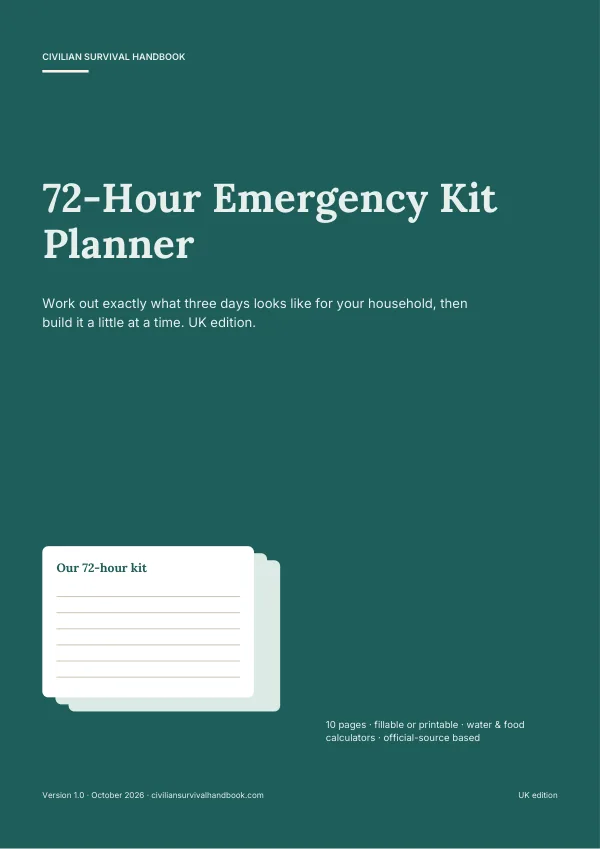 For this topic72-Hour Emergency Kit Planner£3.99
 Your whole household planHousehold Emergency Plan Pack£6.99
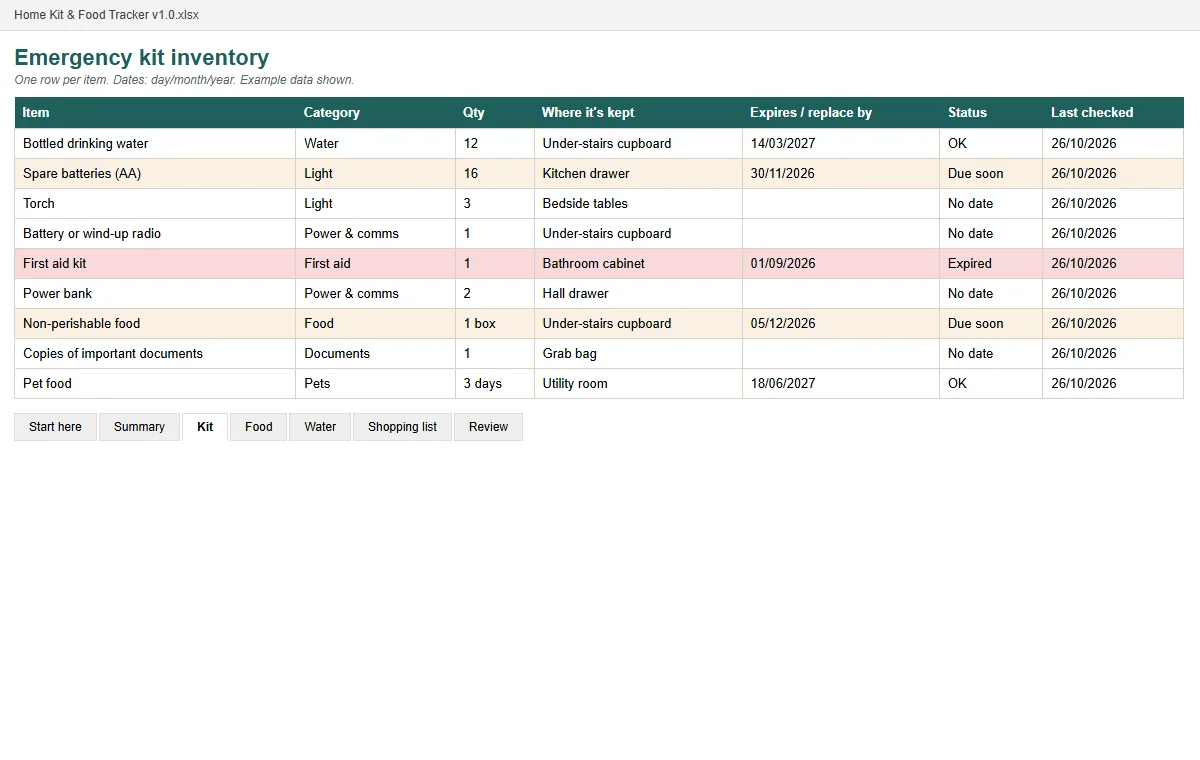 Bundle · £15.97 separatelyPrepared, Not Panicked bundle£9.99
Real pages shown before you buy · instant PDF · one-off price · 30-day refund.
Frequently asked questions
What is on a 72-hour emergency kit list?
Based on GOV.UK: bottled water and non-perishable food for 3 days, a torch and batteries, an FM radio, a charged power bank, cash and cards, copies of documents and key phone numbers, a first aid kit and essential medication, hygiene products, and blankets and warm clothing — plus baby and pet supplies if needed.
Is the printable checklist free?
Yes. Enter your email on this page and we'll send the PDF. Everything on the PDF is also listed on this page, so you can use it without signing up.
Do I need to buy everything at once?
No. GOV.UK says you don't need to do it all at once: check what you already have, then pick up an extra item or two during regular shopping to spread the cost.
What about pets?
GOV.UK lists pet food and bottled water. The British Red Cross also suggests leads, harnesses or carriers, medication, bedding and waste bags.
Do I need a kit if I live in a city?
Yes — disruption isn't only rural. For example, a fire at a high-voltage substation in Hayes, near Heathrow, on 20 March 2025 led to around 150 people being evacuated, according to London Fire Brigade.
Sources
- GOV.UK Be Ready — Checklist (PDF, October 2026) (checked 26 October 2026)
- GOV.UK Be Ready — Be ready for emergencies (checked 26 October 2026)
- GOV.UK Be Ready — Water supply interruptions or outages (checked 26 October 2026)
- Ready Scotland — Make an emergency kit (checked 26 October 2026)
- NI Direct — Be ready for emergencies (checked 26 October 2026)
- British Red Cross — Prepare an emergency kit (checked 26 October 2026)
- NHS — Carbon monoxide poisoning (checked 26 October 2026)
- GOV.UK — When do the clocks change? (checked 26 October 2026)
- London Fire Brigade — Fire at electrical substation, Hayes (March 2025) (checked 26 October 2026)
From the blog
Prepping on £5 a week: a 12-week plan to reach the Be Ready 3-day kit
A week-by-week plan to build the GOV.UK Be Ready 3-day emergency kit for about £5 a week: free steps first, then food at ONS…
Getting startedThe Be Ready 72-hour list, costed for one person and ready to print
Every item on the GOV.UK Be Ready checklist for one person for 3 days, with prices we actually saw at Aldi on 3 November 2026 and…
FoodHow to open a tin without a tin opener
Three ways to open a tin with no tin opener: a metal spoon, a sturdy kitchen knife, or a rough stone or concrete step. Step by…
FoodWhat to stock up on for winter: a calm UK list
What to keep at home this winter for snow, storms and power cuts: the GOV.UK Be Ready 3-day basics, a short winter add-on, how to…
Getting startedEmergency kit or first aid kit? What each one is for
A household emergency kit keeps you going for 3 days without power, water or shops. A first aid kit treats injuries. What goes in…
Go bagsGo bag, bug out bag or 72-hour kit: which one you need, and in what order
There are really two kits: one that keeps you going at home for 3 days and one you carry if you're told to leave. What Be Ready,…
Buying guidesWhere to buy a ready-made grab bag in the UK, and when to build your own
Ready-made grab bags and survival kits sold in the UK, with prices we saw on 2 November 2026, compared against the GOV.UK Be…
Getting startedThe 3-day government kit: what Be Ready actually asks for, and what it misses
What the UK's Be Ready advice asks you to keep at home for 3 days, item by item, and the gaps: heat, toilets, cooking and a…
Getting startedPrepping in a small flat on a small budget
Start prepping in a small UK flat without spending much: the free steps from GOV.UK Be Ready, the Priority Services Register,…
Getting startedPrepping essentials: a 25-item UK starter list, by budget
What to buy first, in order, for about £25, £75 and £150, with real UK prices checked on 1 November 2026. Starts with free steps…
Getting startedDoes the UK government give out free emergency kits?
No kits are being posted to homes. What the GOV.UK Be Ready campaign (launched 22 October 2026) actually asks for, what the list…