In short: Planning for an emergency in a flat starts with knowing your building's fire strategy. London Fire Brigade says your building's plan may be to stay put or to leave, and that your landlord, housing provider or managing agent needs to tell you the fire safety arrangements, including the evacuation plan. In England, the Fire Safety (England) Regulations 2022 require the responsible person in buildings with two or more homes and common parts to give residents fire safety instructions, including when they move in and at least once a year. Never use the lift in a fire. Keep a compact kit, store bottled water (Be Ready suggests 3 litres per person per day for drinking, for 3 days) and swap contact details with neighbours.
Key facts
- London Fire Brigade says your landlord, housing provider or managing agent needs to tell you about the fire safety arrangements for your building, including the evacuation plan. Source
- Under a stay put policy, London Fire Brigade says walls, floors and doors will hold back flames and smoke for a minimum of 30 to 60 minutes; if you're directly affected by fire, smoke or heat, alert everyone and leave. Source
- In England, responsible persons in multi-occupied residential buildings with two or more sets of domestic premises must give residents fire safety instructions when they move in and on an annual basis. Source
- GOV.UK's Fire Kills campaign says never use lifts in a fire and always use the stairs. Source
- Be Ready recommends 3 litres of drinking water per person per day for 3 days, with extra for baby formula, medical devices and pets. Source
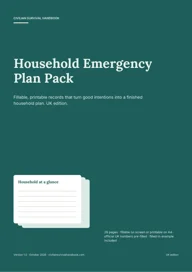 Want this written down for your home? Household Emergency Plan Pack — printable, £6.99.
Most household emergency advice assumes a house with a front door, a garden and a loft. If you live in a flat, some of it changes. Your fire plan depends on how the whole building is designed and managed. The lift may not be an option. Space for a kit is tight. And if you rent, some of the answers sit with your landlord or managing agent. This guide covers what's different, using London Fire Brigade, GOV.UK Fire Kills and Be Ready guidance.
Step 1: find out your building's fire strategy
London Fire Brigade says your building's advice may be to stay put or to leave, and that your landlord, housing provider or managing agent needs to tell you about the fire safety arrangements for your building, including the evacuation plan.
In England, this is backed by the Fire Safety (England) Regulations 2022. GOV.UK's fact sheet says the responsible person for a building with two or more sets of domestic premises and common parts must give residents fire safety instructions:
- when they move into the building
- on an annual basis
- whenever the information is updated
The instructions cover how to report a fire, a reminder of the building's evacuation strategy, and what else residents must do once a fire has occurred. The overview fact sheet says residents must also be given information about why fire doors matter, and that these duties apply regardless of the building's height.
If you've never seen these instructions, ask for them. Write the answer into your household plan.
What "stay put" and "leave" mean
London Fire Brigade describes the two approaches like this. Follow the advice for your own building.
If your building's advice is to stay put and the fire is elsewhere in the block, stay in your flat, close your windows and doors, call 999 and follow the control room's guidance. London Fire Brigade says purpose-built blocks are designed so that walls, floors and doors hold back flames and smoke for a minimum of 30 to 60 minutes. But if you are directly affected by fire, smoke or heat, alert everyone and leave the building.
If your building's advice is to leave (London Fire Brigade also calls this simultaneous evacuation), everyone gets out together. Close your door behind you, use the stairs, not the lift, and call 999 once you're safe. Greater Manchester Fire and Rescue Service says that under this strategy you must leave even if the fire is elsewhere in the building.
If you can't get out safely, London Fire Brigade says to go to a room as far from the fire as possible, ideally with a window, close the door, block gaps with soft materials, shout for help from the window and call 999. Be ready to describe where you are.
Our home fire escape plan guide covers smoke alarms and practising your route.
Lifts
Fire Kills is clear: never use lifts in a fire, always use the stairs. Greater Manchester Fire and Rescue Service explains that a fire may cause a power failure that traps you inside, and says not to use the lift unless that has been agreed as part of your own emergency evacuation plan.
Power cuts matter too. Haringey Council, for example, notes that a building-wide power failure can take both lifts out of service. If you'd struggle with the stairs, plan for that now:
- Ask your landlord or housing officer about a Residential Personal Emergency Evacuation Plan (RPEEP). London Fire Brigade describes it as a plan made for anyone who may need help to leave the building.
- Check whether you can join the Priority Services Register. Be Ready says registered customers can usually get advance notice of planned power cuts and priority help in an emergency.
If you're ever stuck in a lift, Haringey's advice is to use the alarm button or emergency phone, follow the notice in the lift, and call the emergency services if anyone is in distress or needs immediate help.
Communal areas and fire doors
London Fire Brigade says flat front doors and doors on landings should be self-closing fire doors and must not be propped open. Corridors and stairs must be kept clear of things like pushchairs, e-bikes, mobility scooters and rubbish. Report damaged fire doors or equipment to your housing provider. If you're not happy with the response, London Fire Brigade says Londoners can contact it or report the issue online; elsewhere, ask your local fire and rescue service.
A kit for a small space
The Be Ready checklist is the same for a flat as for a house. Storing it is the hard part. There's no official rule, so these are our suggestions:
- One small bag with the essentials: torch, FM radio, power bank, cash, document copies, medication list. Keep it near the front door or in a hallway cupboard.
- Water in several smaller packs, tucked under the bed, at the bottom of a wardrobe or behind the sofa.
- Food that doubles as normal shopping, kept in your usual cupboard and rotated.
- Nothing in shared corridors, stairs or bin stores.
- Blankets and warm clothes you already own count.
Work out your own amounts with our emergency supplies calculator.
Water if the supply stops
Be Ready recommends 3 litres of drinking water per person per day for 3 days, with extra for baby formula, medical devices and pets. It says to keep bottled water for drinking, handwashing and food preparation, and to check your water company's website for updates. Be Ready mentions water butts for flushing, but if you have no outside space, plan on bottled water alone. Our no water supply guide covers what to do on the day.
Talking to your landlord or managing agent
Renters and leaseholders often need to ask. Useful questions:
- What is our building's fire strategy: stay put, or leave?
- Where are the fire instructions for residents?
- Is there a communal fire alarm, and how is it tested?
- Who do I report a damaged fire door or broken lift to, and what's the out-of-hours number?
- Can I have a Residential Personal Emergency Evacuation Plan?
Neighbours
In a block, your neighbours are close by. Be Ready's checklist suggests talking to neighbours about what support you might share during an outage and swapping contact details. Its power cuts page suggests checking in on neighbours and sharing news, such as when power is expected back. A building messaging group can help, especially for anyone who'd struggle with the stairs.
Limitations
This is general information based on London Fire Brigade, Greater Manchester Fire and Rescue Service, GOV.UK and council guidance, checked on 29 October 2026. The Fire Safety (England) Regulations 2022 apply in England only; Scotland, Wales and Northern Ireland have their own rules. Always follow your own building's fire safety instructions and the advice of the fire and rescue service. In an emergency, call 999.
Turn this guide into a written plan
Reading helps. Writing it down is what makes it work when the phones are flat. Start with the free plan builder, or get the full printable version:
Your whole household planHousehold Emergency Plan Pack£6.99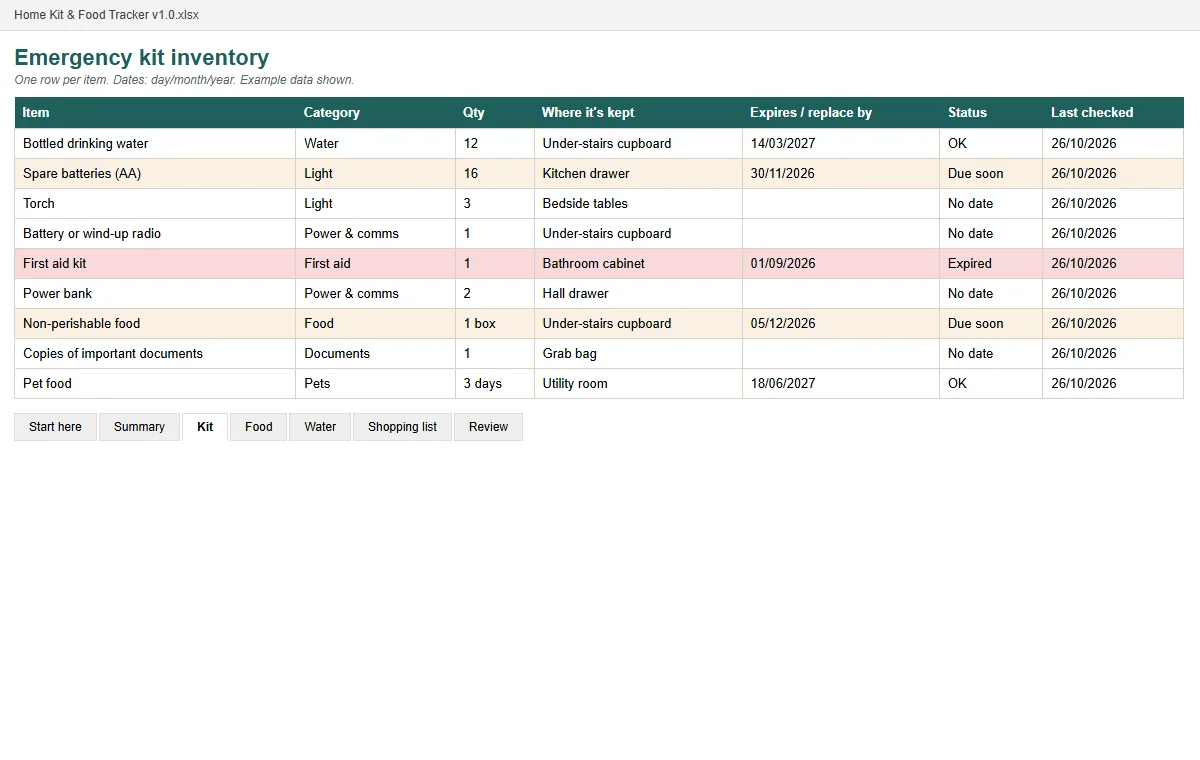 Bundle · £15.97 separatelyPrepared, Not Panicked bundle£9.99
Real pages shown before you buy · instant PDF · one-off price · 30-day refund.
Get the free 72-hour UK household checklist
Tick-box lists for each part of a UK home emergency kit, plus the key numbers on one page. Enter your email and we'll take you straight to the download.
That email address doesn't look right — please check it and try again.
We'll also email you when we publish new guides — occasional, never daily. Unsubscribe any time. See our privacy notice.
Frequently asked questions
What does 'stay put' mean in a block of flats?
London Fire Brigade says that if your building's advice is to stay put and the fire is elsewhere in the block, you stay in your flat with windows and doors closed, call 999 and follow the control room's advice. If fire, smoke or heat is directly affecting you, alert everyone and leave.
How do I find out my building's fire plan?
Ask your landlord, housing provider or managing agent. London Fire Brigade says they need to tell you the fire safety arrangements, including the evacuation plan. In England, the responsible person must give residents fire safety instructions when they move in and at least once a year.
Can I use the lift to get out?
Not in a fire. Fire Kills says never use lifts in a fire and always use the stairs. Greater Manchester Fire and Rescue Service says a fire may cause a power failure that traps you in the lift, unless lift use has been agreed as part of your own evacuation plan.
What if I can't manage the stairs?
London Fire Brigade says your landlord or housing officer can help set up a Residential Personal Emergency Evacuation Plan (RPEEP), a plan made for anyone who may need help to leave the building.
Where do I keep an emergency kit in a small flat?
There's no official rule. Keep the essentials together somewhere you can reach in the dark, such as a hallway cupboard or under a bed, and keep water in several smaller packs if space is tight. Don't store anything in shared corridors or stairs.
Sources
- London Fire Brigade: Escape plan for purpose-built blocks of flats (checked 29 Oct 2026)
- GOV.UK Fire Kills: Plan your fire escape (checked 29 Oct 2026)
- GOV.UK: Fire Safety (England) Regulations 2022, fact sheet: overview (checked 29 Oct 2026)
- GOV.UK: Fire Safety (England) Regulations 2022, fact sheet: information to residents (regulation 9) (checked 29 Oct 2026)
- Greater Manchester Fire and Rescue Service: Fire safety information for residents living in flats operating an evacuation strategy (checked 29 Oct 2026)
- Haringey Council: Lifts in council housing (checked 29 Oct 2026)
- GOV.UK Be Ready: Water supply interruptions or outages (checked 29 Oct 2026)
- GOV.UK Be Ready: Power cuts (checked 29 Oct 2026)
- GOV.UK Be Ready: Checklist (PDF, October 2026) (checked 29 Oct 2026)