In short: For older people and carers, an emergency plan means joining the free Priority Services Register with your energy and water companies, writing down the cared-for person's medicines, needs and contacts (Carers UK's MyBackUp tool helps), asking your council about a carers emergency card, and ordering repeat prescriptions in good time. Agree who will check in person if the power or phones go down.
Free tool: make your household emergency plan in about 10 minutes — your power network from your postcode, contacts, meeting points and a kit list, printed on one page. Works offline.
Key facts
- You can ask to join your energy supplier's Priority Services Register if you've reached State Pension age, have a disability or long-term condition, or rely on medical equipment that needs a power supply. Source
- Water companies in England and Wales offer free priority services, including delivering water if supplies are interrupted and you can't get to a collection point. Source
- The NHS says to request repeat prescriptions up to 5 working days before you need your medicine. Source
- Some areas run carers emergency card schemes: you carry a card with a 24-hour number and ID, and the scheme holds your plan and arranges replacement care if you're taken ill. Source
- Lions Message in a Bottle stores medical details and emergency contacts in a bottle in the fridge, with green cross stickers telling responders where to look. Source
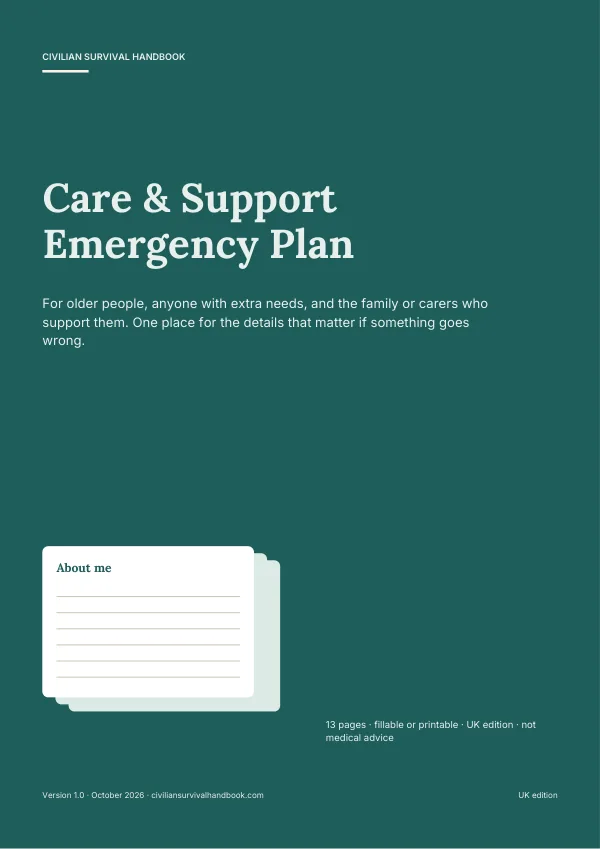 Want this written down for your home? Care & Support Emergency Plan — printable, £4.99.
Emergencies such as power cuts, water outages, floods or a sudden illness tend to hit older people and the people who care for them hardest — not because they are more frightening, but because more depends on things running smoothly. The good news is that most of the useful preparation is free, quick, and done once. This guide covers the registers to join, the plan to write down, and the small schemes that help responders.
Join the Priority Services Register (energy and water)
The Priority Services Register (PSR) is the most useful single step for many older households.
Energy. Ofgem says you can ask to join if you've reached State Pension age, have a disability or long-term medical condition, rely on medical equipment that needs a power supply, or have had a recent change such as a hospital stay or bereavement. Services include priority support in an emergency, advance notice of planned power cuts where possible, a password scheme so you can check a caller is genuine, and naming a trusted person such as a carer to receive communications. Your supplier and your network operator each keep their own register, so contact both.
Ofgem says network operators must offer PSR customers extra help during power cuts, such as battery packs to charge phones or medical equipment. Being on the register doesn't bring extra compensation payments.
Water. Water companies in England and Wales run their own free priority services. These include delivering water if supplies are unexpectedly interrupted and you can't reach a collection point, a password scheme, a nominated contact, and "knock and wait". Register with your water company before anything goes wrong.
Carers UK notes that you can sign up someone you care for on their behalf. In Northern Ireland, the PSR isn't available; Carers UK points to NIE Networks' scheme for similar help.
Write a carer's emergency plan
Carers UK recommends a written contingency plan so someone else can step in if you suddenly can't care. Its Creating a contingency plan guidance suggests gathering:
- the name, address and contact details of the person you look after
- who to contact in an emergency (friends, family, professionals)
- their medicines, and where they're kept
- any ongoing treatment and allergies
- GP and pharmacy details
- care and support services they receive
- continence products, and who supplies them
- mobility challenges and aids, such as a wheelchair or hoist
- any behaviours others should know about
Carers UK's free online tool, MyBackUp, guides you through it. Talk the plan through with the person you care for, if possible, and with the people you name. Give them a copy or tell them where it is, and keep it up to date.
Carers UK also suggests preparing one hospital bag for the person you care for. It should hold their emergency contacts, a medicines list with doses, appointment details, overnight things and any advance care plan.
Buying for a parent? You can send a plan as a gift.
Ask about a carers emergency card
GOV.UK's Be Ready guidance suggests carers ask their local council about a carer's card, which can show emergency services that someone depends on them.
Carers UK explains how these schemes generally work. They're run by some councils, trusts or local carers' centres. You register and draw up an emergency plan with a worker's help. You then carry a card with a 24-hour number and a unique ID number, so no personal details appear on the card. If you're taken ill, whoever is with you calls the number and the scheme arranges replacement care.
As one example, North Yorkshire Council's carers emergency card is for adults caring for another adult in the county. It provides 24-hour cover, contacting your named emergency contact or arranging other support if there isn't one. Names, eligibility and application steps vary, so search your own council's carers pages or ask your local carers' centre.
Message in a Bottle
The Message in a Bottle scheme was set up by Lions Clubs International British Isles. Gwynedd Council describes how it works: you fill in a form with allergies, health conditions, medicines and emergency contacts. The form goes in a small bottle with a green cross, kept in the fridge, and green cross stickers inside the home tell responders where to look. In Gwynedd the bottles are free from council offices and libraries; elsewhere, ask your council or local Lions club.
For someone living with dementia or communication difficulties, Alzheimer's Society's free This is me leaflet records their background, routines and preferences. It can be used at home, in hospital, in respite care or in a care home.
Medicines and repeat prescriptions
- The NHS says to request repeat prescriptions up to 5 working days before you need them. You can order through the NHS App or NHS website, another online service your surgery uses, or the surgery directly. Some pharmacies deliver.
- NHS winter advice is to get prescription medicines before holiday periods and when bad weather is forecast.
- Be Ready suggests keeping a list of regular medicines and doses with your important phone numbers, and adding medical information to a phone's "Medical ID" or "ICE" settings.
- If medicine runs out completely, the NHS says you can use the NHS 111 online emergency prescription service. Pharmacies can supply some emergency medicines without a prescription, though you may have to pay.
Power-dependent equipment: oxygen, stairlifts and alarms
Be Ready advises making a plan with your care provider or clinical team now. It suggests thinking about how a power cut would affect powered wheelchairs and stairlifts, keeping backup batteries for medical devices charged, and asking your phone provider whether a landline works in a power cut. Some providers offer a free backup battery unit. It also notes that telecare and alerting devices may not work without power or internet, so agree that someone will check in person.
Home oxygen. NHS Highland's guidance for home oxygen users says oxygen concentrators switch off in a power cut. Users have a large backup cylinder, which lasts roughly 10 to 20 hours depending on the prescribed rate. Make sure the user, or someone with them, knows how to connect the backup cylinder. Use a battery torch or lamp and never candles near oxygen. Make sure anyone using oxygen is on the PSR. If you have concerns about the equipment, contact your oxygen supplier's helpline, which you'll find on their paperwork.
See our power cuts guide for torches, phone charging and what to do while the power is off.
Checking on neighbours and relatives
Be Ready asks households to make a plan to check in on neighbours, particularly if the power goes out. Agree a backup plan with anyone who may need extra support, especially if they live alone. That means you or a trusted person will visit in person if phones are down. Swap contact details, and consider a street or building group chat. Giving a trusted person a spare key also helps.
Winter
The NHS advises heating the rooms you use regularly to at least 18°C if you can. It also says to keep in touch with older friends, neighbours and family and ask if they need practical help. Check whether you or the person you care for can get a Cold Weather Payment.
Checklist
- Join the PSR with the energy supplier and the electricity network operator (and gas network)
- Register for priority services with the water company
- Write the care plan (Carers UK MyBackUp) and share it with named contacts
- Ask the council or carers' centre about a carers emergency card
- Set up Message in a Bottle, or This is me if relevant
- Pack a hospital bag with medicines list and contacts
- Order repeat prescriptions early, especially before holidays and bad weather
- Check backup batteries, oxygen cylinder plan and landline backup
- Agree who will check in person, and give them a spare key
- Add everything to your household emergency plan
Limitations
This page is general information, not medical, legal or care advice. Schemes and eligibility vary by council, supplier and nation — Northern Ireland, Scotland and Wales may differ from England — so check locally. For medical equipment, follow your clinical team's and supplier's instructions. In an emergency, follow official instructions and call 999 if anyone is in danger.
Turn this guide into a written plan
Reading helps. Writing it down is what makes it work when the phones are flat. Start with the free plan builder, or get the full printable version:
For this topicCare & Support Emergency Plan£4.99 Your whole household planHousehold Emergency Plan Pack£6.99
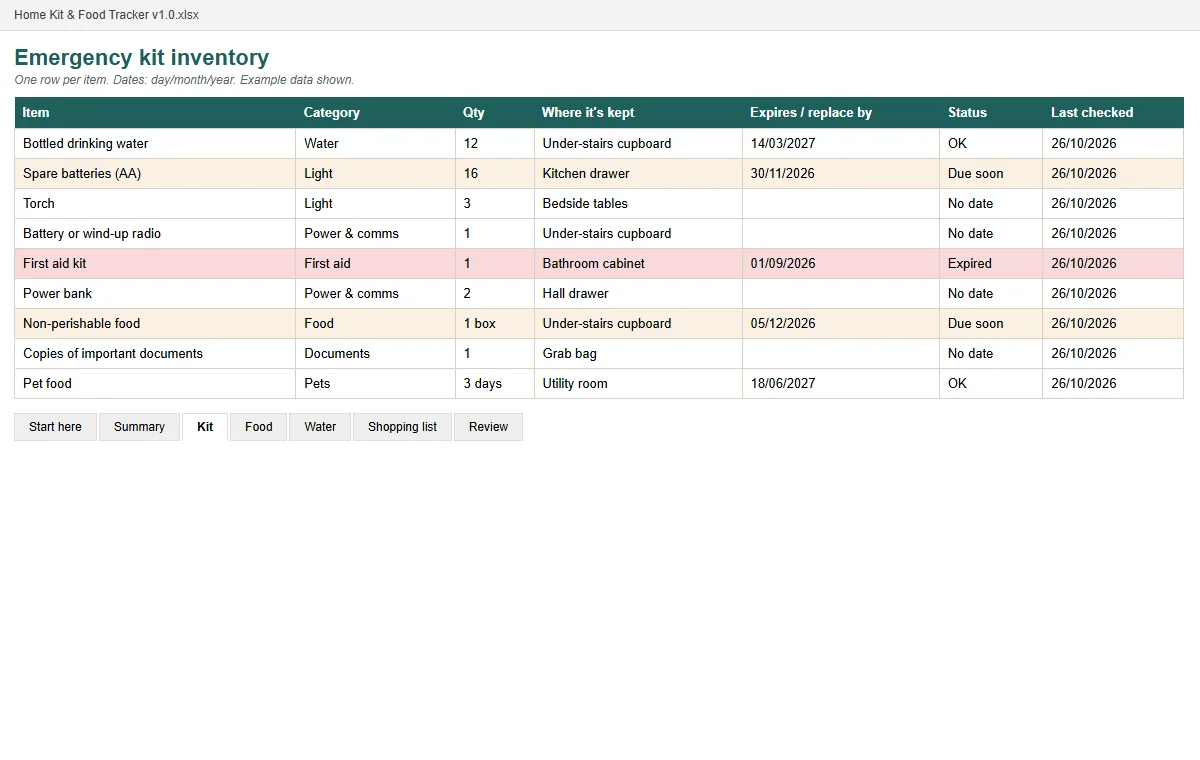 Bundle · £15.97 separatelyPrepared, Not Panicked bundle£9.99
Real pages shown before you buy · instant PDF · one-off price · 30-day refund.
Get the free 72-hour UK household checklist
Tick-box lists for each part of a UK home emergency kit, plus the key numbers on one page. Enter your email and we'll take you straight to the download.
That email address doesn't look right — please check it and try again.
We'll also email you when we publish new guides — occasional, never daily. Unsubscribe any time. See our privacy notice.
Frequently asked questions
What should a carer's emergency plan include?
Carers UK suggests the person's contact details, emergency contacts, medicines and where they're kept, allergies, GP and pharmacy, care services, continence products and supplier, mobility aids, and anything others need to know about behaviour. Its free MyBackUp tool walks you through it.
What is a carers emergency card?
A card some councils and carers' centres offer, carrying a 24-hour phone number and an ID number rather than personal details. If you're taken ill, whoever is with you rings the number and the scheme puts your agreed plan into action.
Is the Message in a Bottle scheme real?
Yes. It was set up by Lions Clubs International British Isles. You fill in a form with medical details and contacts, keep it in a bottle in the fridge, and put green cross stickers up so responders know to look there.
What happens to home oxygen in a power cut?
NHS guidance says oxygen concentrators switch off in a power cut, and users normally have a backup cylinder. Make sure you know how to switch to it, never use candles near oxygen, and join the Priority Services Register.
What if someone runs out of medicine?
The NHS says you can use the NHS 111 online emergency prescription service for repeat medicine you've completely run out of, and pharmacies can supply some emergency medicines without a prescription, though you may have to pay.
Sources
- Be Ready (GOV.UK) — Advice for disabled persons and carers
- Be Ready (GOV.UK) — Be ready for emergencies
- Ofgem — Join your supplier's Priority Services Register
- Ofgem — Check if you can get a payment for a power cut
- CCW — Extra free help: priority services
- Carers UK — Creating a contingency plan
- Carers UK — Getting help in an emergency
- Carers UK — Being prepared for the unexpected
- North Yorkshire Council — Carers emergency card
- Cyngor Gwynedd — Message in a Bottle scheme
- NHS — How to order a repeat prescription
- NHS — Emergency prescriptions
- NHS — Keep warm, keep well
- NHS Highland — Contingency planning for power outages: home oxygen
- Alzheimer's Society — This is me