In short: A pet emergency plan means keeping your pet's microchip details up to date, packing a small kit (food, water, medicines, lead or carrier, and records in a waterproof bag), knowing where your pets would go if you had to leave home, and naming someone who can look after them if you're suddenly ill. In the UK, dogs must be microchipped by 8 weeks old, and in England cats must be microchipped by 20 weeks old.
Free tool: make your household emergency plan in about 10 minutes — your power network from your postcode, contacts, meeting points and a kit list, printed on one page. Works offline.
Key facts
- Every dog in the UK must be microchipped and registered on an approved database by 8 weeks old, and you can be fined up to £500 if it isn't. Source
- Since 10 June 2024, cats in England must be microchipped before they reach 20 weeks old; owners found without a chip have 21 days to get one or may face a fine of up to £500. Source
- The RSPCA advises sealing microchip numbers, vet and vaccination details and a photo of your pet in a watertight bag when a flood is predicted. Source
- GOV.UK's personal flood plan says many evacuation centres will let you bring your pet, and to put cats or small animals in a carrier or small box. Source
- The Cinnamon Trust offers free short-term foster care for the pets of owners aged 65 or over, or terminally ill, during a hospital stay. Source
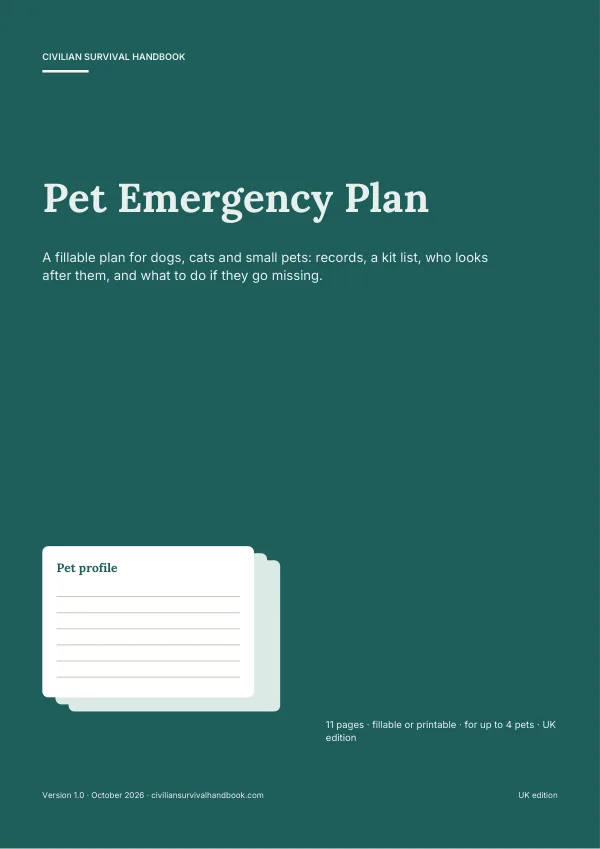 Want this written down for your home? Pet Emergency Plan — printable, £2.99.
Most household emergency plans forget the pets until the moment they matter. A little planning now — an up-to-date microchip, a small kit, and a named person who can step in — means your dog, cat, rabbit or other small pet is looked after if you have to leave home quickly or you're suddenly taken ill. This checklist sticks to what UK official bodies and the main animal charities actually advise.
Does my pet need to be microchipped?
A microchip is the single most useful thing you can do before an emergency, because it is how a lost or frightened pet gets back to you.
- Dogs (UK): GOV.UK says every dog must be microchipped and registered on an approved database by 8 weeks old. You can be fined up to £500 if it isn't. A dog in a public place must also wear a collar with a tag showing the owner's name and address. GOV.UK points Northern Ireland readers to separate guidance on dog licensing and microchipping.
- Cats (England): Since 10 June 2024, cats in England must be microchipped before they reach 20 weeks old. Owners found without a chip have 21 days to get one implanted or may face a fine of up to £500. Free-living cats with little or no human contact, such as farm, feral or community cats, aren't covered.
Keep the details current. A chip is only as good as the database record behind it. GOV.UK says you're responsible for updating your contact details — for example after a house move — by contacting the database company, which may charge a fee. Make a note of your pet's chip number and which database it's registered with, and keep it with your other records.
Pet emergency kit checklist
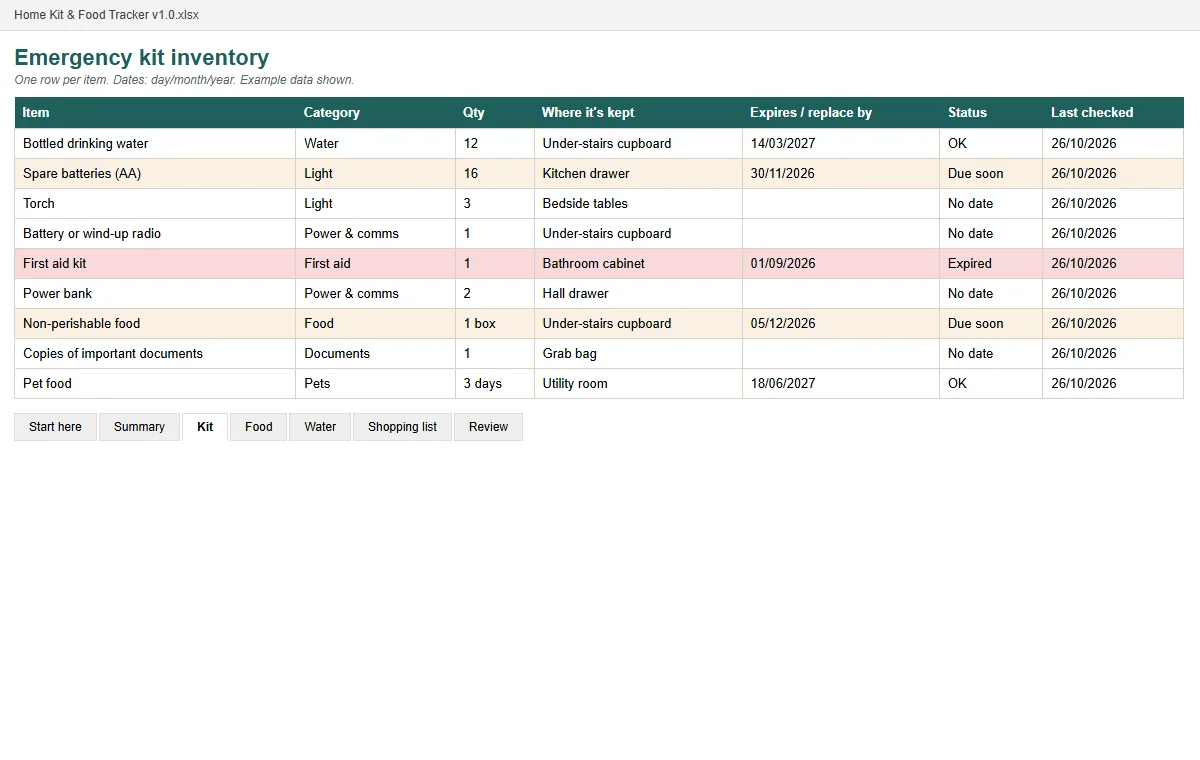
GOV.UK's Be Ready checklist includes "pet food and bottled water" alongside the household's own three days of supplies. The RSPCA and GOV.UK's flood guidance add carriers, bedding, medicines and records. Keep the kit together, near your own grab bag, so you can pick both up at once.
- Pet food for at least 3 days (the food your pet normally eats)
- Bottled water and a bowl for each pet
- Any medicines your pet takes, with the dose written down
- A sturdy lead and collar with ID tag (dogs)
- A carrier or secure box for cats, rabbits and other small animals
- Bedding or a blanket, and a favourite toy for comfort
- Poo bags, cat litter and a small tray, or puppy pads
- A waterproof bag holding: microchip number, vet and vaccination details, and a recent photo of your pet
- Your vet's number and their out-of-hours number
- Contact details for your pet's emergency carer, and any kennels or cattery you'd use
The RSPCA specifically recommends putting microchip numbers, vet and vaccination details and a photo in a watertight bag, so you have proof of ownership and something to show people if your pet gets lost.
Keeping vet records and contacts ready
PDSA advises saving your vet's number and their out-of-hours number in your phone and asking about the out-of-hours service at your next check-up. It says all vet practices provide out-of-hours emergency cover, though you may be referred to another surgery. If your pet's life is in danger, get to a vet immediately and ring ahead if you can.
Alongside the numbers, write down:
| Record | Why it helps |
|---|---|
| Microchip number and database | Proves ownership and speeds up reunion |
| Vaccination dates | Kennels, catteries and fosterers usually ask |
| Medicines and doses | Lets someone else care for your pet safely |
| Feeding routine and quirks | Helps a stand-in carer keep your pet settled |
| Pet insurance policy number | Some policies cover boarding if you're in hospital |
Put a copy with your own household emergency plan and give one to your named emergency carer.
Flooding and evacuation with pets
GOV.UK's personal flood plan asks you to think now about where your pets would go and what they would need — food, carriers and medicines — and to list kennels, carers and vets among your contacts.
Before a flood
- Plan your route out and keep the numbers of people who could help move your animals.
- Have carriers ready and set aside food for your pets in case you need to leave, as the RSPCA advises.
When a flood warning is issued
- GOV.UK says to move your family, pets and important items to safety, for example upstairs or to higher ground.
- The RSPCA says to bring small animals indoors (upstairs if possible) and move food, bedding and fresh water somewhere dry.
- Seal your pet's records and photo in a watertight bag.
If you're asked to evacuate
- GOV.UK's flood plan says many evacuation centres will let you bring your pet. Put cats and small animals in a carrier or small box, and take their food.
- Leave when the emergency services tell you to — don't delay to search for a pet that has hidden.
If an animal is trapped
The RSPCA is clear: if animals are stranded or in danger, don't try to rescue them yourself. Call the RSPCA on 0300 1234 999 (8am to 6pm) or 999 for the fire and rescue service, and never put your own or anyone else's life at risk. Floodline is 0345 988 1188, 24 hours a day, for flood warnings in England. For more on getting the household ready, see our storms and flooding guide.
After a flood, the RSPCA advises drying any wet animal quickly with towels — especially in cold weather and for young, old, pregnant or sick animals.
Fireworks, heat and cold
These aren't emergencies in the same sense, but they are predictable risks worth building into your plan.
- Fireworks: The RSPCA suggests setting up a quiet safe space before the season, walking dogs in daylight, closing windows and curtains, keeping cats in after dark with the cat flap blocked, and bringing rabbit and guinea pig hutches indoors if you can. Make sure pets are microchipped in case they bolt. Never punish a frightened pet; ask your vet if fear is severe.
- Hot weather: The RSPCA says never leave dogs in cars, caravans, conservatories or outbuildings in warm weather. It warns that when it's 22°C outside, those spaces can quickly reach 47°C. Walk in the early morning or late evening, keep shade and cool water available, and contact a vet immediately if you see signs of heatstroke such as heavy panting, collapse or vomiting.
- Cold weather: The RSPCA warns that antifreeze and rock salt can be fatal to dogs and cats, so wipe paws, legs and tummies after walks on gritted ground and contact a vet immediately if you suspect poisoning.
Who looks after your pet if you're in hospital?
This is the gap most plans miss. If you live alone and are taken ill suddenly, nobody may know there is a pet at home.
- Name an emergency carer now. Ask a friend, neighbour or relative who is happy to step in, give them a spare key if you're comfortable doing so, and share your pet's records and routine.
- Make it visible. Keep a note with your emergency contacts saying you have pets at home and who to call. Our household emergency plan has space for this.
- Know the charity schemes: - The Cinnamon Trust offers free short-term foster care while you're in hospital or recovering, for owners aged 65 or over or who are terminally ill (the criteria apply to the whole household). It recommends registering early so it can place your pet quickly. Phone 01736 757 900, Monday to Friday, 10am to 4pm. - Cats Protection's Cat Guardians is a free service that cares for and rehomes your cat if you die. It does not cover temporary care; for hospital stays it suggests checking whether your pet insurance covers boarding. - Dogs Trust's Canine Care Card arranges for Dogs Trust to look after your dog if you die, become seriously ill or move into a care home. Some dogs can't be covered, such as banned breeds, so check the terms.
- Check your insurance. If you have pet insurance, find out whether it pays for kennels or a cattery while you're in hospital.
Limitations
This page is general information, not veterinary or legal advice. Microchipping rules differ across the UK — the cat rule described here applies in England — so check the rules where you live. In an emergency, follow the instructions of the emergency services, call 999 if anyone is in danger, and don't put yourself at risk to rescue an animal. For a sick or injured pet, contact your vet.
Turn this guide into a written plan
Reading helps. Writing it down is what makes it work when the phones are flat. Start with the free plan builder, or get the full printable version:
For this topicPet Emergency Plan£2.99 Your whole household planHousehold Emergency Plan Pack£6.99
 Bundle · £12.97 separatelyFamily Starter£9.99
Real pages shown before you buy · instant PDF · one-off price · 30-day refund.
Get the free 72-hour UK household checklist
Tick-box lists for each part of a UK home emergency kit, plus the key numbers on one page. Enter your email and we'll take you straight to the download.
That email address doesn't look right — please check it and try again.
We'll also email you when we publish new guides — occasional, never daily. Unsubscribe any time. See our privacy notice.
Frequently asked questions
Do cats have to be microchipped in the UK?
In England, yes: since 10 June 2024 cats must be microchipped before 20 weeks old, with exemptions for free-living cats such as farm or feral cats. Check local rules if you live in Scotland, Wales or Northern Ireland.
What should go in a pet emergency kit?
At minimum: pet food and bottled water (both on GOV.UK's Be Ready checklist), any medicines, a lead or carrier, bowls, bedding, and copies of microchip and vet details with a recent photo in a waterproof bag.
Can I take my pet to an evacuation centre?
GOV.UK's personal flood plan says many evacuation centres will allow you to bring your pet. Put cats and small animals in a carrier or box and take their food.
Who will look after my pet if I go into hospital?
Arrange a named emergency carer (a friend, neighbour or relative) now. If you're 65 or over or terminally ill, the Cinnamon Trust offers free short-term fostering during hospital stays; Cats Protection suggests checking whether your pet insurance covers boarding.
What should I do if my pet is trapped in floodwater?
Don't try to rescue them yourself. The RSPCA says to call it on 0300 1234 999 (8am to 6pm) or 999 for the fire and rescue service, and never put your own life at risk.
Sources
- GOV.UK — Get your dog microchipped
- GOV.UK — Treasured pets now safer as microchipping for cats becomes compulsory
- Be Ready (GOV.UK) — Be ready for emergencies
- GOV.UK — Personal flood plan
- GOV.UK — What to do before or during a flood
- RSPCA — Keeping animals safe during floods
- RSPCA — Keeping pets safe during fireworks
- RSPCA — Keeping your dog safe in summer
- RSPCA — Keep pets safe in cold weather
- PDSA — Emergency care for pets
- The Cinnamon Trust — Temporary pet care
- Cats Protection — Cat Guardians FAQs
- Dogs Trust — Canine Care Card