In short: Before a storm, check Met Office weather warnings, which are yellow, amber or red. Sign up for free flood warnings, or call Floodline on 0345 988 1188 in England, Scotland and Wales. Secure loose items outside, charge your phone and power bank, and keep a torch, radio, water and food for 3 days at home.
Free tool: make your household emergency plan in about 10 minutes — your power network from your postcode, contacts, meeting points and a kit list, printed on one page. Works offline.
Key facts
- An amber warning means an increased likelihood of impacts from severe weather; a red warning means dangerous weather is expected and there is a very high likelihood of risk to life. Source
- A storm is named when it is expected to cause disruption or damage significant enough to warrant an amber or red warning. Source
- Floodline is a free, 24-hour service on 0345 988 1188 for England, Scotland and Wales. Source
- In Northern Ireland, report flooding to the Flooding Incident Line on 0300 2000 100. Source
- The Environment Agency usually issues a flood alert 2 to 12 hours before flooding and a flood warning 30 minutes to 2 hours before. Source
- After a flood, take photos of any damage and the flood water line, and speak to your insurer about what you can move and throw away. Source
 Want this written down for your home? Storm & Flood Plan — printable, £4.99.
Storms and flooding are among the most common emergencies UK households face, and most of the damage and stress can be reduced with a little preparation. This guide explains what the official warnings mean, how to sign up for free flood warnings wherever you live in the UK, what to put in a flood kit, and a simple checklist for before, during and after a storm.
What do Met Office weather warnings mean?
The Met Office issues yellow, amber and red warnings based on a combination of the impact the weather may have and the likelihood of those impacts.
| Warning | What it means | What to do |
|---|---|---|
| Yellow | Covers a range of situations — often a high likelihood of moderate impacts, such as some travel disruption, or bigger impacts that are less certain | Read the warning and check whether it could affect you |
| Amber | An increased likelihood of impacts from severe weather that could disrupt your plans — for example travel delays, road and rail closures, power cuts and risk to life and property | Think about changing your plans and take action to protect yourself and your property |
| Red | Dangerous weather is expected, with a very high likelihood of risk to life and substantial disruption | Act now to keep yourself and others safe; avoid travelling where possible and follow the emergency services and local authorities |
The Be Ready campaign points people to the Met Office website for the latest forecasts and to sign up for email alerts and warnings.
Why are storms given names?
The UK storm-naming scheme is run by the Met Office with Met Éireann and the Dutch weather service KNMI, and began in 2015. The Met Office says there is no set wind speed or rainfall total that triggers a name; instead, a storm is named when it is expected to cause disruption or damage significant enough to warrant an amber or red warning. Wind is usually the main factor, but heavy rain and snow are considered too. A new list of names is published each September.
In practice, when you hear a storm has been named, it's a good prompt to check the warnings for your area and run through the checklist below.
How do I get flood warnings?
Flood warnings are run separately in each part of the UK. They are free.
England
Sign up on GOV.UK to get warnings by phone call, text or email, or call Floodline. The service covers homes at risk from rivers, the sea and groundwater — it does not cover surface water (flash) flooding. You can also check for flooding in the next 5 days and check your long-term flood risk.
Scotland
Register with SEPA's Floodline. Depending on where you live, you can get a targeted flood warning for your local area or a more general flood alert for a wider area. You can also check Scotland's flood forecast.
Wales
Sign up with Natural Resources Wales. NRW says its warning service covers around 90% of properties at risk of flooding from rivers or the sea in Wales. You can register more than one location — for example, an elderly relative's home.
Northern Ireland
GOV.UK doesn't list a flood warning sign-up for Northern Ireland; instead, use the nidirect flood maps to check your risk. Report flooding to the Flooding Incident Line on 0300 2000 100 (nidirect).
Floodline (England, Scotland and Wales)
- Phone: 0345 988 1188
- Textphone: 0345 602 6340
- Open: 24 hours
GOV.UK also says you can ask Floodline to send flood warnings to a friend or relative on your behalf — useful for someone who isn't confident with phones.
What do flood alerts and warnings mean?
The Environment Agency uses three levels in England (GOV.UK):
- Flood alert — flooding is possible, prepare now. Usually issued between 2 and 12 hours before flooding. Be ready to follow your flood plan and have insurance papers and medication to hand.
- Flood warning — flooding is expected, act now. Usually issued 30 minutes to 2 hours before flooding. Move people, pets and valuables to safety, go upstairs or to higher ground, and turn off gas, electricity and water if it's safe to do so.
- Severe flood warning — danger to life. Stay somewhere safe, be ready to evacuate and follow the emergency services. Call 999 if you're in immediate danger.
What should be in a flood kit?
nidirect recommends an emergency flood kit including:
- copies of your home insurance documents
- a battery-powered or wind-up radio
- warm, waterproof clothing, rubber boots and blankets
- a first aid kit and any medication people in the house need
- bottled water and tinned or dried food
- things for looking after a baby
From the Be Ready checklist, add:
- a torch and spare batteries (torches are safer than candles)
- a charged power bank for phones
- important phone numbers written on paper
- some cash, and printed copies of key documents
Keep it in a waterproof bag somewhere upstairs or easy to grab. GOV.UK suggests keeping your flood plan in a safe place with spare medication, important documents and contact details. Our radio buying guide and important documents checklist can help, and our 72-hour kit page covers the wider basics.
Before, during and after a storm: checklist
Before
| Task | Done? |
|---|---|
| Check Met Office warnings and your flood risk | ☐ |
| Sign up for flood warnings (or Floodline) | ☐ |
| Secure loose objects — ladders, garden furniture, anything that could hit windows | ☐ |
| Close and fasten doors and windows, especially on the windward side and garage doors | ☐ |
| Park cars in a garage or away from trees, walls and fences | ☐ |
| Charge phones and power banks; check your radio and torch | ☐ |
| Know where your water stop tap, gas shut-off valve and electricity main switch are | ☐ |
| Photograph your rooms and valuables for insurance | ☐ |
| Move valuables and important documents upstairs if flooding is possible | ☐ |
| Check on neighbours or relatives who may need help | ☐ |
The storm steps above are from the Met Office's stay safe in a storm advice. GOV.UK explains that the stop tap, gas valve and main electricity switch are in different places in different homes — the stop tap is often where the water supply comes in, the gas valve next to the meter and the electricity switch on the fuse board. Find yours now, in daylight. A power cut is likely in a big storm, so see our power cuts guide too.
During
- Stay indoors as much as possible, and don't go outside to repair damage while the storm is in progress.
- If you must go out, don't walk or shelter close to buildings, trees, walls or fences.
- Don't touch electrical or telephone cables that have been blown down.
- Avoid driving unless necessary, and take care on exposed roads and bridges.
- Don't walk, cycle or drive through flood water — GOV.UK warns it can contain sewage and hide debris, uneven ground and missing manhole covers.
- Don't touch an electrical switch if you're standing in water.
- Listen to local radio and follow instructions from the emergency services. Call 999 if life is at risk.
After
GOV.UK's after-a-flood advice includes:
- check with the emergency services that it's safe to return home
- don't turn your water, gas or electricity back on until your utility company or a qualified engineer has checked they're safe
- take photos of any damage and the flood water line, and contact your insurer to start a claim before throwing things away
- don't eat food that has touched flood water
- throw away fridge food if the power has been off for more than 4 hours, and freezer food if it has been off for more than 24 hours
- don't use tap water if its colour, taste or smell changes — contact your water company
- if you rent, your landlord is responsible for repairs
Insurance: photos, documents and Flood Re
Good records make a claim much easier. Before winter, photograph each room, valuables and serial numbers, and save copies of your policy somewhere you can reach if your home is flooded — on paper in your kit and in secure online storage.
Check your policy covers flood damage. If you rent, GOV.UK advises asking your landlord what their insurance covers, as it may not include your belongings — you may need your own contents insurance.
If you're a homeowner struggling to find affordable cover, GOV.UK says you can find lower-cost home insurance through Flood Re. Flood Re describes itself as a joint initiative between the government and insurers to make the flood cover in household policies more affordable. GOV.UK also notes that if your home has been flooded and your insurer is part of Flood Re's Build Back Better scheme, you could get up to £10,000 towards flood resilience as part of your repairs. If an insurer asks for evidence of your flood risk, you can contact the Environment Agency, which says it will send a free letter within 20 days.
Limitations
This guide is general information, not professional advice. Weather and flood services, phone numbers and insurance schemes can change, so check the official sites linked above. Always follow instructions from the emergency services and your local council, and call 999 if you or someone else is in immediate danger. Flood warnings are run differently in England (Environment Agency), Scotland (SEPA), Wales (Natural Resources Wales) and Northern Ireland, so use the service for where you live.
Turn this guide into a written plan
Reading helps. Writing it down is what makes it work when the phones are flat. Start with the free plan builder, or get the full printable version:
For this topicStorm & Flood Plan£4.99 Your whole household planHousehold Emergency Plan Pack£6.99
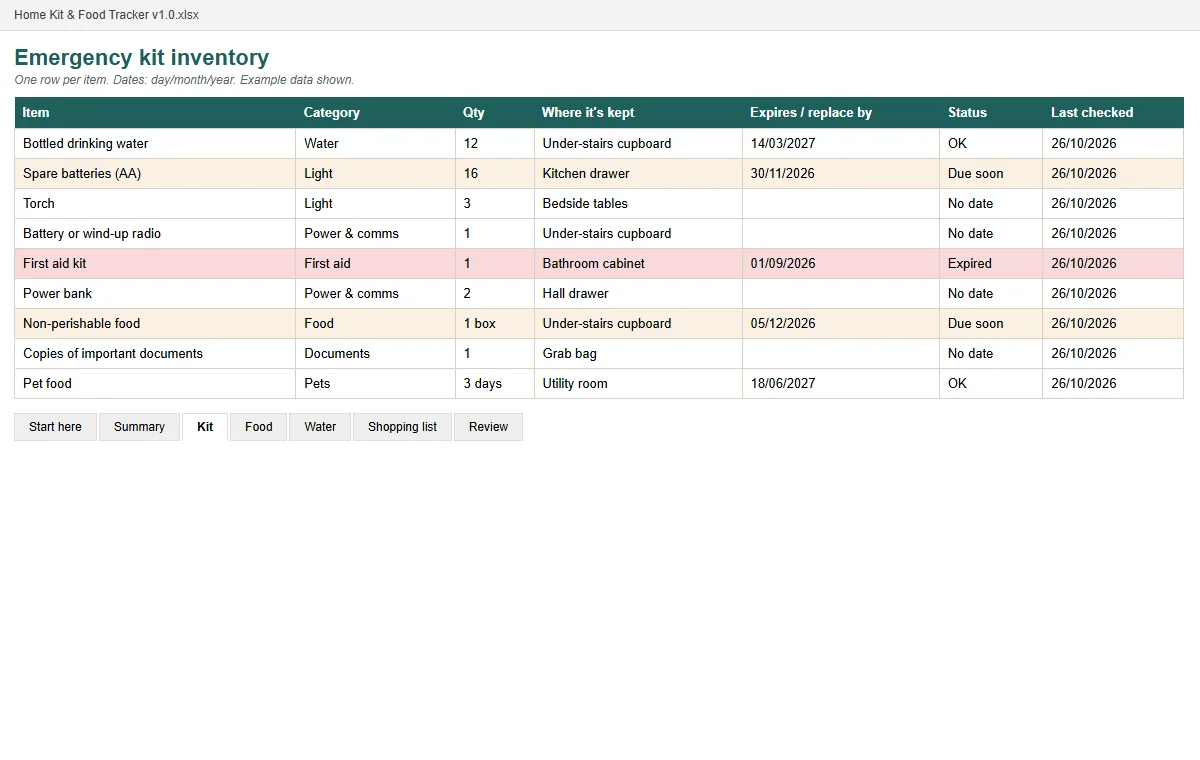 Bundle · £15.97 separatelyPrepared, Not Panicked bundle£9.99
Real pages shown before you buy · instant PDF · one-off price · 30-day refund.
Get the free 72-hour UK household checklist
Tick-box lists for each part of a UK home emergency kit, plus the key numbers on one page. Enter your email and we'll take you straight to the download.
That email address doesn't look right — please check it and try again.
We'll also email you when we publish new guides — occasional, never daily. Unsubscribe any time. See our privacy notice.
Frequently asked questions
What is the Floodline number?
Floodline is 0345 988 1188 (textphone 0345 602 6340) and runs 24 hours a day for England, Scotland and Wales. In Northern Ireland, report flooding to the Flooding Incident Line on 0300 2000 100.
How do I sign up for flood warnings?
In England, sign up free on GOV.UK or by calling Floodline. In Scotland, register with SEPA's Floodline; in Wales, sign up with Natural Resources Wales. GOV.UK does not list a warning sign-up for Northern Ireland, but nidirect has flood maps to check your risk.
What does an amber weather warning mean?
The Met Office says an amber warning means an increased likelihood of impacts from severe weather that could disrupt your plans, such as travel delays, power cuts or risk to life and property. You should think about changing your plans and taking action to protect yourself and your property.
What should be in a flood kit?
nidirect suggests copies of home insurance documents, a battery-powered or wind-up radio, warm waterproof clothing, boots and blankets, a first aid kit and medication, bottled water and tinned or dried food, and things for any baby. Add a torch, phone power bank and important contact numbers.
Do flood warnings cover flash flooding?
No. The GOV.UK flood warning service in England covers river, sea and groundwater flooding, not surface water (flash) flooding, so watch Met Office rain warnings too.
What is Flood Re?
Flood Re is a joint initiative between the government and insurers that aims to make the flood cover in household insurance more affordable. GOV.UK says homeowners can find lower-cost home insurance through it.
Sources
- Met Office — Weather warnings guide
- Met Office — What does it take for a storm to be named?
- Met Office — Stay safe in a storm
- GOV.UK — Sign up for flood warnings
- GOV.UK (Environment Agency) — Flood alerts and warnings: what they are and what to do
- GOV.UK — Prepare for flooding
- GOV.UK — What to do before or during a flood
- GOV.UK — What to do after a flood
- GOV.UK — Get insurance (prepare for flooding)
- SEPA — Sign up to Floodline
- SEPA — Flooding
- Natural Resources Wales — Sign up to receive flood warnings
- nidirect — Preparing for a flood
- nidirect — Severe weather, storms, flooding and drought
- Flood Re
- Be Ready (GOV.UK) — Be ready for emergencies