In short: The government's Be Ready advice is to keep non-perishable food for 3 days: food with a long shelf life that needs no fridge or cooking, such as tinned meat, fish or vegetables, dried fruit and nuts. Buy food your household usually eats, add an item or two on normal shopping trips, and check dates every six months.
Key facts
- Be Ready recommends non-perishable food for 3 days: food with a long shelf life that doesn't need refrigeration or cooking, such as tinned meat, fish or vegetables, dried fruit and nuts. Source
- The Be Ready checklist says it's best to buy food you'd usually eat, and to pick up missing items during regular shopping trips to spread the cost. Source
- The Be Ready checklist suggests a reminder every six months to check expiry dates and swap out items that need replacing. Source
- The Food Standards Agency says a fridge should stay cold for up to 4 hours, and a freezer should stay frozen for up to 48 hours if full or 24 hours if half full. Source
- If the fridge reaches 8°C or above, the FSA says to eat food that normally needs refrigeration within 4 hours. Source
- GOV.UK says use-by dates are about safety and best before dates are about quality. Source
 Want this written down for your home? 72-Hour Emergency Kit Planner — printable, £3.99.
An emergency food stockpile in the UK doesn't need special survival food. It's mostly the tins and packets you already buy, kept in one cupboard and used in turn. This page gives you a printable list for the official 3 days, then a simple way to grow it to 2 weeks without one big shop. Prepared, not panicked.
If you want a full 3-day no-cook menu, see our emergency food guide. For water, medicines and everything else on a longer plan, see two weeks of emergency supplies. This page is just the food list and how to build it.
Step 1: the official 3-day food list
GOV.UK's Be Ready campaign asks for non-perishable food for 3 days for everyone at home. It means food with a long shelf life that doesn't need a fridge or cooking. Its examples are tinned meat, fish or vegetables, dried fruit and nuts.
The Be Ready checklist adds one simple rule: it's best to buy food you'd usually eat. The British Red Cross agrees, and suggests including some food that can be eaten cold, since you may not be able to cook.
The emergency food stockpile list
Tick off what you already have first. Then add the rest a little at a time.
Protein
- Tinned fish (in oil, water or sauce)
- Tinned meat, or a plant-based alternative
- Tinned beans, lentils or chickpeas
- Nut butter
Vegetables and fruit
- Tinned vegetables you'd eat cold (sweetcorn, carrots, peas, mixed beans)
- Tinned tomatoes
- Tinned fruit in juice
- Dried fruit
Starchy foods
- Crackers, oatcakes or rice cakes
- Breakfast cereal
- Long-life bread or wraps (check the date when you buy)
Ready to eat
- Tinned soups or stews that you're happy to eat cold
- Fruit pouches
Snacks and drinks
- Nuts and seeds
- Cereal bars, biscuits, chocolate
- Small cartons of long-life (UHT) milk or plant milk
- Juice cartons
Tools and special needs
- Manual tin opener
- Spoons, a bowl and a cup that don't need washing up straight away
- Foods for allergies or special diets
- Ready-to-feed baby formula, if needed
- Pet food
How much to buy: count meals, not tins
The easiest way to plan is to count meals. Multiply the number of people by the number of days, then by 3 meals a day.
| Household | 3 days | 7 days | 14 days |
|---|---|---|---|
| 1 person | 9 meals | 21 meals | 42 meals |
| 2 people | 18 meals | 42 meals | 84 meals |
| 4 people | 36 meals | 84 meals | 168 meals |
Add snacks on top, especially for children. Our free emergency supplies calculator works out water and supplies for your own household.
Step 2: grow it to 2 weeks by buying what you already eat
Two weeks is not the official UK advice. It's an optional extra plan for households who want more breathing space. The calm way to build it is to copy what you already eat.
- Write down your cupboard meals. Think of 5 to 7 meals your household already eats that use only tins, jars and packets, for example tuna pasta, bean chilli or soup with crackers.
- List the ingredients for each one. That list is your 2-week shopping list.
- Add one or two extra items on each normal shop. Be Ready says you don't need to do it all at once, and suggests buying missing items on regular trips to spread the cost.
- Repeat the meal list until you reach 2 weeks.
Some of these meals will need cooking. Pasta and rice also need water. Be Ready notes that you'd need more water for cooking and washing on top of the 3 litres per person per day for drinking. So keep your first 3 days as no-cook food, and add cooked meals after that.
| Stage | Food goal | Tip |
|---|---|---|
| Days 1–3 | No-cook food from the list above | This is the official Be Ready baseline |
| Days 4–7 | Your cupboard meals, once each | Choose meals everyone likes |
| Days 8–14 | Your cupboard meals, a second time | Add a few treats; they help on long days |
| Every 6 months | Check dates and eat the oldest stock | Replace it on your next shop |
Rotate it so nothing goes to waste
A stockpile only works if you eat it before it goes out of date. Use "first in, first out":
- Put new shopping at the back of the shelf and use from the front.
- Write the month you bought it on the lid in marker pen.
- Cook one meal from the stockpile each week, then replace what you used.
- Set a reminder every six months to check expiry dates.
GOV.UK explains that use-by dates relate to safety, while best before dates relate to quality. Most cupboard food has a best before date. GOV.UK also says the label tells you how to store food, and that food which says "refrigerate after opening" should go in a fridge at 5°C or below. In a power cut you won't have a working fridge, so small tins and cartons you can finish in one go are easier.
If the power goes off: eat fridge food first
Your stockpile is the last thing you eat in a power cut, not the first. The Food Standards Agency (FSA) says:
- A power cut of less than 4 hours is unlikely to affect chilled or frozen food.
- Keep the doors shut. A fridge should stay cold for up to 4 hours. A freezer should stay frozen for up to 48 hours if full, or 24 hours if half full. These are estimates and depend on the appliance.
- Use a fridge thermometer. If the fridge reaches 8°C or above, eat chilled food within 4 hours, or throw it away if the power isn't back by then.
- If it's below 8°C outside, you can keep chilled food outdoors in a sealed box, clean, dry, out of the sun and away from animals.
The FSA's eating order is: fridge food, then defrosted frozen food that doesn't need cooking, then other perishable food, and last of all tinned, bottled and dried food. It also says tinned food can be eaten without heating.
If you cook, the FSA notes that gas cookers may still work, but electric and induction cookers won't. Most camping stoves and barbecues are for outdoor use only, and the NHS says do not use a barbecue or camping stove indoors because of carbon monoxide. Our power cuts guide has more.
Babies, special diets and pets
- Babies. Be Ready says ready-made or "ready-to-feed" formula is best, because you may not be able to boil water to make up powdered formula safely.
- Special diets. Keep the versions your household already eats safely, and check allergen labels each time you restock.
- Pets. The checklist lists pet food and bottled water. See our pet emergency plan.
To see every item on the official list in one place, use our Be Ready kit list. If you'd like a printable planner to track food dates and top-ups, the 72-Hour Kit Planner has kit logs you can fill in.
Limitations
This page is general information based on GOV.UK Be Ready, Food Standards Agency, NHS and British Red Cross guidance, checked on 28 October 2026. It isn't medical or dietary advice. If someone in your home has allergies, a medical diet or a baby with feeding needs, ask their GP, dietitian or health visitor. In Scotland, Food Standards Scotland gives food safety advice. Always follow official instructions in an emergency, and call 999 if life is at risk.
Turn this guide into a written plan
Reading helps. Writing it down is what makes it work when the phones are flat. Start with the free plan builder, or get the full printable version:
For this topic72-Hour Emergency Kit Planner£3.99 Your whole household planHousehold Emergency Plan Pack£6.99
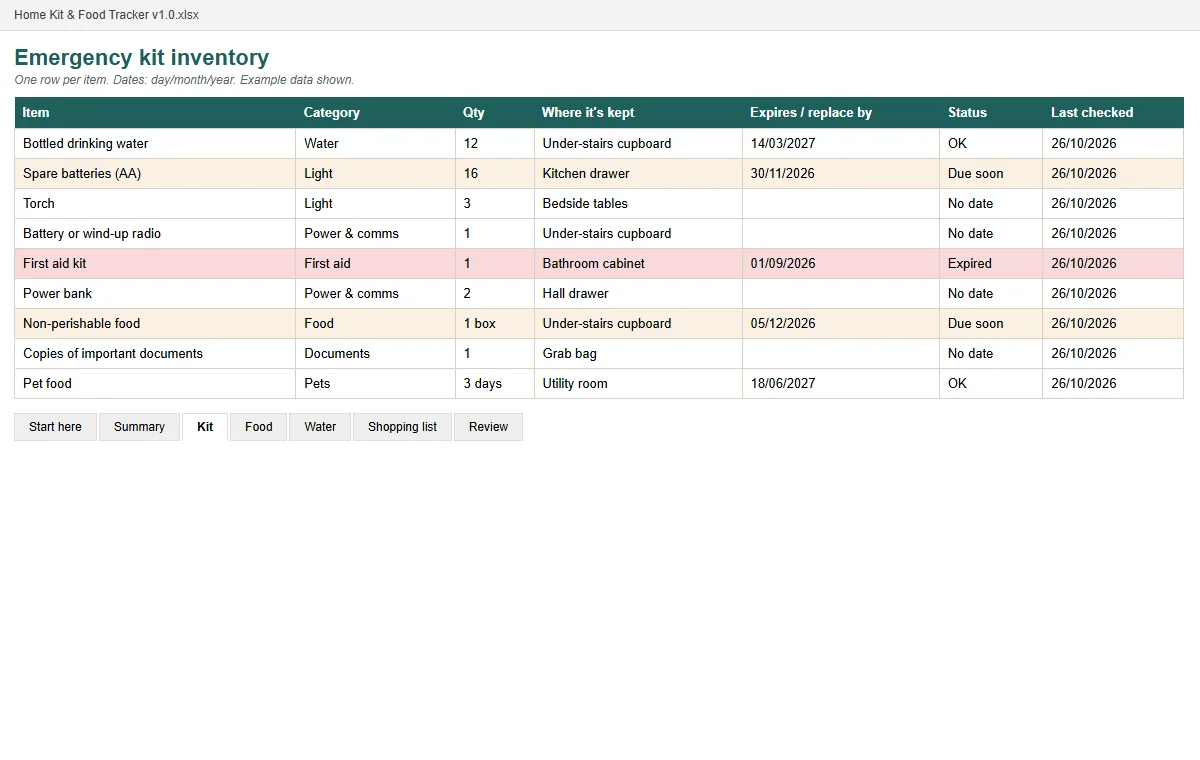 Bundle · £15.97 separatelyPrepared, Not Panicked bundle£9.99
Real pages shown before you buy · instant PDF · one-off price · 30-day refund.
Get the free 72-hour UK household checklist
Tick-box lists for each part of a UK home emergency kit, plus the key numbers on one page. Enter your email and we'll take you straight to the download.
That email address doesn't look right — please check it and try again.
We'll also email you when we publish new guides — occasional, never daily. Unsubscribe any time. See our privacy notice.
Frequently asked questions
What food should I stockpile for an emergency in the UK?
Be Ready recommends non-perishable food for 3 days that doesn't need a fridge or cooking, for example tinned meat, fish or vegetables, dried fruit and nuts. Choose food your household already eats, and add a manual tin opener.
How much emergency food do I need?
The official UK advice is food for 3 days for everyone in your home. A simple way to plan is to count meals: people × days × 3 meals. For 2 people and 3 days, that's 18 meals, plus snacks.
How do I build a 2-week food stockpile without buying it all at once?
Write down the cupboard meals you already eat, then add one or two extra items on each normal shop. Be Ready says you don't need to do it all at once and suggests spreading the cost over regular shopping trips.
How long does food in the fridge and freezer last in a power cut?
The Food Standards Agency says a fridge should stay cold for up to 4 hours with the door shut, and a freezer should stay frozen for up to 48 hours if full or 24 hours if half full. These are estimates and vary by appliance.
Is it safe to eat stockpiled food after the best before date?
GOV.UK says best before dates are about quality, so food is usually still safe after that date but may be less good. Don't eat food after its use-by date, because that date is about safety.
Sources
- GOV.UK Be Ready: Be ready for emergencies (checked 28 Oct 2026)
- GOV.UK Be Ready: Checklist PDF (checked 28 Oct 2026)
- GOV.UK Be Ready: Power cuts (checked 28 Oct 2026)
- Food Standards Agency (GOV.UK): Food safety in a power cut, advice for consumers (checked 28 Oct 2026)
- GOV.UK: Best before and use-by dates (checked 28 Oct 2026)
- NHS: Carbon monoxide poisoning (checked 28 Oct 2026)
- British Red Cross: Prepare an emergency kit (checked 28 Oct 2026)