In short: The UK's official baseline is 3 days of supplies, including 3 litres of drinking water per person per day. Sweden and Norway suggest a week and Germany 10 days. To reach two weeks, build up gradually from your 3-day kit during normal shopping: two weeks of drinking water is 42 litres per person, before cooking and washing.
Free tool: make your household emergency plan in about 10 minutes — your power network from your postcode, contacts, meeting points and a kit list, printed on one page. Works offline.
Key facts
- Be Ready recommends 3 litres of drinking water per person per day, with more needed for cooking and washing. Source
- Be Ready advises building up readiness gradually, picking up missing items during regular shopping trips to spread the cost. Source
- Sweden's guidance says being prepared means being able to manage on your own for at least a week. Source
- Germany's BBK suggests food and drink to last 10 days, with about 14 litres of liquid per person per week. Source
- Be Ready advises requesting prescriptions up to 5 working days before you need your medicine. Source
 Want this written down for your home? Extended Disruption Plan — printable, £3.99.
If recent news has you thinking that three days of supplies doesn't feel like enough, a two-week plan is a reasonable next step, as long as you build it calmly and steadily rather than in one big shop. This guide explains what official sources actually recommend, how to stretch from 3 days to 14 without panic buying, and how to keep everything fresh. Prepared, not panicked.
What do governments actually recommend?
Start with the official baselines. They are lower than two weeks, and that's fine: two weeks is an extended plan, not an official requirement.
| Source | Suggested period |
|---|---|
| UK — Be Ready | 3 days |
| EU — Preparedness Union Strategy | At least 72 hours |
| Netherlands — Denk vooruit | The first 72 hours |
| Sweden — Civil Defence and Resilience Agency | At least a week |
| Norway — DSB | A week |
| Germany — BBK | 10 days of food and drink |
Why go further than 3 days? The UK's National Risk Register 2025 plans for a national power failure in which full restoration could take up to 7 days, and for regional power failures where restoring every customer in remote areas could take several weeks. Most disruptions are much shorter, but a little extra in the cupboard gives you breathing space. Our Europe country-by-country guide has more on each country's advice.
How do I build to two weeks without panic buying?
Be Ready's own advice is the right approach: you don't need to do it all at once. It suggests checking your cupboards first, noting what your household still needs, and picking up missing items during your regular shopping trips to spread the cost.
A calm way to do it:
- Get to 3 days first. Use our 72-hour kit guide. That's the official baseline and covers most real-world disruptions.
- Add one or two extra items each shop. A tin, a pack of pasta, a bottle of water. Over a couple of months, this adds up quietly.
- Buy what you already eat. Be Ready says it's best to buy food you'd usually eat. This makes rotation easy and stops waste.
- Avoid buying lots of one thing at once, especially when there's a news story or a shortage. Steady top-ups don't empty shelves for others.
A 14-day build plan
| Step | What to do | Done when |
|---|---|---|
| Days 1–3 covered | Water, no-cook food, torch, FM radio, power bank, cash, medicines, first aid | You could manage 3 days at home |
| Days 4–7 | Add water and longer-life food for another 4 days; add hygiene items and pet food | You match the Swedish and Norwegian "one week" advice |
| Days 8–10 | Keep adding a few items per shop; think about cooking without power and staying warm | You match Germany's 10-day advice |
| Days 11–14 | Final top-up of water and food; spare batteries; check everyone's needs (baby, medical, pets) | Two weeks for your household |
| Every 6 months | Check dates, eat and replace older items, update for changes in your household | Your supplies stay usable |
How much water do I need for two weeks?
Water is the big one. Be Ready recommends 3 litres of drinking water per person per day, and says more would be needed for cooking and washing. It also says bottled water is the safest way to prepare for water outages, and to plan extra for baby formula, medical devices and pets.
Here's the drinking-water maths using that 3-litre figure:
| Household | 3 days | 7 days | 14 days |
|---|---|---|---|
| 1 person | 9 litres | 21 litres | 42 litres |
| 2 people | 18 litres | 42 litres | 84 litres |
| 4 people | 36 litres | 84 litres | 168 litres |
For comparison, Sweden suggests an adult may need three to five litres a day to cover drinking, cooking and basic washing, and Germany's BBK suggests about 14 litres of liquid per person per week.
Two weeks of water takes up real space. If you're in a flat, it's fine to stop at a week of water and rely on your water company for longer outages: Be Ready says that if you're on your water company's Priority Services Register, it will arrange alternative supplies for you. See our water guide for storage tips.
How do I rotate food and water?
Rotation means you eat your supplies before they go out of date and replace them, so nothing is wasted.
- Put new items at the back and use from the front.
- Write the purchase or expiry month on the lid or label in marker pen.
- Set a six-monthly reminder. Be Ready suggests checking expiry dates every six months and swapping out items that need replacing.
- Keep bottled water in a cool, dark place and only store it for as long as the date on the bottle, as Ireland's Be Emergency Ready booklet advises.
- Cook from your store now and then, so you know you actually like what's in there.
Our food guide covers what keeps well without a fridge.
What about medicines?
Medicines are where a longer plan needs most care. Be Ready advises keeping essential medication and medical supplies at home, and requesting prescriptions up to 5 working days before you need your medicine. Sweden's guidance goes further and suggests having enough regularly prescribed medicine at home to last a month.
In the UK, don't over-order: order repeats on time and talk to your GP or pharmacist if you're worried about running short. Keep a written list of everyone's medicines and doses with your plan, and make sure any medical equipment has backup batteries or a backup plan.
What about pets?
Be Ready's checklist includes pet food and bottled water, and Sweden reminds owners that they are responsible for their animals' care in a crisis. Add two weeks of your pet's usual food, any medication, litter or poo bags, and extra water. Our pet emergency plan has a full list.
How much will it cost?
It depends on your household and what you already have, so we won't guess at a figure. The cheapest approach is the one Be Ready suggests: start with what's in your cupboards and add a little to each normal shop. If money is tight, aim for 3 days first; that is the official advice, and it is genuinely useful. Be Ready also suggests that if you have extra items, you could donate them to someone who can't prepare.
Work out your own numbers with our free emergency supplies calculator.
Two-week checklist
- Drinking water: 3 litres per person per day (42 litres per person for 14 days), plus extra for pets and baby formula
- Food you usually eat that keeps without a fridge, ideally some that needs no cooking
- A safe way to heat food and water, used only as the manufacturer allows (the Food Standards Agency notes most camping stoves and barbecues are for outdoor use only)
- Battery or wind-up FM radio, torch and spare batteries
- Charged power banks
- Cash: a mix of coins and notes
- Essential medicines, a written medicines list and a first aid kit
- Hand sanitiser, wet wipes, hygiene and bathroom products
- Baby formula (ready-to-feed) and nappies, if needed
- Pet food, water and medication
- Blankets, sleeping bags and warm clothes
- Copies of key documents and a paper list of important numbers
- Six-monthly reminder in your calendar
If you want to understand what a long outage could look like, read our long blackout and cyber attack guide, and for the bigger picture see our UK household plan for people worried about war.
Limitations
This page is general information, not professional advice. Two weeks is an optional extended plan; the UK's official advice is to be ready for 3 days. Always follow official instructions, and call 999 in an emergency. Some services and advice differ between England, Scotland, Wales and Northern Ireland, so check your local water company, council and the relevant national guidance.
Turn this guide into a written plan
Reading helps. Writing it down is what makes it work when the phones are flat. Start with the free plan builder, or get the full printable version:
For this topicExtended Disruption Plan£3.99 Your whole household planHousehold Emergency Plan Pack£6.99
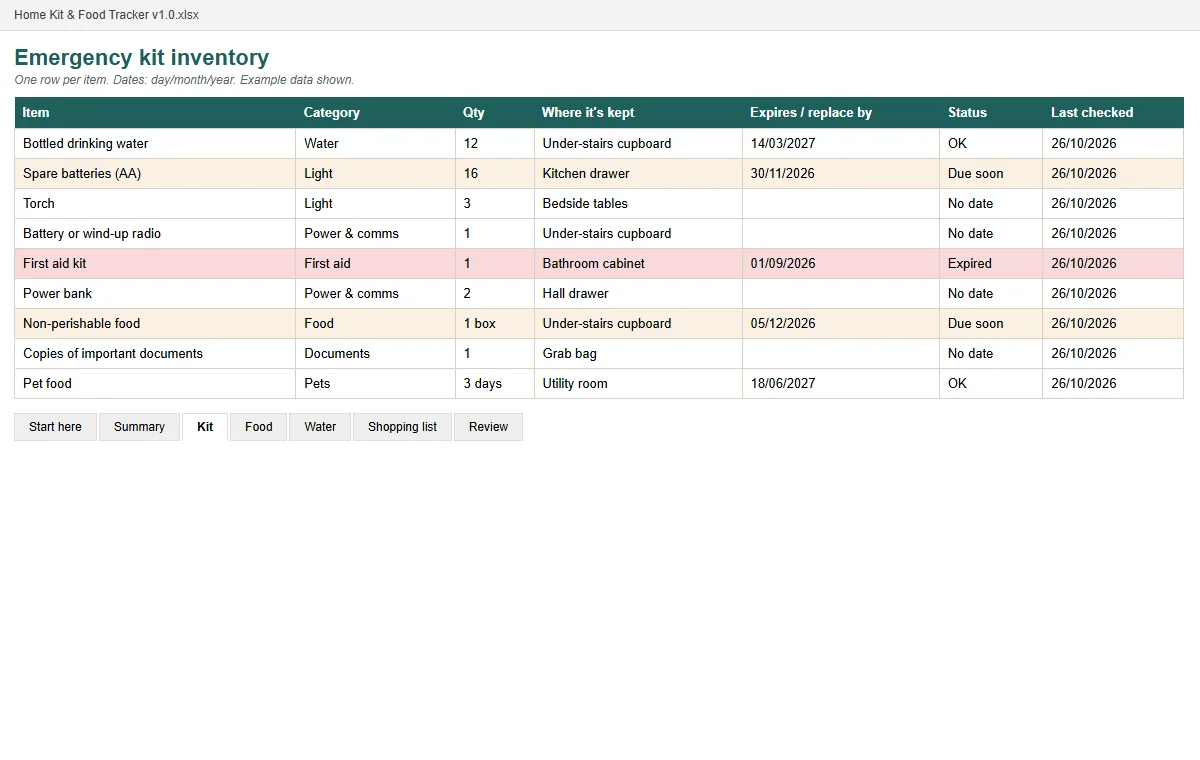 Bundle · £15.97 separatelyPrepared, Not Panicked bundle£9.99
Real pages shown before you buy · instant PDF · one-off price · 30-day refund.
Get the free 72-hour UK household checklist
Tick-box lists for each part of a UK home emergency kit, plus the key numbers on one page. Enter your email and we'll take you straight to the download.
That email address doesn't look right — please check it and try again.
We'll also email you when we publish new guides — occasional, never daily. Unsubscribe any time. See our privacy notice.
Frequently asked questions
Does the UK government recommend two weeks of supplies?
No. The UK's Be Ready campaign recommends being ready for 3 days. Two weeks is an extended, optional plan for households who want extra resilience, built on top of that official baseline.
How much water do I need for two weeks?
Using Be Ready's figure of 3 litres per person per day for drinking, two weeks is 42 litres per person, or 168 litres for a household of four. Be Ready notes more is needed for cooking and washing.
Which countries recommend more than 72 hours?
Sweden and Norway suggest being able to manage on your own for a week, and Germany's BBK suggests food and drink for 10 days. The EU, UK, Denmark, Finland, France and the Netherlands use a 72-hour or 3-day baseline.
Should I stockpile prescription medicines?
Don't over-order prescriptions. Be Ready advises requesting prescriptions up to 5 working days before you need your medicine, and keeping essential medication and medical supplies at home. Ask your GP or pharmacist if you are worried about running short.
How often should I check my emergency supplies?
Be Ready suggests setting a reminder every six months to check expiry dates, swap out items that need replacing and update your kit if your household's needs have changed.
Sources
- GOV.UK Be Ready — Be ready for emergencies
- GOV.UK Be Ready — Be Ready checklist (PDF)
- GOV.UK Be Ready — Water supply interruptions or outages
- European Commission — Preparedness (Preparedness Union Strategy)
- Swedish Civil Defence and Resilience Agency — Home preparedness: prepping for at least a week
- Swedish Civil Defence and Resilience Agency — Access to water during a crisis
- DSB (Norway) — How to contribute to Norway's emergency preparedness
- BBK (Germany) — Stockpiling
- Denk vooruit (Netherlands) — Noodpakket
- Food Standards Agency — Food safety in a power cut: advice for consumers
- Office of Emergency Planning (Ireland) — Be Emergency Ready booklet
- Cabinet Office — National Risk Register 2025 (PDF)