In short: The European Commission's Preparedness Union Strategy (March 2025) commits the EU to guidelines for population self-sufficiency of at least 72 hours. National advice ranges from 3 days (Denmark, the Netherlands, Finland, France) to a week (Sweden, Norway) and 10 days (Germany). 112 is the free emergency number across the EU.
Key facts
- The EU Preparedness Union Strategy includes an action to develop guidelines to reach population self-sufficiency of a minimum of 72 hours. Source
- 112 is the European emergency phone number, available everywhere in the EU, free of charge. Source
- Sweden's guidance says being prepared means being able to manage on your own for at least a week. Source
- Germany's BBK suggests a supply of food and drink to last 10 days, with about 14 litres of liquid per person per week. Source
- Denmark advises households to be able to manage for 3 days, with 3 litres of drinking water per person per day. Source
- The UK's Be Ready campaign says being ready for 3 days helps you manage while support reaches those most in need. Source
 Want this written down for your home? Extended Disruption Plan — printable, £3.99.
If recent news has you worried, it can help to know that governments across Europe are giving their households the same calm, practical message: keep enough at home to look after yourselves for a few days while emergency services help those who need it most. This guide sets out what the EU and individual countries actually say, how long each suggests, and where to read the official advice yourself. Prepared, not panicked.
What did the EU say about 72 hours?
The European Commission's Preparedness Union Strategy, published in March 2025, sets out how the EU plans to get ready for crises ranging from natural disasters and pandemics to cyber attacks and conflict. Under "population preparedness", one of its actions is to develop guidelines to reach population self-sufficiency of a minimum of 72 hours.
Other household-facing actions on the same page include:
- improving early warning systems
- raising awareness of risks and threats, through campaigns and toolkits
- including preparedness in school curricula
- promoting preparedness in youth programmes
The strategy is a framework, not a shopping list. The practical, detailed advice still comes from each country's own civil protection authority, and that advice varies quite a lot.
How long does each country suggest?
| Country | Official guidance | How long they suggest | Link |
|---|---|---|---|
| EU (all member states) | Preparedness Union Strategy, European Commission | At least 72 hours (guidelines being developed) | commission.europa.eu |
| Sweden | "In case of crisis or war" brochure and home preparedness pages, Swedish Civil Defence and Resilience Agency | At least a week | mcf.se |
| Finland | 72-hour recommendation (coordinated by SPEK, funded by the National Emergency Supply Agency); "Preparing for incidents and crises" guide on Suomi.fi | 72 hours | huoltovarmuuskeskus.fi |
| Norway | Self-preparedness advice, DSB | A week | dsb.no |
| Germany | Stockpiling advice and "Planning ahead for crises and disasters" guide, BBK | 10 days of food and drink | bbk.bund.de |
| Netherlands | Denk vooruit campaign, run by the NCTV | The first 72 hours | denkvooruit.nl |
| Ireland | Be Emergency Ready booklet, Office of Emergency Planning | No set period — "some preparation is better than no preparation at all" | Be Emergency Ready booklet |
| France | "Tous responsables : face aux risques, agissons" guide, SGDSN | 72 hours | sports.gouv.fr |
| Denmark | "Forberedt på kriser", Danish authorities | 3 days | borger.dk |
| United Kingdom | Be Ready, GOV.UK | 3 days | beready.campaign.gov.uk |
Country by country: what the advice says
Sweden: at least a week
Sweden's Civil Defence and Resilience Agency (its English guidance, previously at msb.se, now lives at mcf.se) says being prepared means being able to manage on your own for at least a week. It groups the advice into water, food, heat, communication, payments and cash, medicines and pets, and notes that water shortages matter more than food. For regularly prescribed medicines, it suggests having enough at home to last a month.
On water, the agency says to expect an adult to need three to five litres a day for drinking, cooking and basic washing, plus extra for pets.
Its household brochure is called "In case of crisis or war" in English. The agency says this is the fifth version sent to the Swedish public, following editions in 1943, 1952, 1961 and 2018, and you can download or order it in English.
Finland: 72 hours
Finland's long-standing 72-hour recommendation is coordinated by SPEK, the Finnish National Rescue Association, and funded by the National Emergency Supply Agency. In November 2024 the Ministry of the Interior led a new online guide, "Preparing for incidents and crises", published on Suomi.fi in Finnish, Swedish and English, with summaries in 15 languages. SPEK suggests at least 5 litres of bottled water for each member of the household.
Norway: a week
Norway's Directorate for Civil Protection (DSB) says the authorities recommend that as many people as possible are prepared to fend for themselves for a week. Its list includes stored drinking water, shelf-stable food, a way to cook without mains power, warm clothes and sleeping bags, battery, crank or solar torches and a DAB radio, medicines and first aid, power banks, some cash, pet food, and a printed list of important phone numbers.
Germany: 10 days
Germany's Federal Office of Civil Protection and Disaster Assistance (BBK) suggests a supply of food and drink to last 10 days, and about 14 litres of liquid per person for each week. Separately, it recommends a grab-and-go emergency pack with personal medication, first aid supplies, a battery radio, a document folder, food for 2 days and warm clothing, in case you have to leave home.
Netherlands: the first 72 hours
The Dutch Denk vooruit ("Think ahead") campaign is run by the National Coordinator for Counterterrorism and Security (NCTV). It says a noodpakket (emergency kit) helps you through the first 72 hours after a disaster or emergency, and suggests 3 litres of water per person per day. Its list includes a battery radio, a torch, a first aid kit, blankets, a whistle, cash, copies of ID documents and spare keys. It also suggests checking the kit every six months.
Ireland: do what you can
Ireland's Be Emergency Ready booklet, published by the Department of Defence's Office of Emergency Planning, does not set a fixed number of days. It suggests 2 to 3 litres of drinking water per person per day, non-perishable food that you rotate, a battery, wind-up or solar radio, power banks and documents in a waterproof bag. Its message is that some preparation is better than none. It also says the number to dial in an emergency is 112 or 999.
France: 72 hours
France's SGDSN (the General Secretariat for Defence and National Security) published the guide « Tous responsables : face aux risques, agissons » in November 2025. It asks people to learn how to keep themselves and their loved ones self-sufficient for 72 hours, including by putting together an emergency kit.
Denmark: 3 days
Denmark's guidance, written by the Danish Agency for Societal Safety, says your household should be able to manage for 3 days, with 3 litres of drinking water per person per day, food for 3 days, and medicine and first aid supplies.
And the UK?
The UK is not in the EU, but its advice lines up with the 72-hour baseline. GOV.UK's Be Ready campaign says being ready for 3 days helps you manage while support reaches those most in need, with 3 litres of drinking water per person per day. Our 72-hour kit guide turns that into a list, and our UK household plan for people worried about war covers the wider steps.
What's the same everywhere?
Despite the different time periods, the core list is strikingly similar across countries:
- Water — the item every country puts first.
- Food you already eat, that keeps without a fridge and ideally without cooking.
- A battery or wind-up radio, plus a torch and spare batteries.
- Medicines and a first aid kit.
- Some cash, in case card payments fail.
- Warmth — blankets, sleeping bags, warm clothes.
- Paper copies of important numbers and documents.
- Pets — food and water for them too.
If you want to go beyond 72 hours, our guide to two weeks of emergency supplies shows how to build up gradually, and our long blackout guide covers keeping a household going when power and phones are down.
What number do I call in an emergency in Europe?
112 is the European emergency phone number, available everywhere in the EU and free of charge. It works alongside national emergency numbers. In the UK and Ireland, 999 and 112 both work. If you live in or travel to another country, it is worth noting that country's local numbers on your contact sheet too.
Limitations
This page is general information, not professional advice. It summarises official guidance as published when we reviewed it; check each country's official site for the latest version, as advice is updated. Always follow instructions from local authorities and emergency services, and call 112 (or 999 in the UK and Ireland) in an emergency. In the UK, details differ between England, Scotland, Wales and Northern Ireland.
Turn this guide into a written plan
Reading helps. Writing it down is what makes it work when the phones are flat. Start with the free plan builder, or get the full printable version:
For this topicExtended Disruption Plan£3.99 Your whole household planHousehold Emergency Plan Pack£6.99
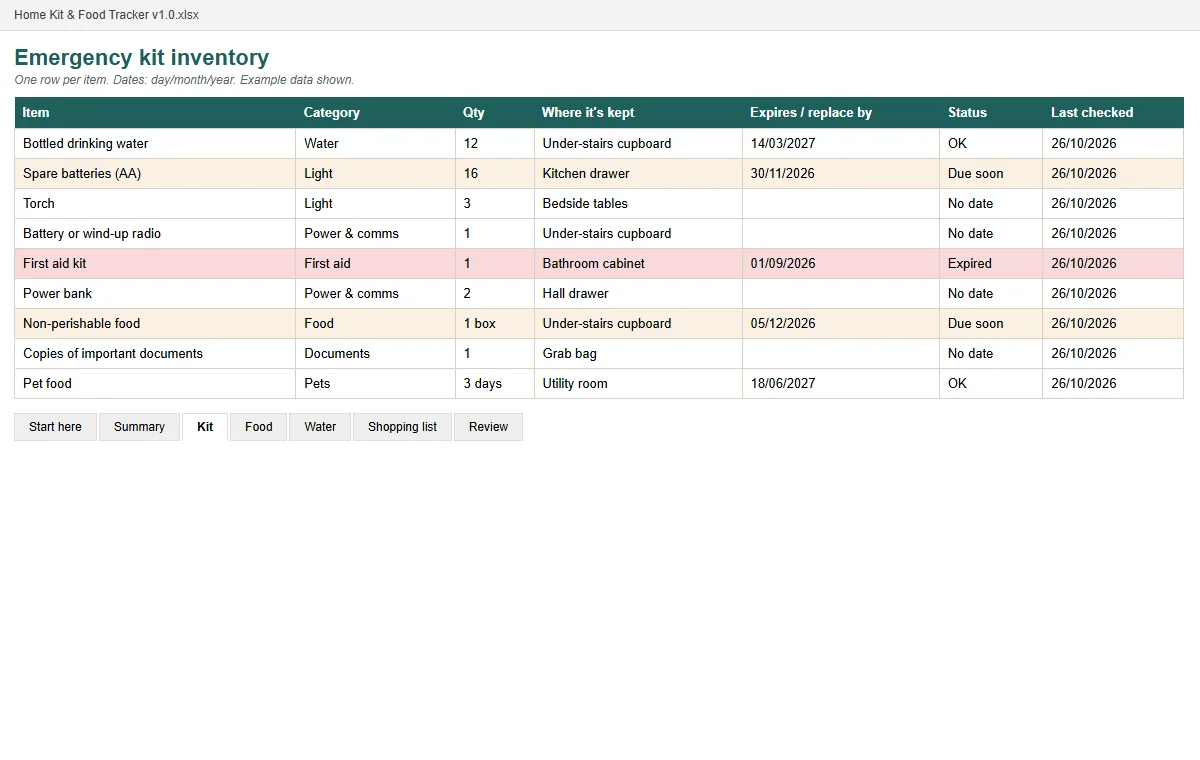 Bundle · £15.97 separatelyPrepared, Not Panicked bundle£9.99
Real pages shown before you buy · instant PDF · one-off price · 30-day refund.
Get the free 72-hour UK household checklist
Tick-box lists for each part of a UK home emergency kit, plus the key numbers on one page. Enter your email and we'll take you straight to the download.
That email address doesn't look right — please check it and try again.
We'll also email you when we publish new guides — occasional, never daily. Unsubscribe any time. See our privacy notice.
Frequently asked questions
Did the EU tell people to keep 72 hours of supplies?
The European Commission's Preparedness Union Strategy, published in March 2025, includes an action to develop guidelines so the population can be self-sufficient for a minimum of 72 hours. Detailed household advice still comes from each country.
Which European country recommends the longest period?
Of the countries in this guide, Germany's BBK suggests the longest: food and drink to last 10 days. Sweden and Norway both suggest being able to manage on your own for a week.
What is Sweden's crisis brochure called?
The English version is called "In case of crisis or war". Sweden's Civil Defence and Resilience Agency says the current brochure is the fifth version sent to the Swedish public, and you can download or order it in English.
Is 112 the emergency number everywhere in Europe?
112 is the European emergency number, free and available everywhere in the EU. It works alongside national numbers. In the UK and Ireland you can call 999 or 112.
How much water do European governments suggest?
Advice varies: Denmark and the Netherlands say 3 litres per person per day, Ireland 2 to 3 litres, Germany about 14 litres per person per week, and Sweden 3 to 5 litres a day for an adult to cover drinking, cooking and basic washing.
Sources
- European Commission — Preparedness (Preparedness Union Strategy)
- European Commission — 112, the European emergency number
- Swedish Civil Defence and Resilience Agency — Home preparedness: prepping for at least a week
- Swedish Civil Defence and Resilience Agency — Access to water during a crisis
- Swedish Civil Defence and Resilience Agency — Download and order the brochure In case of crisis or war
- National Emergency Supply Agency (Finland) — New guide provides instructions on how to prepare for disruptions and crises
- SPEK (Finnish National Rescue Association) — One in two Finnish households have taken self-preparedness measures to cope for 72 hours
- DSB (Norway) — How to contribute to Norway's emergency preparedness
- BBK (Germany) — Stockpiling
- BBK (Germany) — Emergency pack
- Denk vooruit (Netherlands, NCTV) — Noodpakket
- Denk vooruit — Over Denk vooruit
- Office of Emergency Planning (Ireland) — Be Emergency Ready booklet (hosted by South Dublin County Council)
- Ministère des Sports (France) — Guide « Tous responsables : face aux risques, agissons »
- borger.dk (Denmark) — Forberedt på kriser
- GOV.UK Be Ready — Be ready for emergencies