In short: Nobody can tell you whether there will be a war, and this guide doesn't try. What official UK planning does show is that serious disruption, from conflict, cyber attacks or severe weather, would most likely mean losing power, phone signal, card payments or some deliveries for a while. The government's Be Ready advice is to be able to manage for 3 days: water, food, a torch, an FM radio, cash, medicines and copies of documents, plus a plan with your neighbours.
Key facts
- The UK government's Be Ready advice asks households to be ready to manage for 3 days, including 3 litres of bottled drinking water per person per day. Source
- The National Risk Register 2025 covers 89 risks in 9 themes, one of which is 'Conflict and instability'. Its scenarios are planning tools, not predictions. Source
- In the NRR's worst-case scenario for a national power failure, full restoration could take up to 7 days, with knock-on effects on mobile and internet, water, sewage, fuel and gas. Source
- Be Ready recommends keeping a mix of coins and notes in case electronic payments or cash machines aren't working. Source
- The EU's Preparedness Union Strategy (26 March 2025) encourages people to keep essential supplies for a minimum of 72 hours. Source
- The NHS advises being truthful with children about scary news, in a way suitable for their age, rather than trying to block all news. Source
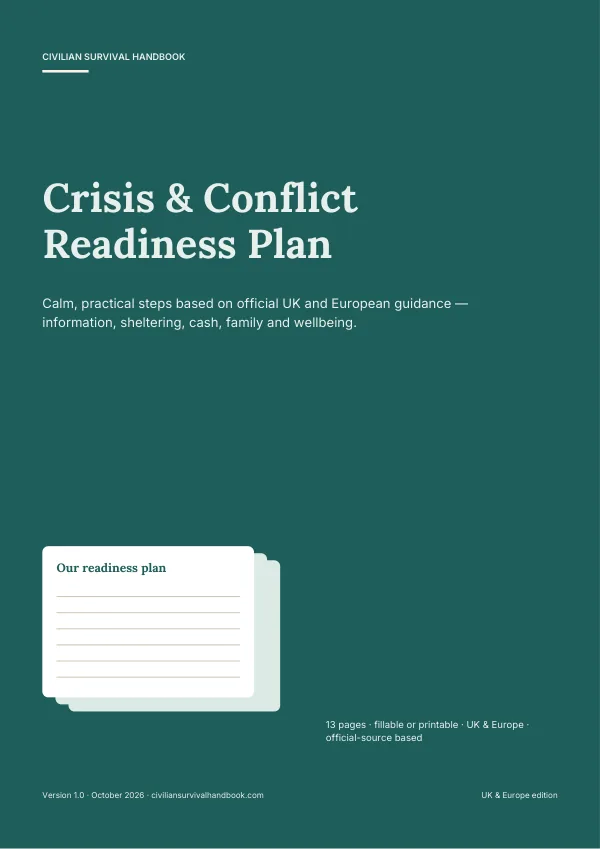 Want this written down for your home? Crisis & Conflict Readiness Plan — printable, £4.99.
If recent news has you worried about war, you're not alone, and it's a reasonable thing to think about. This guide won't tell you whether a conflict is coming. Nobody honest can. Instead it looks at what official UK planning says disruption would most likely mean for an ordinary household, and turns that into a calm, practical plan. Prepared, not panicked.
Why are people asking "will there be a war in the UK?"
Partly because governments are openly asking households to prepare, which is new for many people. That's the official context:
- The UK's Be Ready campaign. The government's public preparedness site, Be Ready, says that "from severe weather to cyber attacks, emergencies can disrupt the services you rely on", and asks households to be ready to manage for 3 days. It was developed by the Cabinet Office with local and national government, responders, voluntary organisations and academics (About Be Ready).
- The National Risk Register. The National Risk Register 2025 (NRR), published by the Cabinet Office on 16 January 2025, covers 89 risks in 9 themes. One theme is "Conflict and instability". Others include cyber attacks and state threats, such as attacks on electricity, gas, fuel or telecoms infrastructure. Each risk has a "reasonable worst-case scenario", and the NRR is clear these are not a prediction of what is most likely to happen. They exist so planners can prepare.
- European governments. The European Commission's Preparedness Union Strategy, launched on 26 March 2025, encourages people to keep essential supplies for a minimum of 72 hours. Sweden's civil defence agency publishes a brochure called In case of crisis or war and advises households to plan for at least a week. Finland's national guide, published in November 2024, covers long power, water and telecoms outages as well as longer crises such as pandemics or military conflicts (National Emergency Supply Agency).
The common thread is that the same simple steps help whatever the cause, whether that's a storm, a cyber attack or something bigger. For a country-by-country comparison, see our Europe 72-hour preparedness guide.
What would disruption from conflict actually mean for a household?
The NRR's conflict and infrastructure scenarios mostly describe knock-on effects on everyday services. Here is what they say, in household terms.
| Service | What the NRR planning scenarios describe | What it means at home |
|---|---|---|
| Power | A worst-case national grid failure would cut mains power "instantaneously and without warning". Full restoration could take up to 7 days. After an attack on electricity infrastructure, most customers would be reconnected within 24 hours, though remote areas could take weeks. | Lighting, heating, cooking, fridges, phone charging and some medical equipment |
| Phones and internet | A national power failure would also hit mobile and internet services. In a regional loss of all communications, people affected couldn't call 999/112 until mobile masts got backup generators. | You may not be able to call, text or get online for a while |
| Water | The power failure scenario lists knock-on effects on water and sewage. | Bottled water matters |
| Payments | A worst-case cyber attack on a retail bank could take its systems offline for at least 2 days, hitting hardest those with only one bank account. Damage to transatlantic data cables could disrupt payment systems. | Cards and apps may not work. Cash helps. |
| Supplies | The conflict scenarios describe disruption to supply chains and to fuel (gas and oil), and global economic instability. | Some goods may be scarce or cost more for a while |
Source: National Risk Register 2025 (PDF). For more on long outages, see our guide to a long blackout or cyber attack.
How to prepare: start with 72 hours
Be Ready's household advice is the best UK starting point. In summary:
- Water: bottled water for 3 days, 3 litres per person per day for drinking, plus more for cooking and washing.
- Food: 3 days of non-perishable food that needs no fridge or cooking. Be Ready says "it's best to buy food you'd usually eat".
- Light and warmth: a torch and spare batteries ("torches are safer than candles"), blankets, sleeping bags and warm clothes.
- Information: a battery or wind-up FM radio, with station frequencies written down, and a charged power bank.
- Money: a mix of coins and notes, in case card payments or cash machines fail.
- Medicines: essential medication and a first aid kit. Order repeat prescriptions in good time. Be Ready says up to 5 working days before you need them.
- Documents: printed copies of IDs and key documents, plus a written list of contacts, medications and doses.
- Babies and pets: ready-to-feed formula (you may not be able to boil water), nappies, pet food and water.
Our 72-hour kit guide goes through each item.
Going further: from 72 hours towards two weeks
The UK asks for 3 days. Sweden asks for at least a week, and calls 72 hours "better than nothing". If you'd like more of a buffer, there's nothing wrong with gradually building up more of the same basics: water, food you already eat, medicines, and ways to keep warm and informed. Our two weeks of supplies guide shows how to do that sensibly. The key word is gradually.
Where to get information you can trust
In a real emergency, information matters as much as supplies.
- Emergency Alerts. The government's Emergency Alerts service warns about life-threatening emergencies nearby. Your phone may make a loud siren-like sound for about 10 seconds, even on silent. The service never asks for personal details. See our Emergency Alerts guide.
- Local radio. The NRR says people affected by an incident may be asked to "go in, stay in and tune in" to local radio or check official sources online. A battery or wind-up FM radio still works when the power and mobile networks don't.
- Official websites. GOV.UK, your council, and in Scotland Ready Scotland. In Northern Ireland, nidirect.
The NRR also warns that online information can be "misleading and inaccurate, making it harmful to share". Before forwarding something alarming, check it against an official source.
Your neighbours are part of the plan
Be Ready suggests swapping contact details with neighbours, setting up a street or building group chat, and planning to check on anyone who needs extra support, especially if the power goes out. If you or someone you care for relies on electricity for medical equipment, check whether you can join the Priority Services Register. In Northern Ireland it's called the Customer Care Register.
How to talk to children about war on the news
Children pick up on worried adults and frightening headlines. The NHS (citing the Mental Health Foundation) suggests that you:
- don't try to block all news, which is unlikely to work and can increase fears
- are truthful about what has happened, in a way suitable for their age
- tell them it's normal to be concerned, and that you're concerned too
- encourage questions
- reassure them you'll do everything you can to keep them safe
Practical preparation can help too. Be Ready suggests teaching children when to call for help, their home address and a parent's phone number. Children and young people can talk to Childline free on 0800 1111.
What not to do
- Don't panic buy. The Be Ready checklist says you don't need to do it all at once. Pick up an extra item or two on normal shopping trips to spread the cost. Panic buying empties shelves for people who need things now.
- Don't share unverified claims. Forwarding rumours spreads anxiety. Stick to official sources.
- Don't rush out to buy expensive kit. The basics on this page do most of the work, and you probably own some already.
- Don't let it take over. Make the plan, put the kit away, set a six-monthly reminder to check expiry dates, then get on with life.
Limitations
This page is general information, not professional, legal or security advice. It doesn't assess the likelihood of any conflict. In an emergency, follow instructions from the emergency services and government, and call 999 if someone is in immediate danger. Arrangements differ across England, Scotland, Wales and Northern Ireland, so check Ready Scotland, nidirect or your local council for local details.
Turn this guide into a written plan
Reading helps. Writing it down is what makes it work when the phones are flat. Start with the free plan builder, or get the full printable version:
For this topicCrisis & Conflict Readiness Plan£4.99 Your whole household planHousehold Emergency Plan Pack£6.99
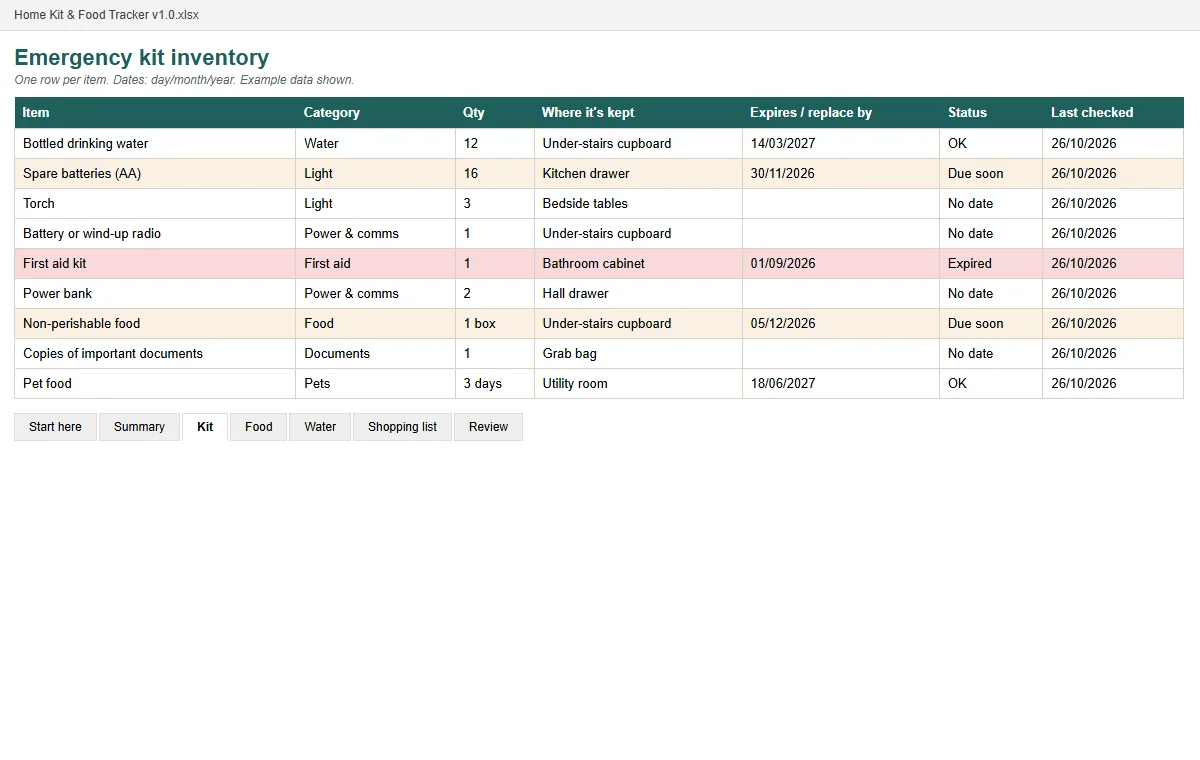 Bundle · £15.97 separatelyPrepared, Not Panicked bundle£9.99
Real pages shown before you buy · instant PDF · one-off price · 30-day refund.
Get the free 72-hour UK household checklist
Tick-box lists for each part of a UK home emergency kit, plus the key numbers on one page. Enter your email and we'll take you straight to the download.
That email address doesn't look right — please check it and try again.
We'll also email you when we publish new guides — occasional, never daily. Unsubscribe any time. See our privacy notice.
Frequently asked questions
Will there be a war in the UK?
We can't answer that, and neither can anyone selling fear. The government's National Risk Register sets out worst-case planning scenarios so organisations can prepare, and it says these are not predictions. What households can do is prepare for disruption in general.
How do I prepare for war in the UK?
Prepare for disruption rather than for a specific event: be able to manage for 3 days without power, shops or card payments, as Be Ready suggests. That means water, food that needs no cooking, a torch, a battery or wind-up FM radio, cash, medicines, copies of documents and a household plan.
Why are governments telling people to prepare?
Several governments now publish household preparedness advice. The UK has Be Ready, the EU's Preparedness Union Strategy encourages 72 hours of supplies, Sweden asks households to plan for at least a week, and Finland publishes a national preparedness guide that covers situations including military conflict.
Should I stockpile food in case of war?
No need to bulk-buy. The Be Ready checklist says you don't need to do it all at once: build up gradually, pick up an extra item or two on normal shopping trips, and buy food you'd usually eat.
Where would I get reliable information in a crisis?
From official sources: Emergency Alerts on your phone, local radio, GOV.UK and your council. The National Risk Register warns that some information online can be misleading and harmful to share.
How do I talk to my child about war on the news?
The NHS suggests being truthful in an age-appropriate way, saying it's normal to be concerned, inviting questions and reassuring them you'll do everything you can to keep them safe. Children can also call Childline free on 0800 1111.
Sources
- GOV.UK — Be Ready
- GOV.UK — Be Ready: be ready for emergencies
- GOV.UK — Be Ready checklist (PDF)
- GOV.UK — About Be Ready and UK resilience
- Cabinet Office — National Risk Register 2025
- Cabinet Office — National Risk Register 2025 (PDF)
- GOV.UK — Emergency Alerts
- European Commission — EU Preparedness Union Strategy (26 March 2025)
- Swedish Civil Defence and Resilience Agency — In case of crisis or war
- Swedish Civil Defence and Resilience Agency — Basics of home emergency preparedness
- National Emergency Supply Agency (Finland) — New guide on preparing for disruptions and crises
- NHS — Talking to your child about feelings
- nidirect — Be ready for emergencies
- Scottish Government — Ready Scotland