In short: The UK National Risk Register plans for a total failure of Great Britain's electricity transmission system, with most demand back within a few days and full restoration taking up to 7 days. Prepare by keeping 3 days of water (3 litres per person per day), cash, a battery or wind-up FM radio, a torch, warm layers and paper copies of key numbers.
Free tool: make your household emergency plan in about 10 minutes — your power network from your postcode, contacts, meeting points and a kit list, printed on one page. Works offline.
Key facts
- The National Risk Register 2025 includes 'Failure of the National Electricity Transmission System (NETS)' and 'Cyber attack: electricity infrastructure' as risk scenarios. Source
- In the national power failure scenario, a significant proportion of demand is reconnected within a few days and full restoration could take up to 7 days. Source
- On 28 April 2025 at 12:33 CEST, the power systems of continental Spain and Portugal experienced a total blackout. Source
- Gas ovens, boilers, heat pumps and home internet won't work without power. Source
- A fridge should stay cold for up to 4 hours; a full freezer should keep food frozen for up to 48 hours (24 hours if half full). Source
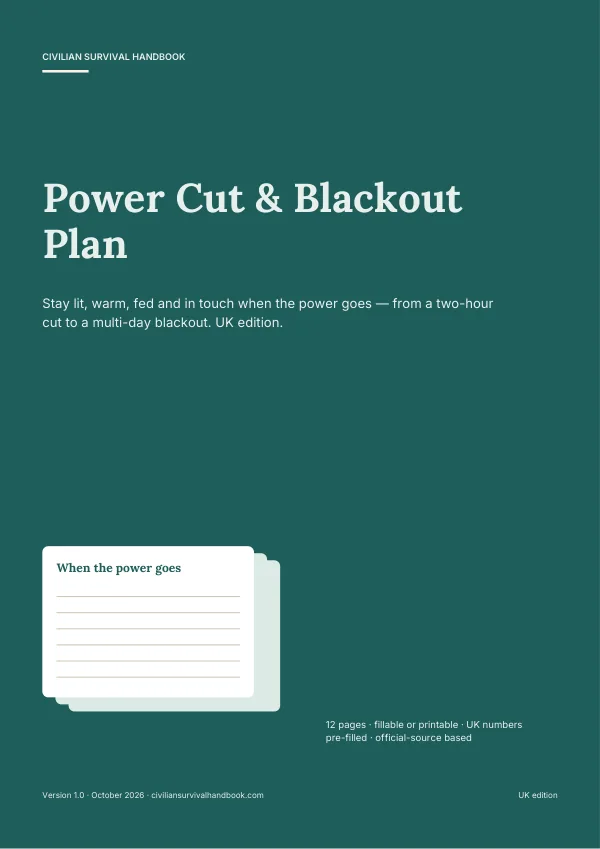 Want this written down for your home? Power Cut & Blackout Plan — printable, £4.99.
If recent news about cyber attacks or Europe's big blackout has you wondering what would happen if the lights went out for days, you are not alone, and the good news is that the government has already thought it through. This guide uses the UK's own planning scenarios to show what a long outage could look like and the simple, practical steps that keep a household going. Prepared, not panicked.
What does the UK actually plan for?
The government's National Risk Register 2025, published in January 2025, sets out the "reasonable worst-case" scenarios that emergency planners prepare for. Several are about power and digital systems:
- Failure of the National Electricity Transmission System (NETS) — a total failure of the system that carries electricity across Great Britain, causing a nationwide loss of power.
- Regional failure of the electricity network — a major failure across several regions, most likely from extreme weather.
- Cyber attack: electricity infrastructure — a malicious cyber attack leading to a total failure of the NETS.
- Simultaneous loss of all fixed and mobile forms of communication — landlines, broadband and mobiles all down in one region, for example after a severe storm.
- Cyber attack: UK retail bank, and other cyber scenarios covering gas, fuel, transport, telecoms and health systems.
These are planning tools, not predictions. The register itself says Great Britain has never experienced a nationwide loss of power, the likelihood is low, and GB has one of the most reliable energy systems in the world.
How long would a national power failure last?
For the national failure scenario, the register assumes the event happens in winter, when demand is high, and that power is lost instantly and without warning for anyone without a backup generator. It describes recovery like this:
| Time after failure | Planning assumption (NRR 2025) |
|---|---|
| Within a few hours | Small pockets of customers gradually reconnected, with intermittent supply |
| Within a few days | A significant proportion of demand reconnected, forming a stable "skeletal network" |
| Up to 7 days | Full restoration |
| Possibly months | Restoration of some critical services, depending on the cause and damage |
The register notes that a nationwide loss of power would have knock-on effects on mobile and internet services, water, sewage, fuel and gas. For the cyber version of the scenario, it says recovery could take longer than expected, depending on the sophistication of the attack.
For a regional failure, it expects most customers to be reconnected in stages within hours, but says it could take several weeks to restore everyone when damage is widespread or in remote areas.
The NETS covers Great Britain. Northern Ireland has its own network, run by NIE Networks; see our NIE Networks power cut page.
What happened in Spain and Portugal in April 2025?
According to ENTSO-E, the European network of electricity transmission operators, at 12:33 CEST on 28 April 2025 the power systems of continental Spain and Portugal experienced a total blackout. A small area of south-west France near the Spanish border was briefly affected. ENTSO-E's expert panel published its final report on 20 March 2026 and found the blackout resulted from many interacting factors, including oscillations and gaps in voltage control.
Spain's grid operator, Red Eléctrica, said that by 7:00 the next morning, 99.95% of demand had been restored. The lesson for households is simple: even a large, modern grid can fail suddenly, and the first day is when your own supplies matter most.
What stops working when the power goes?
Electricity sits underneath most of daily life. In a long outage, expect knock-on effects:
- Heating and cooking. Be Ready says gas ovens, boilers, heat pumps and your home internet won't work without power.
- Card payments and cash machines. Be Ready advises keeping a small amount of cash in case electronic payments or ATMs are disrupted.
- Phones and internet. Broadband needs power at your home. Mobile networks can go down as well.
- Water. Mains water may be disrupted during and after a power cut.
- Fridges and freezers. Food starts to warm up within hours.
How do I keep my household going?
Keep some cash at home
Be Ready suggests a mix of coins, notes and cards, with the amount depending on your household's essential needs. Think about what you would need for a few days of food, fuel or a taxi to a relative.
Have a radio and a paper plan
If phones and the internet are down, a battery or wind-up FM radio is how you hear official updates. Be Ready suggests writing down the frequencies of the national or local stations you rely on. See our wind-up radio guide.
Phones also hold most people's contacts. Write important numbers on paper: family, GP, pharmacy, your electricity network operator (105 in England, Scotland and Wales; 03457 643643 in Northern Ireland), your water company and your insurer. Our household emergency plan has a template.
On landlines, Be Ready says a corded landline may still work in a power cut, but check with your provider. If yours won't, your provider might offer a free backup battery unit lasting at least an hour so you can still reach emergency services. Keep a power bank charged for your mobile.
Store water
Be Ready recommends 3 litres of drinking water per person per day for 3 days, plus extra for baby formula, medical devices and pets, and says bottled water is the safest way to prepare. If you are on your water company's Priority Services Register, it will arrange alternative supplies for you. More in our water guide.
Stay warm safely
With no heating, use blankets, sleeping bags and layered clothing, close curtains and keep the doors of unused rooms shut. Be Ready says torches are safer than candles. The Food Standards Agency notes that most camping stoves and barbecues are designed for outdoor use only, so check the manufacturer's instructions, and read our carbon monoxide guide before using any fuel-burning appliance.
Manage the fridge and freezer
The Food Standards Agency says a fridge should stay cold for up to 4 hours, and a freezer should keep food frozen for up to 48 hours if full, or 24 hours if half full. These are estimates and vary by appliance.
- Keep fridge and freezer doors closed as much as possible.
- If chilled food reaches 8°C or above, eat food that needs refrigeration within 4 hours, or throw it away.
- Eat in this order: fridge food first, then defrosted frozen food that doesn't need cooking, then other perishables, then tins, jars and dried food.
A long-outage checklist
- Bottled water: 3 litres per person per day, for at least 3 days
- Food that needs no fridge and ideally no cooking
- Battery or wind-up FM radio, with station frequencies written down
- Torch and spare batteries (not candles)
- Charged power banks; backup batteries for any medical equipment
- Cash: a mix of coins and notes
- Paper list of key numbers, including 105 or 03457 643643 (NI)
- Blankets, sleeping bags and warm layers
- Essential medicines and a first aid kit
- Pet food and water
- Sign up to the Priority Services Register if someone in your home relies on power or needs extra help
If someone in your home uses powered medical equipment, register for the Priority Services Register and talk to your clinical team about a backup plan. For building beyond three days, see two weeks of emergency supplies and our main power cuts guide.
What about a cyber attack on my own accounts?
Large-scale attacks on infrastructure are for government and industry to handle. What you can do is protect your own accounts and data. Be Ready's cyber advice recommends passkeys or strong unique passwords with 2-step verification, automatic updates, and backing up important files and photos. If you think you have been a victim of cyber crime, contact Report Fraud on 0300 123 2040.
Limitations
This page is general information, not professional advice. National Risk Register scenarios are planning assumptions, not forecasts. In an emergency, follow official instructions and call 999 (or 112) if life is in danger. Arrangements differ across the UK: power cut numbers, networks and some services are different in Northern Ireland, Scotland and Wales.
Turn this guide into a written plan
Reading helps. Writing it down is what makes it work when the phones are flat. Start with the free plan builder, or get the full printable version:
For this topicPower Cut & Blackout Plan£4.99 Your whole household planHousehold Emergency Plan Pack£6.99
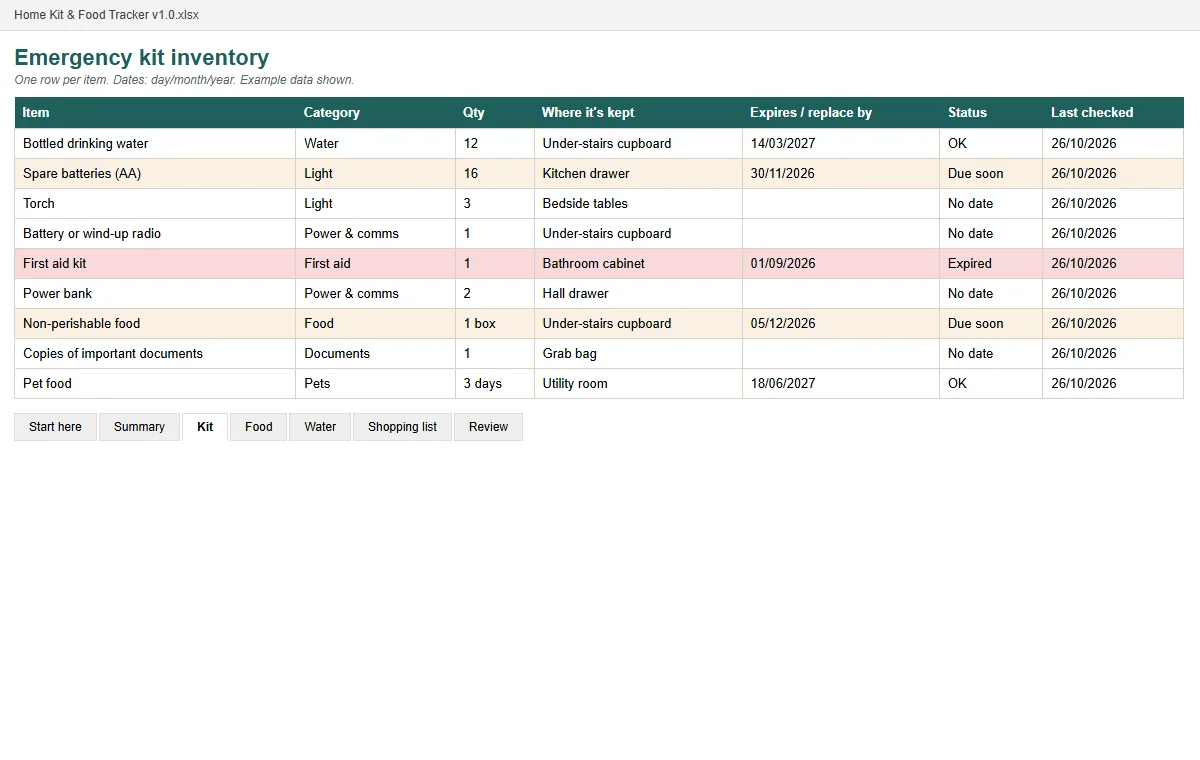 Bundle · £15.97 separatelyPrepared, Not Panicked bundle£9.99
Real pages shown before you buy · instant PDF · one-off price · 30-day refund.
The Power Cut Card for your fridge
Who to call, what to switch off, how long the fridge and freezer stay cold, and how to keep warm. One calm page from official UK advice. Enter your email and we'll take you straight to the download.
We'll also email you when we publish new guides — occasional, never daily. Unsubscribe any time. See our privacy notice.
Frequently asked questions
How long would a national blackout last in the UK?
Great Britain has never had a nationwide loss of power. The National Risk Register's planning scenario expects small pockets reconnected within hours, a significant proportion of demand within a few days, and full restoration taking up to 7 days, though some critical services could take much longer.
Will my gas boiler work in a power cut?
Usually not. Be Ready says gas ovens, boilers, heat pumps and home internet won't work without power, so plan to keep warm with blankets, layers and by staying in one room.
Will my landline work in a power cut?
A corded landline may still work, but check with your provider. If yours won't, Be Ready says your provider might offer a free backup battery unit lasting at least an hour so you can still reach emergency services.
How long does food in the freezer last without power?
The Food Standards Agency says a full freezer should keep food frozen for up to 48 hours, or 24 hours if half full, and a fridge should stay cold for up to 4 hours. Keep the doors closed as much as possible.
Should I keep cash at home?
Be Ready suggests keeping a small amount of cash, a mix of coins and notes, in case electronic payments or ATMs are disrupted. How much depends on your household's essential needs.
Sources
- GOV.UK — National Risk Register 2025
- Cabinet Office — National Risk Register 2025 (PDF)
- ENTSO-E — 28 April 2025 Iberian blackout
- Red Eléctrica — Red Eléctrica's response to the incident of 28 April
- GOV.UK Be Ready — Power cuts
- GOV.UK Be Ready — Water supply interruptions or outages
- GOV.UK Be Ready — Cyber
- GOV.UK Be Ready — Be ready for emergencies
- Food Standards Agency — Food safety in a power cut: advice for consumers