In short: Message in a Bottle is a Lions Clubs scheme. You fill in a form with your personal and medical details and keep it in a bottle in the fridge. Green cross stickers on the fridge door and inside the front door tell emergency services where to look. Lions Clubs British Isles says the bottle and forms are free.
Key facts
- Lions Clubs British Isles says the scheme encourages people to keep basic personal and medical details on a standard form in a common place: the fridge. Source
- Each bottle holds a form and two green cross stickers. One sticker goes on the fridge door and the other on the inside of the front door. Source
- If you go to hospital, the form goes with you and is handed to staff on arrival. Source
- Lions says the bottle and forms are free to the user. Many local Lions Clubs give bottles away; if you order from Lions National Headquarters you pay for postage. Source
- If two people live in the home, each fills in a form and both go in the same bottle. Source
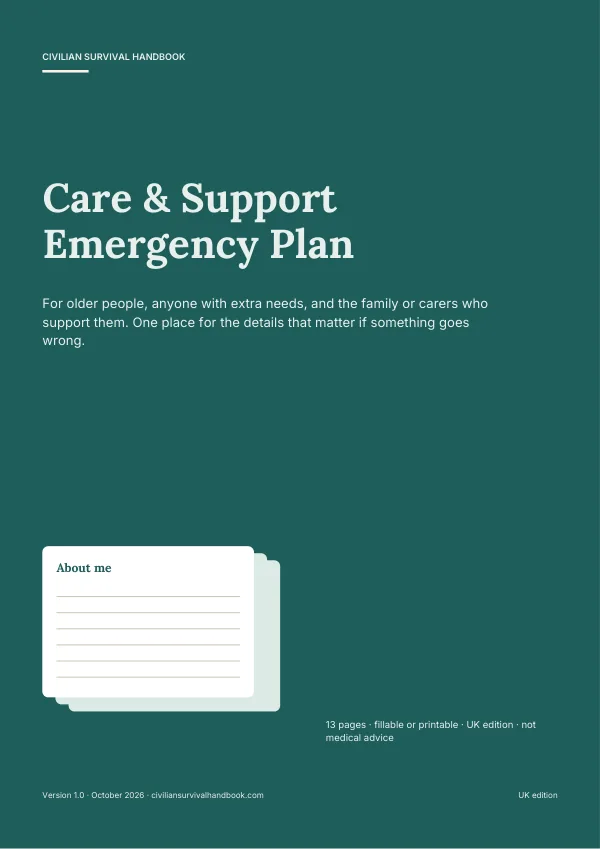 Want this written down for your home? Care & Support Emergency Plan — printable, £4.99.
Message in a Bottle is a simple idea: your key medical details, written on one form, kept in a bottle in the one place almost every home has, the fridge. If paramedics, police or firefighters ever need to come in, a green sticker tells them where to look. The scheme is run by Lions Clubs British Isles. This page explains how it works, using only what the Lions' own pages say. It sits with our household plan guides.
How the scheme works
According to the Lions How it works page:
- You get a bottle. Each one holds a pre-printed form and two green cross stickers.
- You fill in the form with details that identify you, basic medical information, emergency contact numbers and any allergies.
- The form goes in the bottle, and the bottle goes in the fridge.
- One sticker goes on the fridge door and the other on the inside of the front door.
- Emergency services see the sticker and know to look in the fridge, so they don't have to search the house.
- If you go to hospital, the form goes with you and is handed to staff when you arrive.
If two people live in the home, Lions says each fills in a form, and both forms go in the same bottle.
Who it is for
Lions describes the scheme as useful for people with conditions such as diabetes, allergies, disabilities and life-threatening illnesses. It is also a good fit for anyone who lives alone, or an older parent whose details family members can't always give from memory.
How to get one, and the cost
- Ask your local Lions Club. Lions says many local clubs give bottles to the public at no cost, and some supply GP surgeries, health centres and chemists.
- Order online. The Lions Message in a Bottle website has an order link that goes to its contact page.
- Cost. Lions says the bottle and forms are free to the user. Its FAQ says that if you order directly from Lions National Headquarters, you pay for postage.
Keeping it up to date
A form is only useful if it is right. Lions says you can download and print a new form from its website. A good habit is to check it whenever a medicine changes, and at the same time as your smoke alarm test.
Your Message in a Bottle checklist
- Get a bottle from your local Lions Club or the Lions website
- Fill in the form: identity, medical details, allergies, emergency contacts
- Put the bottle in the fridge, somewhere easy to see
- Sticker on the fridge door
- Sticker on the inside of the front door
- Add a reminder to check the form when medicines change
- Tell family or carers that you have one
How it fits with the rest of your plan
Message in a Bottle covers what responders need at home. It works well alongside an ICE card in a wallet or bag, an emergency contacts list, and a fuller written plan. Our guide for older people and carers shows how the pieces fit together.
Limitations
This page summarises the Lions Clubs British Isles scheme pages as they read on 30 October 2026. We are not part of the scheme. Check the Lions website or your local club for the latest details. A form in the fridge does not replace calling 999 in an emergency.
Turn this guide into a written plan
Reading helps. Writing it down is what makes it work when the phones are flat. Start with the free plan builder, or get the full printable version:
For this topicCare & Support Emergency Plan£4.99 Your whole household planHousehold Emergency Plan Pack£6.99
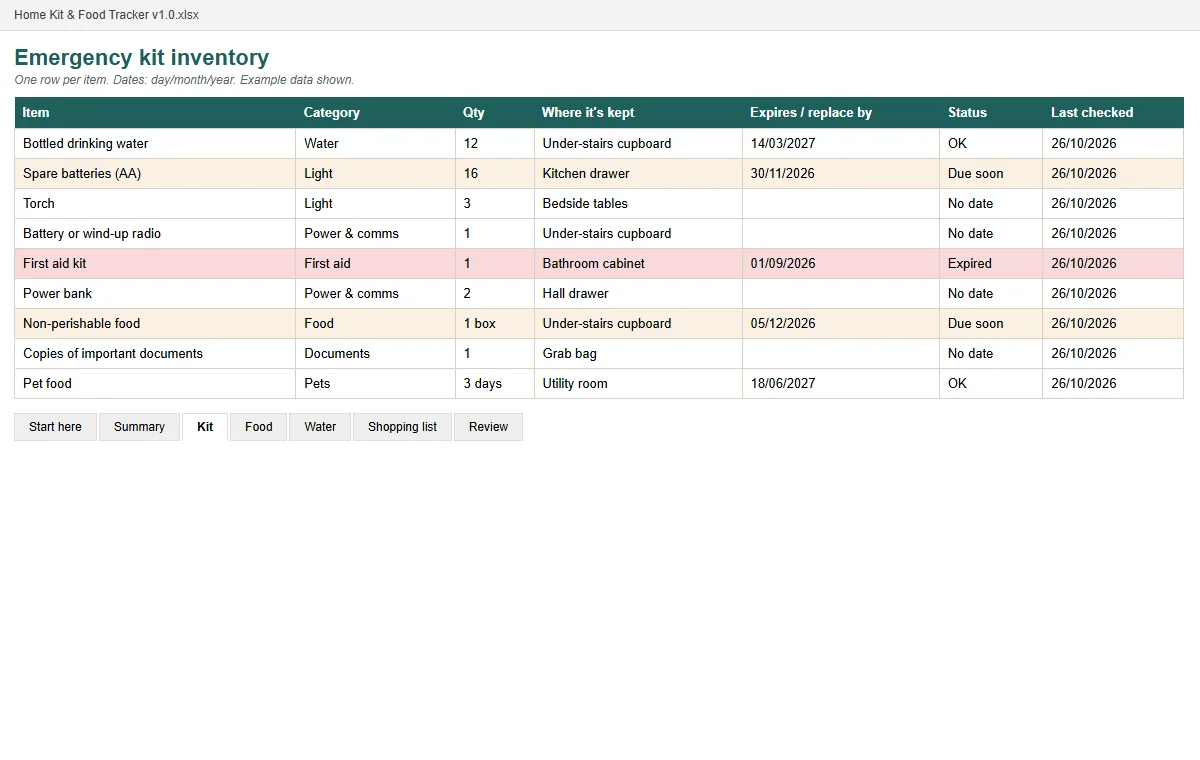 Bundle · £15.97 separatelyPrepared, Not Panicked bundle£9.99
Real pages shown before you buy · instant PDF · one-off price · 30-day refund.
Get the free 72-hour UK household checklist
Tick-box lists for each part of a UK home emergency kit, plus the key numbers on one page. Enter your email and we'll take you straight to the download.
That email address doesn't look right — please check it and try again.
We'll also email you when we publish new guides — occasional, never daily. Unsubscribe any time. See our privacy notice.
Frequently asked questions
What is the Message in a Bottle scheme?
It's a Lions Clubs scheme for keeping your basic personal and medical details on a standard form in a bottle in the fridge, so emergency services can find them quickly.
Where do the Message in a Bottle stickers go?
Lions says one green cross sticker goes on the fridge door and the other on the inside of the front door.
How do I get a Message in a Bottle?
Ask your local Lions Club, or order through the Lions Message in a Bottle website. Lions says many local clubs give bottles away; ordering from the national headquarters means paying postage.
How do I update my form?
Lions says you can download and print a new two-page form from its website. Put the new form in the bottle and remove the old one.
Sources
- Lions Clubs British Isles: Message in a Bottle, How it works (checked 30 Oct 2026)
- Lions Clubs British Isles: Message in a Bottle, FAQs (checked 30 Oct 2026)
- Lions Clubs British Isles: Message in a Bottle home page (checked 30 Oct 2026)