In short: For a UK home, the most useful survival handbook is not a wilderness book. The SAS Survival Handbook by John 'Lofty' Wiseman covers kit, navigation, finding food and first aid outdoors; the Worst-Case Scenario Survival Handbook is a light-hearted guide to unlikely emergencies. For power cuts, storms and floods at home, start with the free GOV.UK Be Ready checklist (be ready for 3 days) and write a household plan with UK numbers such as 105 for power cuts.
Key facts
- The publisher describes the SAS Survival Handbook as covering preparation and kit, navigation, food and health, safety and security, and disaster survival such as flash floods and fast-moving fires, with urban survival tips added. Source
- Chronicle Books lists The NEW Worst-Case Scenario Survival Handbook (20th anniversary edition) as a 328-page hardcover published on 30 April 2019. Source
- The government's Be Ready checklist asks households to be ready for 3 days, including 3 litres of bottled drinking water per person per day. Source
- In the 2026 UK public survey, 14% of people said their household had a written emergency plan. Source
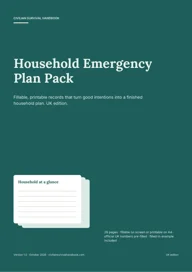 Want this written down for your home? Household Emergency Plan Pack — printable, £6.99.
People searching for a "survival handbook" usually picture the classic SAS book: shelters, snares, signal fires. That's a good read, but most UK emergencies happen at home — a power cut, a storm, a flood, the water going off — and a wilderness manual doesn't cover the things you actually need then. This page compares the best-known survival handbooks with what a UK household needs. We have not tested or reviewed these books in depth; descriptions come from the publishers' own pages, read on 31 October 2026. We don't earn anything from any book on this page.
The short answer
| If you want... | Best fit | Cost |
|---|---|---|
| Outdoor, travel and wilderness skills | SAS Survival Handbook (John 'Lofty' Wiseman) | Paperback; pocket Collins Gem edition too |
| A fun, illustrated read about unlikely emergencies | The NEW Worst-Case Scenario Survival Handbook | Hardcover, 328 pages |
| The official UK checklist for home emergencies | GOV.UK Be Ready | Free |
| Your own household's plan, written down | Our free plan builder, or the printable Household Emergency Plan Pack | Free / £6.99 |
The SAS Survival Handbook
Written by John 'Lofty' Wiseman. His publisher, William Collins, says he was the youngest person to pass SAS selection, at 18, and went on to be the SAS's Chief Survival Instructor. The current paperback (ISBN 978-0-00-759586-0) is described as covering:
- preparation and survival kit
- navigation
- food and health, including first aid
- safety and security
- disaster survival, such as flash floods and fast-moving fires
The publisher says it adds urban survival tips to the original handbook. There is also a pocket version, the Collins Gem SAS Survival Guide.
Good for: walkers, campers, travellers and anyone who enjoys bushcraft. Not built for: a UK home in a power cut. It isn't organised around UK services, so it won't give you 105, Floodline or the Priority Services Register.
The Worst-Case Scenario Survival Handbook
By Joshua Piven and David Borgenicht. Chronicle Books lists the 20th anniversary edition as a 328-page hardcover from April 2019, an illustrated step-by-step guide written with humour. Its scenarios range from extreme weather and a flu outbreak to escaping quicksand and landing a plane.
Good for: a gift or a light read. Not built for: planning — it's a book of one-off situations, not a household checklist.
What a UK home actually needs
The UK government's Be Ready campaign asks households to be ready for 3 days of disruption. Its checklist includes 3 litres of bottled drinking water per person per day, a torch, a battery or wind-up FM radio, a power bank, cash, copies of documents, medicines, and food that keeps. It's free, and it's the best place to start. Our Be Ready checklist guide explains each item.
What no book can give you is your own household's details. In the 2026 UK public survey, 14% of people said their household had a written emergency plan. A useful home "handbook" is one page or a short binder with:
- UK numbers: 999; 105 for a power cut in England, Scotland and Wales (Ofgem); 0800 111 999 for a gas emergency in Great Britain, 0800 002 001 in Northern Ireland (HSE); Floodline 0345 988 1188 (GOV.UK).
- Where things are: stopcock, fuse box, gas meter — see how to turn off gas, electricity and water.
- People: who checks on whom, a meeting point, and an out-of-area contact — our emergency contacts template helps.
- Health: medicines, doses, and anyone who needs extra help — consider the Priority Services Register.
- Kit: a 3-day list based on Be Ready — see the UK emergency kit checklist.
Our own handbooks (so you can judge)
We're an independent UK site, not linked to the government. Our free plan builder makes a one-page household plan in about 10 minutes, with nothing to sign up for. The Household Emergency Plan Pack (£6.99) is a printable set of fill-in pages for the whole household — you can see every page before you buy. We also sell a short reference handbook on the principles of getting through disruption; it isn't UK-specific, so for UK numbers and services use the guides above.
If you love the SAS book, keep it on the shelf. Just make sure the plan for your own home is written down too.
Turn this guide into a written plan
Reading helps. Writing it down is what makes it work when the phones are flat. Start with the free plan builder, or get the full printable version:
Your whole household planHousehold Emergency Plan Pack£6.99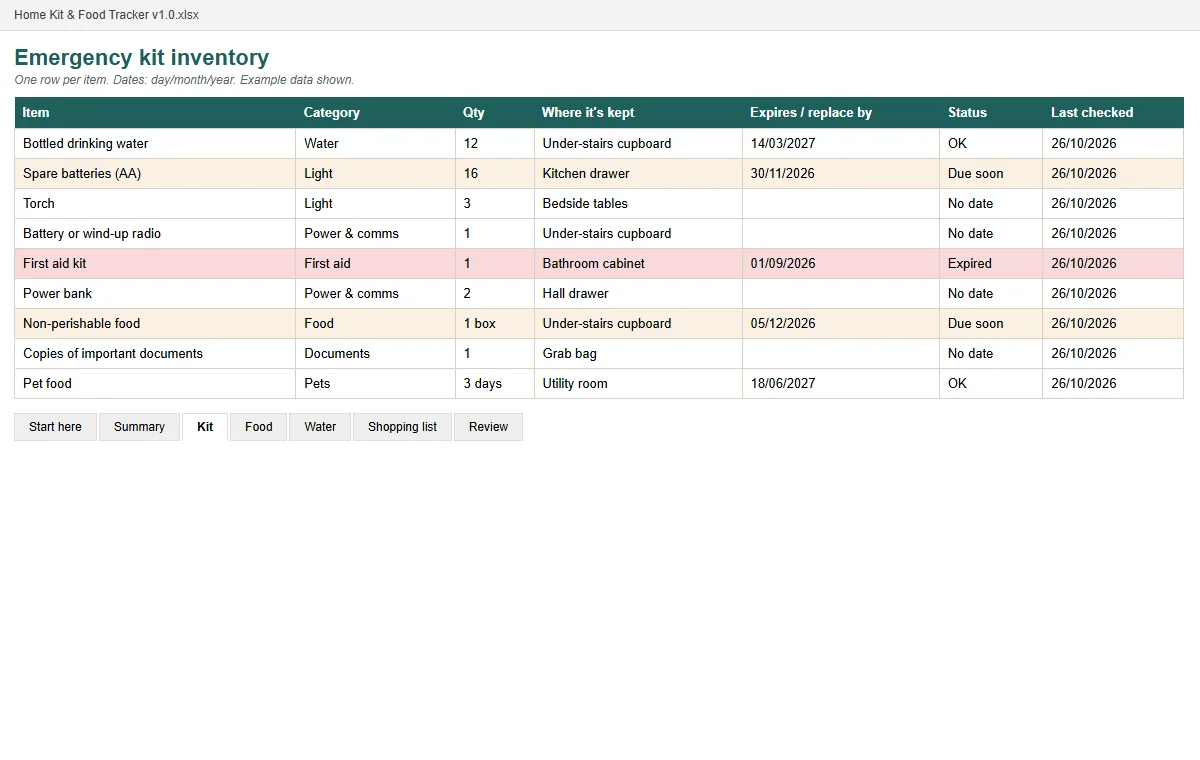 Bundle · £15.97 separatelyPrepared, Not Panicked bundle£9.99
Real pages shown before you buy · instant PDF · one-off price · 30-day refund.
Get the free 72-hour UK household checklist
Tick-box lists for each part of a UK home emergency kit, plus the key numbers on one page. Enter your email and we'll take you straight to the download.
That email address doesn't look right — please check it and try again.
We'll also email you when we publish new guides — occasional, never daily. Unsubscribe any time. See our privacy notice.
Frequently asked questions
What is the best survival handbook for a UK home?
For everyday UK emergencies such as power cuts, storms and floods, the free GOV.UK Be Ready checklist plus your own written household plan is more useful than a wilderness book. The SAS Survival Handbook is a good outdoor and travel manual; it is not written around UK services and numbers.
Is the SAS Survival Handbook worth buying?
If you hike, camp or travel in remote places, many people find it a useful reference. Its publisher, William Collins, describes it as covering kit, navigation, food and health, safety and security, and disaster survival. It won't tell you to call 105 in a power cut or how to join the Priority Services Register.
Who wrote the SAS Survival Handbook?
John 'Lofty' Wiseman. His publisher says he was the youngest person to pass SAS selection, at 18, and later became the SAS's Chief Survival Instructor.
Is the Worst-Case Scenario Survival Handbook serious?
Partly. Chronicle Books presents it as an illustrated, step-by-step guide written with humour, covering everything from extreme weather to escaping quicksand. It is fun to read but not a household emergency plan.
What should a UK home survival handbook include?
UK emergency numbers (999, 105 for power cuts, 0800 111 999 for gas in Great Britain, Floodline 0345 988 1188), where your stopcock, fuse box and gas meter are, who checks on whom, medicines and medical needs, and a 3-day kit list based on Be Ready.
Sources
- William Collins — SAS Survival Handbook: The Definitive Survival Guide (checked 31 Oct 2026)
- William Collins — Collins Gem SAS Survival Guide (checked 31 Oct 2026)
- Chronicle Books — The NEW Worst-Case Scenario Survival Handbook (checked 31 Oct 2026)
- Be Ready (GOV.UK) — Be ready for emergencies
- Be Ready checklist (PDF)
- GOV.UK — UK public survey of risk perception, resilience and preparedness 2026: headline findings
- Ofgem — Check if you can get a payment for a power cut (105)
- HSE — Carbon monoxide and gas safety at home (gas emergency number)
- GOV.UK — Sign up for flood warnings (Floodline)