In short: Be Ready is the UK Government's household preparedness campaign, launched by the Cabinet Office on 22 October 2026. Its checklist asks households to be ready for 3 days: bottled water (3 litres per person per day for drinking), non-perishable food, a torch, a battery or wind-up FM radio, a power bank, cash and documents, first aid and medicines, and baby and pet items if needed.
Free tool: make your household emergency plan in about 10 minutes — your power network from your postcode, contacts, meeting points and a kit list, printed on one page. Works offline.
Key facts
- Be Ready was announced by the Cabinet Office on 22 October 2026 as the first stage of a three-year campaign. Source
- More than 500 organisations across the UK have signed up to share the campaign's messages. Source
- The Be Ready checklist says to keep bottled water for 3 days: 3 litres per person per day for drinking, with more needed for cooking and washing. Source
- The checklist recommends setting a reminder every six months to check expiry dates and swap out items. Source
- In the 2026 UK public survey, 14% of people said their household had a written emergency plan and only 4% had 3 days of bottled water at 3 litres per person per day. Source
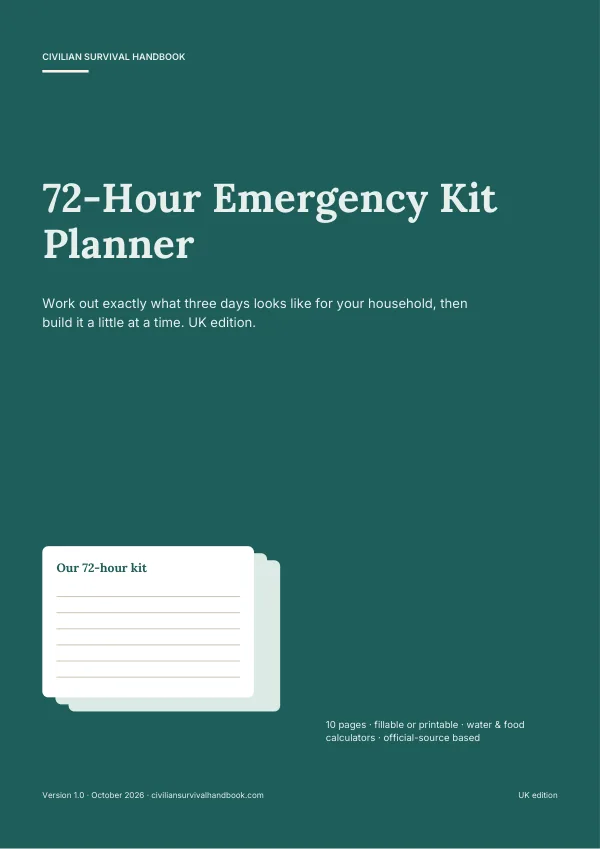 Want this written down for your home? 72-Hour Emergency Kit Planner — printable, £3.99.
On 22 October 2026 the government started Be Ready, a campaign asking every UK household to be ready for three days without normal services: power, water, phones or the internet. GOV.UK calls it the first stage of a three-year campaign, and more than 500 organisations have signed up to share it. You'll see it on the radio and social media over the coming months.
This page explains the official checklist in plain terms, shows where most households fall short, and gives you a way to finish it without spending much. We're an independent site, not part of the campaign. The official site is beready.campaign.gov.uk.
Why three days?
The checklist's own explanation is that being ready for three days "helps you manage while support reaches those most in need" (Be Ready checklist). In a big storm or a long power cut, emergency services and utilities prioritise the most vulnerable people. If your household can look after itself for a few days, help reaches them faster. GOV.UK notes that France, Ireland and the Netherlands give the same three-day advice.
The three things Be Ready asks you to do
- Build a 3-day supply of food, water and essentials (the checklist below).
- Check if you can join the Priority Services Register. It's free, and it tells your energy and water companies you may need extra help in an outage.
- Sign up for Met Office warnings, so you hear about severe weather early.
And, as always: call 999 if anyone is in immediate danger.
The official checklist, explained
The checklist groups items into nine areas. Here's each one with what it means in practice.
| Area | What the checklist says | In practice |
|---|---|---|
| Water | Bottled water for 3 days: 3 litres per person per day for drinking | 9 litres each. A family of four needs 36 litres. More for cooking and washing. See emergency water. |
| Food | Non-perishable food for 3 days that doesn't need a fridge or cooking | Tins, dried fruit, nuts, crackers. Buy what you normally eat so it gets used. Keep a tin opener with it. See emergency food. |
| Light and warmth | Torch and spare batteries; blankets, sleeping bags, warm clothes | A torch per adult beats candles, which are a fire risk. |
| Communication | FM radio (battery or wind-up); charged power bank | The radio is how you hear local news if phones and broadband are down. See wind-up radios. |
| Money and documents | Cash (coins and notes) and cards; copies of IDs; important numbers and medicine details | Card machines can stop in a power cut. Write numbers on paper, because phones go flat. |
| Medical and health | First aid kit; essential medication and supplies | Ask your GP or pharmacist about keeping a few days' spare medicines. |
| Baby products | Ready-to-feed formula; nappies and wipes | The checklist prefers ready-to-feed formula because you may not be able to boil water safely. |
| Pets | Pet food and bottled water | Plus their medicines and a carrier. See our pet emergency plan guide. |
| Hygiene | Hand sanitiser, wet wipes, hygiene and bathroom products | Add bin bags and toilet roll. |
Where most households fall short
The government's own 2026 survey of more than 10,000 people found:
- only 14% had a written household emergency plan
- only 4% had three days of bottled water at 3 litres per person per day
- 19% had a grab bag, and 29% had important numbers written down on paper
- only 13% felt their household was largely or totally prepared
The most common reasons people gave for not preparing were not having enough money (29%), not wanting products to go out of date (25%), and not knowing what to do (23%).
The good news is that each of those has a simple answer.
Doing it on a budget
The checklist itself says you don't need to do it all at once. Its suggested approach:
- See what you already have. Most homes already have a torch, some tins and blankets.
- Plan for your household. Note what your people rely on: medicines, baby formula, pet food.
- Build it gradually. Add an item or two to your normal shop.
- Check it every six months. Swap out anything near its date, and eat it rather than throw it away. That's how you stop things going to waste.
- Talk to your neighbours. Swap numbers and agree what you could share in an outage.
The step most people skip: writing it down
A kit helps for three days. A plan is what tells everyone what to do: who to call when the mobile network is busy, where to meet if you can't get home, and where the stopcock and fuse box are. Only 14% of households have one written down.
You can make one free in about ten minutes with our household plan builder. It finds your power network operator from your postcode, turns your answers into a one-page plan to print for the fridge, and keeps a copy on your phone that works offline. If you want everything in one place, the Household Emergency Plan Pack has 26 fillable pages.
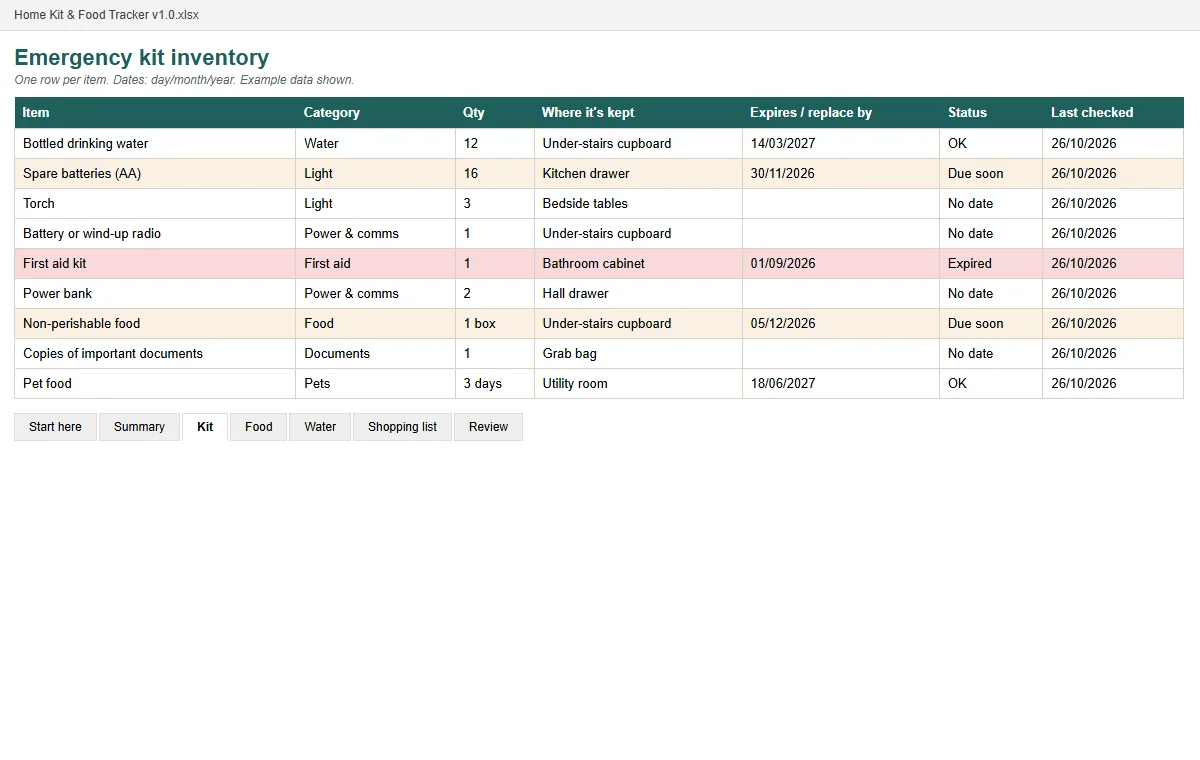
Work out your own numbers with our free emergency supplies calculator, and tick off what you already have on our Be Ready kit list.
Scotland, Wales and Northern Ireland
Be Ready is a UK campaign, and the checklist is also in Welsh. Scotland has its own advice at Ready Scotland, and Northern Ireland's is on nidirect. In Northern Ireland, report power cuts to NIE Networks on 03457 643 643, not 105.
Limitations
This page explains official advice. It isn't government guidance itself and isn't professional advice. Always follow instructions from the emergency services and your local council during an emergency, and call 999 if anyone is in danger.
Turn this guide into a written plan
Reading helps. Writing it down is what makes it work when the phones are flat. Start with the free plan builder, or get the full printable version:
For this topic72-Hour Emergency Kit Planner£3.99 Your whole household planHousehold Emergency Plan Pack£6.99
 Bundle · £15.97 separatelyPrepared, Not Panicked bundle£9.99
Real pages shown before you buy · instant PDF · one-off price · 30-day refund.
Get the free 72-hour UK household checklist
Tick-box lists for each part of a UK home emergency kit, plus the key numbers on one page. Enter your email and we'll take you straight to the download.
That email address doesn't look right — please check it and try again.
We'll also email you when we publish new guides — occasional, never daily. Unsubscribe any time. See our privacy notice.
Frequently asked questions
What is the Be Ready campaign?
Be Ready is a UK Government campaign run by the Cabinet Office. It launched on 22 October 2026 as the first stage of a three-year campaign, and asks households to take simple steps to be ready for three days of disruption to power, water, phones or the internet.
What is on the official Be Ready checklist?
Torch and spare batteries; blankets and warm clothes; a battery or wind-up FM radio; a charged power bank; cash and cards; copies of IDs and documents; important numbers and medicine details; first aid items and essential medication; baby formula and nappies if needed; pet food and water; non-perishable food for 3 days; hygiene products; and bottled water for 3 days at 3 litres per person per day for drinking.
How much water should I store for Be Ready?
The checklist says 3 litres per person per day for drinking, for 3 days. That's 9 litres per person. It notes you'd need more for cooking and washing.
Do I have to buy everything at once?
No. The official checklist says you don't need to do it all at once: check what you already have, then pick up missing items on normal shopping trips to spread the cost.
Is Be Ready the same as the old Prepare campaign?
GOV.UK says the previous Prepare website was updated with new messaging and branding for Be Ready. The address is now beready.campaign.gov.uk.
Is this website part of the government campaign?
No. Civilian Survival Handbook is an independent UK site. We explain the official checklist and link to it; we're not affiliated with or endorsed by the government.
Sources
- GOV.UK — Households encouraged to take small, simple steps to stay prepared in an emergency (22 October 2026)
- GOV.UK Be Ready
- Be Ready checklist (PDF, October 2026)
- UK Public Survey of Risk Perception, Resilience and Preparedness 2026 — headline findings (19 August 2026)
- Priority Services Register
- Ready Scotland
- nidirect — Be ready for emergencies