In short: Prepping in the UK doesn't need bunkers or stockpiles — it means being able to manage for about three days if power, water or phones are disrupted, which is what GOV.UK's Be Ready guidance asks of households. Start with water (3 litres per person per day for drinking), no-cook food, a torch, an FM radio, a power bank, cash, medication and a simple household plan, and build up gradually.
Free tool: make your household emergency plan in about 10 minutes — your power network from your postcode, contacts, meeting points and a kit list, printed on one page. Works offline.
Key facts
- GOV.UK's Be Ready guidance asks households to be ready for 3 days, so support can reach those most in need. Source
- The government has published resilience advice for households since May 2024; the Be Ready campaign updated the earlier Prepare website in October 2026. Source
- The National Risk Register 2025, published by the Cabinet Office on 16 January 2025, covers 89 risks within 9 risk themes. Source
- In the National Risk Register's reasonable worst-case storm scenario, disruption to power, communications and transport could last 1–4 days, and more than 5 days in remote rural areas. Source
- GOV.UK suggests 3 litres of bottled water per person per day for drinking, for 3 days. Source
 Want this written down for your home? Household Emergency Plan Pack — printable, £6.99.
"Prepping" has a reputation for bunkers, camouflage and worst-case thinking. For a UK household it can be much simpler: having enough water, food, light and information at home to manage calmly for a few days if something goes wrong. That's also what the UK government now asks of households through its Be Ready guidance. This guide reframes prepping as ordinary household readiness — what's actually likely, a four-week plan to get started, how to keep costs down, and a beginner preppers list for UK homes.
What does prepping mean in the UK?
In practice, sensible prepping in the UK means being ready for three days of disruption. GOV.UK's checklist says that being ready for 3 days helps you manage while support reaches those most in need.
This isn't new. The government has published resilience advice for households since May 2024, first on its "Prepare" website. In October 2026 the Cabinet Office launched Be Ready, which updated that site with new branding; it says much of the advice is unchanged. It is the first stage of a three-year campaign, and the Cabinet Office notes that France, Ireland and the Netherlands give the same three-day advice.
The British Red Cross puts it plainly: "You don't need to stockpile." The goal is short-term disruption, not long-term self-sufficiency.
What's actually likely in the UK?
The government's view of the biggest risks is set out in the National Risk Register 2025, published by the Cabinet Office on 16 January 2025. It covers 89 risks within 9 risk themes. Two things are worth knowing before you read it:
- Each risk is described as a "reasonable worst-case scenario". The register says these are not a prediction of what is most likely to happen — they're the worst plausible version, used for planning.
- The register says it is not targeted at the general public. It points households to GOV.UK's preparedness advice instead.
For a household, the useful part is the everyday disruption it describes:
| Risk in the register | What it says, in brief | What helps at home |
|---|---|---|
| Storms | In the worst-case scenario, disruption to power, communications and transport could last 1–4 days, and more than 5 days in remote rural areas | Torch, radio, power bank, warm bedding |
| Regional power failure | Storms Arwen and Eunice in winter 2021/22 left thousands of homes without power | Power cut number on paper, cash |
| Loss of drinking water | Water companies in England plan to provide an alternative supply as soon as possible, but within 24 hours | Bottled water at home |
| Loss of phones and internet | Storm Arwen (November 2021) left millions of customers without mobile and fixed-line connections | FM radio, written contact list |
| Flooding | River, coastal and surface water flooding are assessed separately; surface water flooding can happen at very short notice | Grab bag, flood plan, check your risk |
Your local picture matters more than the national one. Local Resilience Forums publish Community Risk Registers for their areas; in Scotland the equivalents are Regional Resilience Partnerships, and in Northern Ireland, Emergency Preparedness Groups. In England you can check current flood warnings or call Floodline on 0345 988 1188; Scotland, Wales and Northern Ireland have their own services. See our storm and flood guide.
A four-week plan to get started
GOV.UK's advice is to build up your readiness gradually, picking up an extra item or two when you can. Here's one way to spread it over a month.
Week 1: check what you already have
- Look through cupboards, drawers and the shed for torches, batteries, blankets, tins and a first aid kit.
- Choose one place in the house for the kit.
- Write down the phone numbers you'd need without your phone: family, GP, insurer, and the power cut line — 105 in England, Scotland and Wales, or 03457 643643 in Northern Ireland.
- Check whether anyone in your home is eligible for the Priority Services Register.
Week 2: water and food
- Add bottled water: GOV.UK suggests 3 litres per person per day for drinking, for 3 days — 9 litres per person.
- Add three days of food that needs no fridge or cooking, and that you'd usually eat.
- Don't forget a manual tin opener, baby formula (ready-to-feed is best, says GOV.UK) and pet food.
Week 3: light, power and information
- A torch and spare batteries. GOV.UK notes that torches are safer than candles.
- An FM radio that runs on batteries or a wind-up handle. Write down your news stations' frequencies. Our wind-up radio guide explains the options.
- A charged power bank.
- Some cash in coins and notes.
Week 4: health, documents and the plan
- Make sure you have essential medication. GOV.UK says to request prescriptions up to 5 working days before you need them.
- Put copies of ID, insurance details and a medication list in a waterproof bag.
- Agree a household plan: a meeting point, who checks on whom, and how to turn off gas, electricity and water.
- Set a reminder to check everything every six months.
How to prep on a budget
- Start with what you own. GOV.UK's first step is to check your cupboards.
- Add to your normal shop. Pick up one or two items each week to spread the cost.
- Buy food you eat anyway, so nothing goes to waste when you rotate it.
- Prioritise if money or space is tight. The British Red Cross suggests starting with medication, drinking water, food, staying informed and a simple household plan.
- Share what you can. GOV.UK suggests donating extra items to people who can't prepare their own household, or printing important documents for someone who can't.
What not to bother with
- Bunkers, tactical gear and "survival" branding. They solve problems the GOV.UK guidance doesn't ask you to solve.
- Huge stockpiles. The aim is three days, built up gradually.
- Specialist equipment you'd have to learn under pressure. Everyday items you already know how to use are more reliable.
- Fuel-burning kit indoors. The NHS lists barbecues and camping stoves used inside as a cause of carbon monoxide build-up.
- Rumours. GOV.UK's hazards guidance says official sources are the most reliable, and to check information before sharing it.
Staying on the right side of the law
Keep it simple: stick to everyday household items. Water, tins, a torch, a radio, blankets and a first aid kit are all you need, and none of them raise any legal questions. If you're unsure about anything else, follow official guidance.
Neighbours and community
Prepping isn't only about your own home. GOV.UK suggests you make a plan to check in on neighbours, swap contact details and consider a street messaging group. The British Red Cross notes that in an emergency we're often each other's first responders, and suggests checking on older neighbours and anyone with a disability or health condition.
If you want to help more widely, GOV.UK's community guidance suggests watching for calls for help from local groups and councils — and asks people not to turn up at the scene of an emergency to help.
A beginner preppers list for UK homes
Based on the GOV.UK Be Ready checklist:
- Bottled water for 3 days (3 litres per person per day for drinking, plus extra for cooking and washing)
- Non-perishable, no-cook food for 3 days
- Torch and spare batteries
- FM radio (battery or wind-up), with frequencies written down
- Charged power bank
- Cash (mix of coins and notes) and cards
- Copies of ID and important documents
- Important phone numbers and a medication list, on paper
- First aid kit
- Essential medication and medical supplies
- Hand sanitiser, wet wipes and hygiene products
- Blankets, sleeping bags and warm clothing
- Baby supplies (ready-to-feed formula, nappies, wipes) if needed
- Pet food and water if needed
- A household emergency plan
For the full version, see our 72-hour emergency kit guide and the printable checklist. For planning, see the household emergency plan pillar.
Limitations
This guide is general information based on GOV.UK, the National Risk Register, NHS and British Red Cross guidance. It is not professional, legal or safety advice. In an emergency, call 999 and follow instructions from the emergency services and official sources. Preparedness advice and services differ between England, Wales, Scotland (Ready Scotland) and Northern Ireland (NI Direct).
Turn this guide into a written plan
Reading helps. Writing it down is what makes it work when the phones are flat. Start with the free plan builder, or get the full printable version:
Your whole household planHousehold Emergency Plan Pack£6.99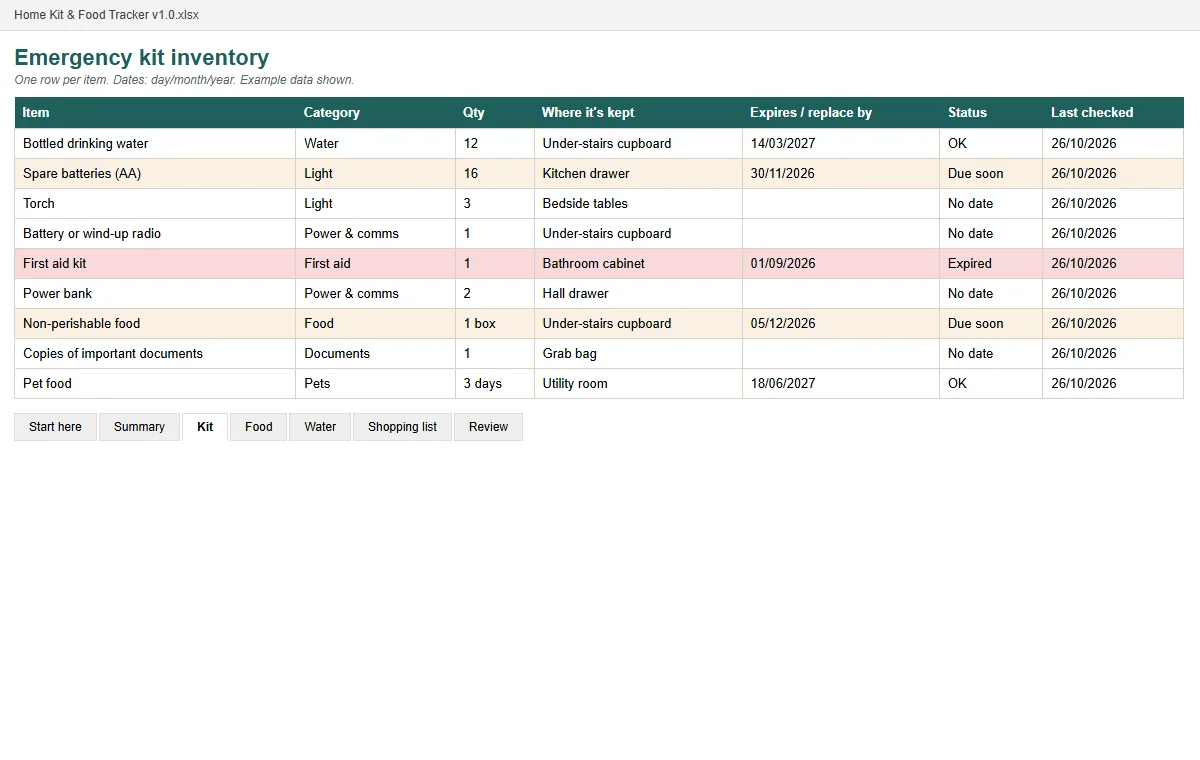 Bundle · £15.97 separatelyPrepared, Not Panicked bundle£9.99
Real pages shown before you buy · instant PDF · one-off price · 30-day refund.
Get the free 72-hour UK household checklist
Tick-box lists for each part of a UK home emergency kit, plus the key numbers on one page. Enter your email and we'll take you straight to the download.
That email address doesn't look right — please check it and try again.
We'll also email you when we publish new guides — occasional, never daily. Unsubscribe any time. See our privacy notice.
Frequently asked questions
Is prepping legal in the UK?
Keeping sensible household supplies — water, food, a torch, a radio, a first aid kit — is ordinary and is exactly what GOV.UK's Be Ready guidance recommends. Stick to everyday household items.
How much should a UK household prepare for?
GOV.UK asks households to be ready for 3 days. The British Red Cross says you don't need to stockpile; the aim is short-term disruption.
What is the most likely emergency in the UK?
For most households, everyday disruption — storms, flooding, power cuts, water outages and phone or broadband outages — matters more than dramatic scenarios. The National Risk Register and your local Community Risk Register describe the risks in more detail.
Does prepping have to be expensive?
No. GOV.UK suggests checking what you already have and picking up an item or two during regular shopping to spread the cost. The British Red Cross says getting ready doesn't need to be complicated or expensive.
Where can I find official UK preparedness advice?
Start with GOV.UK's Be Ready site (gov.uk/beready), which is also available in Welsh. It links to Ready Scotland and NI Direct for advice specific to Scotland and Northern Ireland.
Sources
- GOV.UK Be Ready — home
- GOV.UK Be Ready — Be ready for emergencies
- GOV.UK Be Ready — Checklist (PDF, October 2026)
- GOV.UK Be Ready — Check the risks where you are
- GOV.UK Be Ready — Play your part in your community
- GOV.UK Be Ready — Be informed about hazards
- GOV.UK Be Ready — About this website and UK resilience
- Cabinet Office — Households encouraged to take small, simple steps to stay prepared in an emergency (22 October 2026)
- Cabinet Office — National Risk Register 2025
- National Risk Register 2025 (PDF)
- British Red Cross — How to prepare your home for 72 hours
- Ready Scotland — Make an emergency kit
- NI Direct — Be ready for emergencies
- GOV.UK — Check for flooding
- NHS — Carbon monoxide poisoning