In short: Cold-Health Alerts are issued for England by UKHSA in partnership with the Met Office, with the core season running from 1 November to 31 March. Yellow means people who are particularly vulnerable are likely to struggle, amber means the whole population could be at risk, and red means a significant risk to life even for healthy people. UKHSA advises heating the rooms you use most to at least 18°C if you can.
Key facts
- Cold-Health Alerts are provided by UKHSA in partnership with the Met Office. The core alerting season runs from 1 November to 31 March, and alerts can be issued outside this period for unusual cold. Source
- The Cold-Health Alerting system applies to England. UKHSA and the Met Office carry out a joint risk assessment before issuing an alert. Source
- Yellow alerts may be issued when cold is unlikely to affect most people but could affect those who are particularly vulnerable. Amber means impacts are likely across the whole health service, with the whole population potentially at risk. Red means significant risk to life even for the healthy population. Source
- UKHSA advises trying to heat the rooms you spend a lot of time in, such as the living room or bedroom, to at least 18°C. Source
- UKHSA advises wearing several thin layers, which can keep you warmer than one thick layer, and trying not to sit still for more than an hour or so. Source
- Anyone can register to receive Weather-Health Alerts by email and choose the government region they want alerts for. Source
 Want this written down for your home? Care & Support Emergency Plan — printable, £4.99.
From 1 November, the UK Health Security Agency (UKHSA) starts its winter season of Cold-Health Alerts. You may hear about them on the news as "yellow" or "amber" cold alerts. They are different from Met Office weather warnings, and they mean something slightly different.
This page explains what each colour means, who is most at risk, and the simple steps that help at home. It's especially useful if you look after an older relative or neighbour.
What Cold-Health Alerts are
Cold-Health Alerts are issued by UKHSA in partnership with the Met Office (GOV.UK). When cold weather is forecast, the two organisations carry out a joint risk assessment and decide which alert level to issue. The system applies to England (GOV.UK overview).
- Season: the core season runs from 1 November to 31 March. An extra alert can be issued outside these dates if there is a spell of cold that could affect health.
- Who they are for: mainly health and social care services, so they can get ready. But anyone can sign up.
- How they're decided: like Met Office warnings, the colour combines how big the health impact could be with how likely it is.
UKHSA's user guide notes that the Met Office does not issue a warning for cold temperature itself. Its warnings cover snow, ice and wind. That's one reason the two systems run side by side.
What each colour means
These descriptions come from UKHSA's Weather-Health Alerting user guide.
| Level | What UKHSA says it means | What it means at home |
|---|---|---|
| Green | No alert. The weather is likely to have minimal impact on health. | A good time to get ready: check your heating, plan, and who you'd check on. |
| Yellow | Cold that is unlikely to affect most people, but people who are particularly vulnerable are likely to struggle. Can also be issued when the forecast is uncertain but the worst case is more serious. | Check on older or unwell relatives and neighbours. Make sure they are warm and have food and medicines. |
| Amber | Impacts likely across the whole health service, with the whole population potentially at risk. Other sectors, such as transport, may start to be affected. | Keep in regular touch with anyone at higher risk. Think about cutting unneeded travel. |
| Red | Significant risk to life, even for healthy people. | Check on vulnerable people every day if you can. Follow advice from the NHS, emergency services and your local council. |
UKHSA stresses that yellow alerts should not be ignored. Its own figures from past heat alerts show that serious harm can happen during yellow periods too, so it's worth acting early.
Who is most at risk from the cold
UKHSA's action card lists people at higher risk, including:
- people over 65, especially if frail or socially isolated
- babies and young children
- pregnant women
- people with heart, circulation or breathing conditions, such as COPD or asthma
- people with mental health conditions
- people with disabilities, learning difficulties or cognitive impairment
- people in lower-income households
UKHSA's Keeping warm and well guidance also mentions people who live alone, are housebound, or are at risk of falls.
Practical steps for your home
Heat the rooms you use most. UKHSA advises trying to heat the rooms you spend a lot of time in, such as the living room or bedroom, to at least 18°C (UKHSA). The NHS says the same, and also advises keeping bedroom windows closed at night.
Wear layers. Several thin layers can keep you warmer than one thick one.
Keep moving. Try not to sit still for more than an hour or so. If moving is hard, stretching your arms and legs helps.
Keep heating safe. UKHSA advises having heating appliances serviced regularly, having a carbon monoxide alarm fitted, and getting gas appliances checked by a Gas Safe registered engineer. See our guide to carbon monoxide at home.
Look out for others. Keep in touch with friends, family and neighbours. Ask if they feel unwell or need practical help. Before cold weather, the NHS suggests checking they have enough food for a few days and have collected their prescriptions. If you're worried about an older person, the NHS points to your local council or the Age UK helpline on 0800 678 1602.
Know the signs of hypothermia. The NHS lists shivering, pale, cold skin, slurred speech, slow breathing, tiredness and confusion. Babies may feel cold, seem limp or refuse feeds. Call 999 or go to A&E if you think someone has hypothermia. While you wait, move them somewhere warm, remove wet clothes, and wrap them in a blanket. Don't use a hot bath or rub their arms and legs.
Help with heating costs
Both UKHSA and the NHS say grants, benefits and advice are available to help with heating and energy bills. Our guides explain the main schemes:
How to get the alerts
Register for the Weather-Health Alerting system on GOV.UK and choose your region. Alerts are emailed when issued. You can also see the current status for each English region on the UKHSA data dashboard.
If you care for someone, our emergency plan for older people and carers helps you write down who checks on whom, and what to do if the weather turns.
Limitations
This page explains official UKHSA and NHS guidance. It isn't medical advice and isn't official guidance itself. Cold-Health Alerts cover England only. UKHSA's guidance page and dashboard give the season end as 31 March, while its PDF user guide says 30 March; we have used 31 March. If you're worried about someone's health, call NHS 111, and call 999 in an emergency.
Turn this guide into a written plan
Reading helps. Writing it down is what makes it work when the phones are flat. Start with the free plan builder, or get the full printable version:
For this topicCare & Support Emergency Plan£4.99 Your whole household planHousehold Emergency Plan Pack£6.99
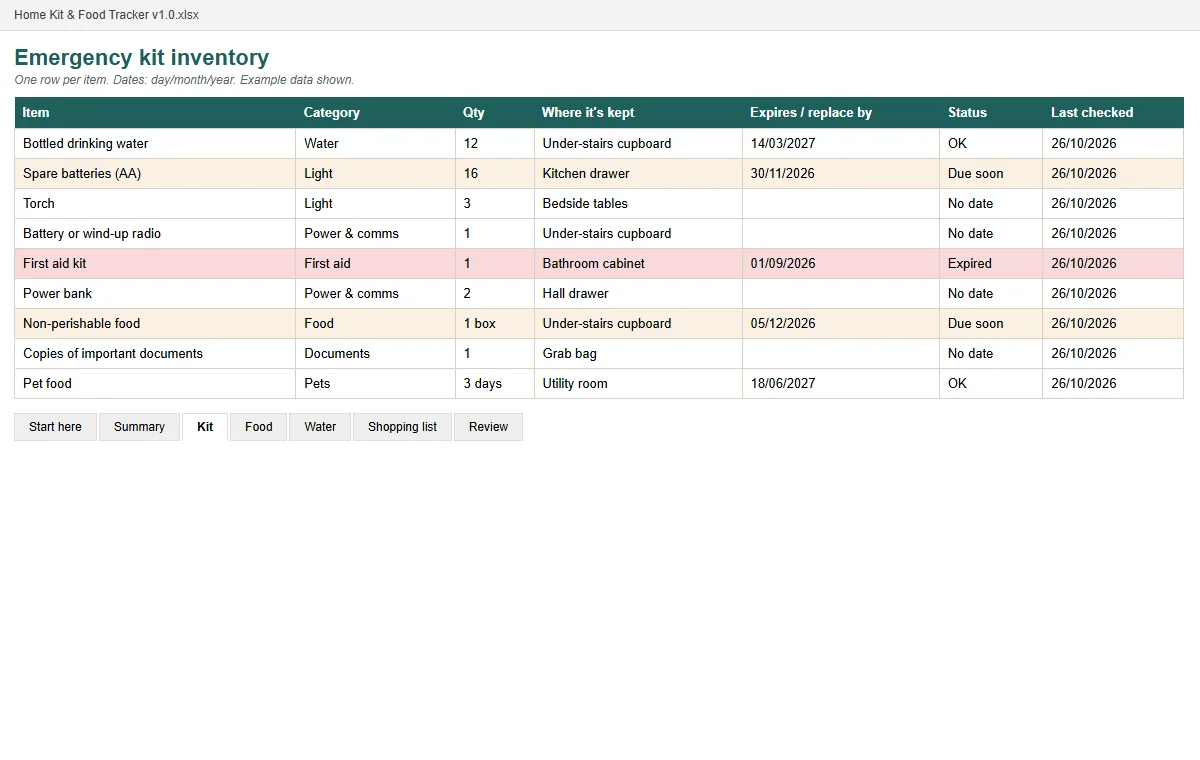 Bundle · £15.97 separatelyPrepared, Not Panicked bundle£9.99
Real pages shown before you buy · instant PDF · one-off price · 30-day refund.
Get the free 72-hour UK household checklist
Tick-box lists for each part of a UK home emergency kit, plus the key numbers on one page. Enter your email and we'll take you straight to the download.
That email address doesn't look right — please check it and try again.
We'll also email you when we publish new guides — occasional, never daily. Unsubscribe any time. See our privacy notice.
Frequently asked questions
What is a Cold-Health Alert?
It is an alert from the UK Health Security Agency (UKHSA), issued with the Met Office, when cold weather is likely to affect people's health. It is mainly aimed at health and care services, but anyone can sign up. It covers England.
When do Cold-Health Alerts run?
The core season runs from 1 November to 31 March. UKHSA can issue an extra alert outside these dates if there is a spell of cold that could affect health.
What does a yellow Cold-Health Alert mean?
UKHSA says a yellow alert may be issued when cold is unlikely to affect most people but could affect people who are particularly vulnerable, such as older people with several health conditions. It can also be issued when the forecast is uncertain but the worst case could be more serious.
What temperature should I keep my home?
UKHSA advises trying to heat the rooms you spend a lot of time in, such as the living room or bedroom, to at least 18°C. The NHS gives the same advice for rooms you use regularly.
Is a Cold-Health Alert the same as a Met Office weather warning?
No. Met Office warnings are about weather impacts such as snow, ice and wind. Cold-Health Alerts are about the effect of low temperatures on health. UKHSA notes there is currently no Met Office warning for cold temperature itself.
How do I sign up?
Register for the Weather-Health Alerting system on GOV.UK and choose your region. Alerts are emailed to you when they are issued. You can also check current alerts on the UKHSA data dashboard.
Sources
- GOV.UK — Weather-Health Alerting System (UKHSA, updated 22 April 2026)
- GOV.UK — Cold-Health Alerting system: overview (UKHSA)
- GOV.UK — Weather-Health Alert system user guide (UKHSA, 22 April 2026)
- UKHSA — Weather-Health Alerting system user guide (PDF)
- GOV.UK — Cold-Health Alert action card for the voluntary and community sector (UKHSA)
- GOV.UK — Keeping warm and well: staying safe in cold weather (UKHSA, updated 28 April 2026)
- UKHSA data dashboard — Cold-health alerts
- NHS — Keep warm, keep well
- NHS — Hypothermia