In short: If the heating is off, broken or too costly to run, UKHSA advises wearing several thin layers, which may keep you warmer than one thick layer, reducing draughts, keeping bedroom windows closed at night and not sitting still for more than an hour or so. Heat the room you use most if you can: UKHSA and the NHS suggest at least 18°C. Never use a hob or oven to heat your home (Met Office), and never bring camping stoves, barbecues or generators indoors. If money is the problem, Ofgem says to contact your energy supplier and ask about payment plans and hardship funds.
Key facts
- UKHSA says several layers of thinner clothing may keep you warmer than one thick layer. Source
- UKHSA and the NHS advise heating the rooms you use most, such as the living room or bedroom, to at least 18°C. Source
- The Met Office says never to use a hob or oven to heat your home, as this can increase carbon monoxide levels. Source
- Greater Manchester Fire and Rescue Service says to replace an electric blanket when it is more than 10 years old, and never to use a hot water bottle with one. Source
- Ofgem says people struggling with energy bills should ask their supplier about a payment plan, payment break or reduction, and about hardship funds. Source
 Want this written down for your home? Care & Support Emergency Plan — printable, £4.99.
There are plenty of reasons the heating might be off: a boiler that has broken down, a wait for an engineer, or bills that are hard to meet. This guide covers keeping warm at home in those situations, using advice from UKHSA's keeping warm and well guidance, the NHS, the Met Office and UK fire services. If the problem is a power cut, our winter power cut checklist covers that instead.
Warm the person first
The cheapest heat is the heat you keep in your body. UKHSA's main tips:
- Wear several thin layers. UKHSA says several layers of thinner clothing may keep you warmer than one thick layer.
- Keep moving. UKHSA suggests trying not to sit still for more than an hour or so. If moving is hard, stretching your arms and legs helps.
- Wear shoes with good grip if you go out on icy surfaces.
The UK Chief Medical Officers' advice for very cold spells adds gathering in one room to share warmth, and wearing layers and keeping moving.
Keep the heat in the room
You can make a room hold its warmth for longer:
- Reduce draughts. UKHSA notes that draught excluders around doors are an inexpensive option. A rolled towel along the bottom of a door also works.
- Close curtains at dusk. The Chief Medical Officers suggest closing curtains when it gets dark and blocking draughts under doors.
- Keep bedroom windows closed at night, as both UKHSA and the NHS advise.
- Ventilate briefly. UKHSA suggests airing a room for a few minutes before and after visitors arrive.
Heat one room if you can
UKHSA and the NHS both suggest heating the rooms you use most, such as the living room or bedroom, to at least 18°C. If you can't heat the whole home, heating one room and spending most of your time there is a sensible way to follow that advice. Close the doors of the rooms you aren't using.
Safe and unsafe ways to get warm
Some ways of getting warm put people at risk. These are the rules from official sources:
- Never use a hob or oven to heat your home. The Met Office says this can increase carbon monoxide levels.
- Never bring camping stoves, barbecues or petrol or diesel generators indoors. The Chief Medical Officers warn about carbon monoxide, and say not to light indoor fires without a proper appliance or working chimney.
- Never leave fires or heaters unattended, and burn only the recommended fuel, never furniture or rubbish.
- Switch off electric heaters and put out fires before bed, as the Met Office advises.
- Fit a carbon monoxide alarm. Be Ready and UKHSA suggest one that meets EN 50291. Our carbon monoxide guide lists the symptoms.
Electric blankets and hot water bottles
An electric blanket heats the bed rather than the room. UK fire services give clear rules for using one:
- Never use a hot water bottle or have drinks while using an electric blanket. Greater Manchester Fire and Rescue Service says spills can cause electrical faults and raise the fire risk.
- Replace a blanket that is more than 10 years old, and stop using one with scorch marks, exposed elements, damp patches, a worn flex or loose connections.
- Unplug it before getting into bed, unless it has a thermostat designed for all-night use.
- Store it flat rather than folded, as Devon & Somerset Fire and Rescue Service advises.
If the boiler has broken down
UKHSA and the NHS advise having heating and cooking appliances checked by a Gas Safe registered engineer, and boiler flues and chimneys checked for blockages. While you wait for a repair, use the steps above. If you rent, tell your landlord straight away.
If you ever smell gas, follow our smell gas guide.
If the cost is the problem
You don't have to sort this out alone. Ofgem says to contact your energy supplier and ask for:
- a payment plan, payment break or reduction
- a review of your current payments and any debt repayments
- details of any hardship funds, grants or schemes for energy costs
Ofgem lists free advice lines:
| Where you live | Who to call |
|---|---|
| England | Citizens Advice: 0808 144 8844 |
| Scotland | Energyadvice.scot: 0808 196 8660 |
| Wales | Advicelink Cymru: 0800 702 2020 |
Be Ready also points to Age UK's cost-of-living advice on 0800 169 6565, quoting "WINTER". The NHS lists the government helpline 0800 444 202 for grants, benefits and energy efficiency help. Your local council may also offer support. Check whether you can get the Warm Home Discount or Cold Weather Payment.
Watch for signs someone is too cold
UKHSA lists signs of hypothermia as shivering, slow breathing, tiredness or confusion, and pale, cold skin. Be Ready says hypothermia is a medical emergency that needs hospital treatment. The NHS says to call 111 if you think someone may have it, and 999 in an emergency.
The NHS says people most at risk from the cold include people aged 65 and over, children under 5, people with long-term health conditions, disabled people, pregnant women and people on low incomes who can't afford heating. If you know someone like this, check in on them. Our guide for older people and carers has more on this.
Limitations
This is general information based on UKHSA, NHS, GOV.UK Be Ready, Met Office, Ofgem and UK fire service advice, checked on 29 October 2026. It isn't medical, financial or gas safety advice. Help schemes and phone lines differ between England, Scotland, Wales and Northern Ireland. If you're worried about someone's health, contact NHS 111 or your GP. In an emergency, call 999.
If you look after someone who feels the cold, the Care & Support Emergency Plan has pages for their contacts, medicines and a check-in plan.
Turn this guide into a written plan
Reading helps. Writing it down is what makes it work when the phones are flat. Start with the free plan builder, or get the full printable version:
For this topicCare & Support Emergency Plan£4.99 Your whole household planHousehold Emergency Plan Pack£6.99
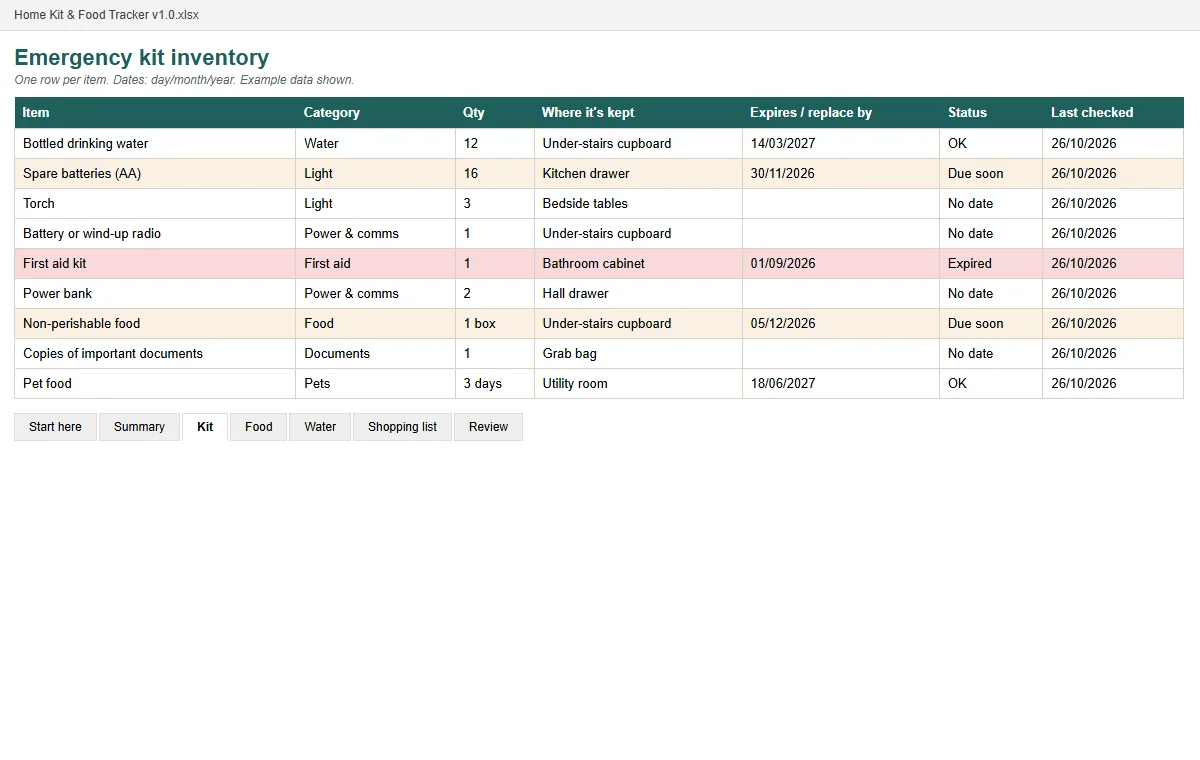 Bundle · £15.97 separatelyPrepared, Not Panicked bundle£9.99
Real pages shown before you buy · instant PDF · one-off price · 30-day refund.
Get the free 72-hour UK household checklist
Tick-box lists for each part of a UK home emergency kit, plus the key numbers on one page. Enter your email and we'll take you straight to the download.
That email address doesn't look right — please check it and try again.
We'll also email you when we publish new guides — occasional, never daily. Unsubscribe any time. See our privacy notice.
Frequently asked questions
What is the best way to keep warm without heating?
UKHSA's advice is several thin layers rather than one thick one, fewer draughts, bedroom windows closed at night, and getting up to move at least every hour. The UK Chief Medical Officers also suggest gathering in one room and closing curtains when it gets dark.
How warm should my home be?
UKHSA and the NHS suggest heating the rooms you use most to at least 18°C. If you can't heat the whole home, heating one room you spend most time in is a practical way to follow that advice.
Is it safe to heat a room with the oven or a gas hob?
No. The Met Office says never to use a hob or oven to heat your home, as this can increase carbon monoxide levels. Never bring camping stoves, barbecues or generators indoors either.
Can I use a hot water bottle with an electric blanket?
No. Greater Manchester Fire and Rescue Service says never to use a hot water bottle or have drinks while using an electric blanket, because spills can cause electrical faults.
I can't afford to put the heating on. Who can help?
Ofgem says to contact your energy supplier first and ask about payment plans and hardship funds. In England, Citizens Advice's energy line is 0808 144 8844. Age UK's advice line is 0800 169 6565 (quote WINTER).
Sources
- UKHSA: Top tips for keeping warm and well this winter (checked 29 Oct 2026)
- NHS: Keep warm, keep well (checked 29 Oct 2026)
- GOV.UK Be Ready: Cold weather, snow and ice (checked 29 Oct 2026)
- GOV.UK: UK CMOs, keeping warm or cool in extreme weather (checked 29 Oct 2026)
- Met Office: WeatherReady tips for snow and ice (checked 29 Oct 2026)
- Greater Manchester Fire and Rescue Service: Electric blankets (checked 29 Oct 2026)
- Devon & Somerset Fire and Rescue Service: Electric blankets (checked 29 Oct 2026)
- Ofgem: Getting help if you can't afford your energy bills (checked 29 Oct 2026)