In short: The government's Be Ready advice is to keep some cash at home, a mix of coins and notes, plus cards, in case card payments or cash machines stop working. It does not set an amount: the right amount depends on your household's essential needs for a few days. Keep it somewhere safe and private.
Key facts
- Be Ready lists 'Cash (mix of coins and notes) and cards' in case electronic payments or ATMs are disrupted. Source
- Be Ready says the amount of cash to keep depends on your family's specific needs for essentials. Source
- The Be Ready checklist asks households to be ready for 3 days and to check their kit every six months. Source
- Paper Bank of England £20 and £50 notes stopped being legal tender on 30 September 2022. There is no deadline to exchange old notes with the Bank of England by post. Source
- The FCA says existing law lets retailers decide whether to accept cash or not. Source
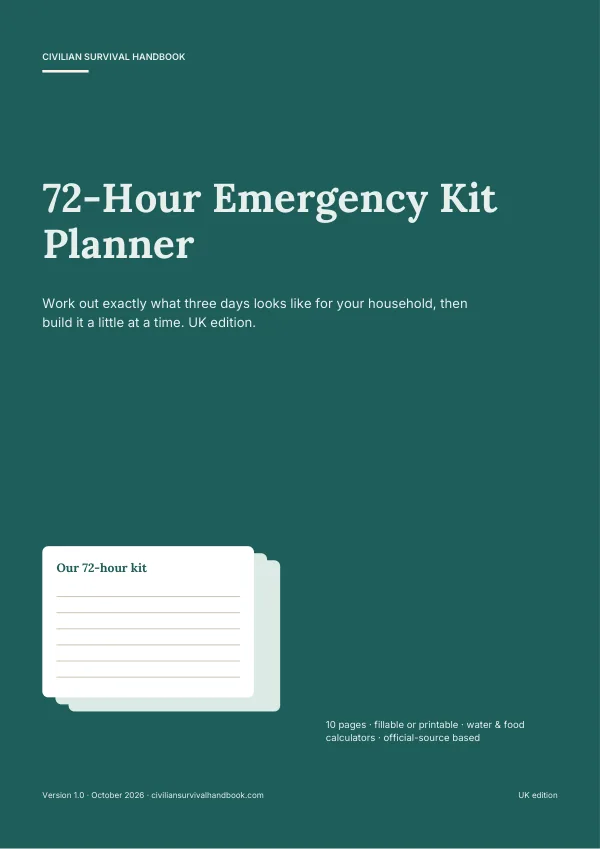 Want this written down for your home? 72-Hour Emergency Kit Planner — printable, £3.99.
Most of us pay by card or phone now. That works well until a power cut, an IT fault or a bank outage stops card machines and cash machines for a while. A little cash at home means you can still buy bread, milk or medicine during that time. This guide covers what the UK Government's Be Ready campaign says about cash, and how to choose an amount that suits your household.
What Be Ready says
Be Ready's checklist includes cash (mix of coins and notes) and cards, in case electronic payments or ATMs are disrupted. It does not give a figure. Be Ready says the amount you should keep depends on your family's specific needs for essentials.
The wider Be Ready checklist asks households to be ready for 3 days, to build up their kit gradually, and to check it every six months. Cash fits the same plan. You don't need to put it aside all at once.
How to work out your amount
There is no official number, so base it on your own household. A simple method:
- List the essentials you'd need to buy over 3 days if cards didn't work: food top-ups, milk, baby formula or nappies, pet food, medicines or a prescription charge, fuel for the car, a taxi to a relative.
- Write a rough cost next to each item, based on what you normally spend.
- Add them up. That total is a sensible starting point for your emergency cash.
- Keep it in small amounts: coins and £5 and £10 notes rather than one £50 note.
Many homes already keep some of what they need in the kit Be Ready suggests: food for 3 days, bottled water and a torch. The better stocked your kit is, the less cash you're likely to need. Our 72-hour kit guide covers the rest of the list.
Why coins and small notes matter
Be Ready asks for a mix of coins and notes. In a power cut or IT outage, a shop that can still trade may not be able to give change easily, and you may only need a few small items. Coins also help with things like car parks or laundrettes.
Keep in mind that taking cash is up to each shop. The FCA says existing law lets retailers decide whether to accept cash or not. Cash gives you another way to pay, but it doesn't guarantee a sale.
Check your notes are still legal tender
Check any cash you've had put away for years. The Bank of England lists paper £20 and £50 notes as having stopped being legal tender on 30 September 2022, and older paper £5 and £10 notes before that.
You can still swap old notes. The Bank of England says paying them into a UK bank account is the easiest and quickest way, and there is no deadline to exchange them with the Bank by post. Notes showing Queen Elizabeth II remain legal tender, so you don't need to swap them for King Charles III notes.
Where to keep it
There's no official guidance on where to store emergency cash, so use common sense:
- Keep it somewhere secure and dry, and tell another adult in the home where it is.
- Keep a separate small amount in your grab bag in case you need to leave home.
- Don't keep it all in one obvious place.
- Check your home insurance policy to see how much cash, if any, it covers.
Write the location on your household plan so someone else can find it if needed.
The Be Ready checklist also suggests talking to your neighbours about what extra support you might be able to share during an outage, and swapping contact details. A neighbour with a little spare cash, or a working card, can make a real difference for a day or two.
When cash runs low in an outage
There are also rules on access to cash. In December 2023 the FCA proposed rules under which designated banks and building societies would assess gaps in access to cash and act to fill them. At the time, FCA data showed 95.1% of the UK population were within 1 mile of a free cash withdrawal point, and 99.7% within 3 miles.
In a long power cut, local cash machines may also be out. That's why it helps to set cash aside before you need it.
Keep cards and details too
Be Ready lists cash and cards together. Keep a note of your bank's phone number on paper, not just in your phone, in case you need to report a lost card or check an outage. Our important documents checklist shows what else to keep copies of.
A quick cash checklist
- Work out 3 days of essentials for your household
- Set aside that amount in coins and small notes
- Check no paper notes are hiding in the stash
- Put a small amount in the grab bag
- Note where it's kept on your household plan
- Check it every six months, when you check your kit
Limitations
This is general information based on GOV.UK Be Ready, Bank of England and FCA pages, checked on 29 October 2026. It isn't financial advice. The amount you keep is your own decision. Scottish and Northern Irish banks issue their own notes, so check with the issuing bank for those. If you have money worries, MoneyHelper and Citizens Advice offer free help.
If you'd like to plan the rest of your 3-day kit in one place, the 72-Hour Kit Planner has tick-off pages for cash, documents, water and food.
Turn this guide into a written plan
Reading helps. Writing it down is what makes it work when the phones are flat. Start with the free plan builder, or get the full printable version:
For this topic72-Hour Emergency Kit Planner£3.99 Your whole household planHousehold Emergency Plan Pack£6.99
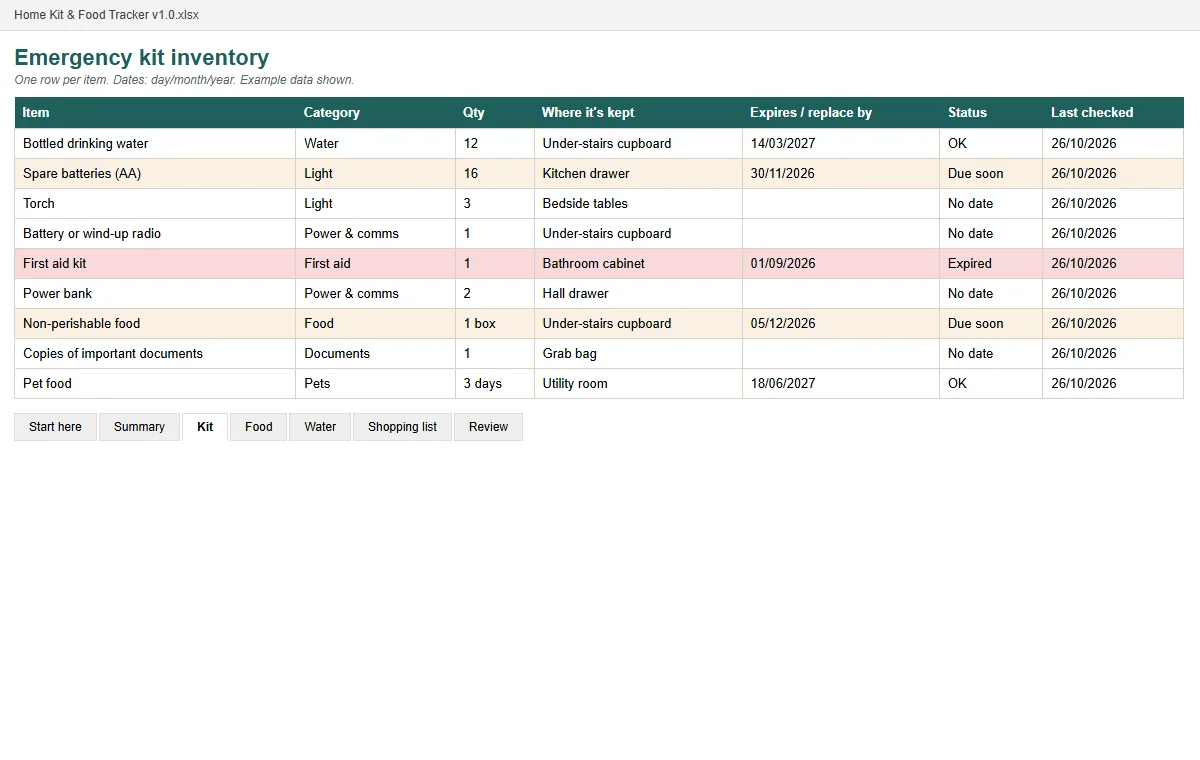 Bundle · £15.97 separatelyPrepared, Not Panicked bundle£9.99
Real pages shown before you buy · instant PDF · one-off price · 30-day refund.
Get the free 72-hour UK household checklist
Tick-box lists for each part of a UK home emergency kit, plus the key numbers on one page. Enter your email and we'll take you straight to the download.
That email address doesn't look right — please check it and try again.
We'll also email you when we publish new guides — occasional, never daily. Unsubscribe any time. See our privacy notice.
Frequently asked questions
How much cash does the government say to keep at home?
It doesn't give a figure. Be Ready says the amount depends on your family's specific needs for essentials, and suggests a mix of coins and notes, plus cards, in case electronic payments or ATMs are disrupted.
Why coins and small notes?
Be Ready asks for a mix of coins and notes. Small amounts make it easier to pay for small things like a loaf of bread or a bag of ice without needing change, which a shop may not have if its tills are down.
Is there a legal limit on how much cash I can keep at home?
We haven't found any UK rule that limits how much cash you can keep at home. Check your home insurance policy to see how much cash, if any, it covers.
Are my old paper notes still OK?
No. The Bank of England lists paper £20 and £50 notes as no longer legal tender since 30 September 2022. You can pay them into a UK bank account or exchange them with the Bank of England by post, which has no deadline.
Will shops take cash if the card machines are down?
Not always. The FCA says existing law lets retailers decide whether to accept cash or not. Cash gives you another option, but it can't guarantee a shop will take it.
Sources
- GOV.UK Be Ready: Be ready for emergencies (checked 29 Oct 2026)
- GOV.UK Be Ready checklist (PDF) (checked 29 Oct 2026)
- Bank of England: Exchanging old banknotes (checked 29 Oct 2026)
- Bank of England: Withdrawn banknotes (checked 29 Oct 2026)
- FCA: New rules to maintain access to cash, 7 Dec 2023 (checked 29 Oct 2026)