In short: GOV.UK's Be Ready campaign says most power cuts are short and local, while wider outages are less common but can last several days. In Great Britain, Ofgem expects network operators to restore power within 12 hours outside severe weather, 24 hours in storm category 1 and 48 hours in storm category 2. NIE Networks says it fixes nine out of ten power cuts in Northern Ireland within three hours. A power cut kit is one box with a torch and spare batteries, a battery or wind-up FM radio, a charged power bank, warm layers, cash and a paper card with 105 (or 03457 643643 in Northern Ireland), kept next to 3 days of water and no-cook food.
Key facts
- Be Ready says most power cuts are short-lived and local; wider outages are less common but can last several days. Source
- Ofgem says network operators in Great Britain should restore power within 12 hours outside severe weather, 24 hours in storm category 1 and 48 hours in storm category 2, depending on how many properties are affected. Source
- NIE Networks says it fixes nine out of ten power cuts within three hours. Source
- In the unlikely event of a national energy shortage, Be Ready says power could be cut by area on a rota, with each cut lasting about three hours. Source
- NESO's Winter Outlook, published on 23 October 2026, says Britain's electricity supplies are expected to remain secure throughout winter 2026/27. Source
- Be Ready says to keep a battery or wind-up torch with spare batteries, as torches are safer than candles, and to avoid using your phone's torch because it drains the battery. Source
 Want this written down for your home? Power Cut & Blackout Plan — printable, £4.99.
A power cut kit is a small box of things that help you get through an evening, or a few days, without electricity. Most of it you probably own already. The point is to keep it in one place you can find in the dark. This guide explains how long UK power cuts usually last, what to put in the box, and what to keep out of it.
For what to do once the lights go out, see our power cuts guide. For cold weather, see the winter power cut checklist.
How long do power cuts last?
GOV.UK's Be Ready campaign says most power cuts are short-lived and local. Wider outages are less common, but they can last several days.
Here's what the official sources say:
| Situation | What official sources say |
|---|---|
| Normal weather, Great Britain | Ofgem expects power back within 12 hours. If 5,000 or more properties are affected, the payment rules use 24 hours. |
| Storm category 1 (8 to 13 times more faults than normal) | Within 24 hours |
| Storm category 2 (at least 13 times more faults than normal) | Within 48 hours |
| Northern Ireland | NIE Networks says it fixes nine out of ten power cuts within three hours. Its guaranteed standard is to restore power within 24 hours, though this may not apply in severe weather. |
| National energy shortage (unlikely) | Power could be cut area by area on a rota, each cut lasting about three hours |
Ofgem's times are standards that network operators are expected to meet, not a forecast for your street. If they miss them, you may be owed a payment; see power cut compensation.
On the national picture, NESO, which runs Britain's electricity system, published its Winter Outlook on 23 October 2026. It says supplies are expected to remain secure throughout winter 2026/27. Our winter blackouts guide explains more.
For an estimate for your own home, check your network operator's website, or call 105 free in England, Scotland and Wales. In Northern Ireland, contact NIE Networks on 03457 643643. NIE Networks says its first estimate is usually three hours, and it updates this once engineers are on site. Not sure who your operator is? Use our power cuts by area page.
How long should a power cut kit last?
Plan in two layers:
- The box covers the first few hours: light, news, phone power and warmth. That's most power cuts.
- Your 3-day supplies sit next to it for the rarer, longer cuts. Be Ready asks for at least 3 days of bottled water, 3 litres per person per day, and food that needs no cooking, with a tin opener.
Our emergency food stockpile list and free emergency supplies calculator help with the second layer.
What goes in a power cut kit
Light
Be Ready says to keep a battery or wind-up torch and spare batteries. Torches are safer than candles. It also says to avoid your phone's torch, because it drains the battery you may need for calls.
News and information
Keep a battery or wind-up FM radio and spare batteries. Be Ready suggests writing down the frequencies of your local and national stations on paper, and trying both FM and digital during a cut.
Phone power
A charged power bank keeps one phone going. The British Red Cross suggests keeping power banks fully charged during storm season. If you rely on a landline or telecare, Be Ready says to ask your provider whether it works in a power cut; they may offer a free backup battery unit lasting at least one hour.
Warmth
Be Ready's checklist includes blankets, sleeping bags and warm clothing. The UK Chief Medical Officers advise several thin layers, gathering in one room, and closing curtains when it gets dark.
Cash
Be Ready says to keep some cash, because card payments and cash machines may not work.
A paper card
Write these on one card and keep it with the torch:
- the power cut number: 105, or 03457 643643 in Northern Ireland
- your network operator's name
- your load block letter (from powercut105.com or your bill)
- radio station frequencies
- numbers for family, neighbours and your GP
Your power cut kit checklist
- Torch for each adult, and spare batteries
- Battery or wind-up FM radio, and spare batteries
- Charged power bank and charging cables
- Blankets or sleeping bags, and warm layers
- Some cash, in coins and notes
- Paper card with numbers, load block letter and radio frequencies
- Fridge thermometer (the FSA suggests one to check food safety)
- Nearby: 3 days of bottled water and no-cook food, with a tin opener
- Nearby: ready-to-feed baby formula and pet food, if needed
Extra items for some households
- Medical equipment. Be Ready says to make a plan with your care provider or clinical team if you use equipment that needs power, and to ask manufacturers how alarms or health monitors work in a power cut.
- Priority Services Register. Ofgem says network operators must offer registered customers extra help, such as battery packs for phones or medical equipment. What's offered varies by company. See our Priority Services Register guide.
What to keep out of the kit
- Camping stoves and barbecues indoors. The UK Chief Medical Officers say not to use them indoors because of the risk of carbon monoxide poisoning.
- Generators indoors. Petrol or diesel generators must stay outdoors, at least 6 metres (20 feet) away, with the exhaust pointing away from windows and doors.
- Candles as your main light. Torches are safer.
Where to keep it and when to check it
Be Ready suggests keeping your notes with your torch or radio somewhere easy to find in the dark. A hallway cupboard or under the stairs works well; tell everyone at home where it is.
- Every six months, test the torch and radio and replace batteries (the Be Ready checklist suggests a six-monthly check)
- Recharge the power bank
- Check water and food dates
- Update the paper card
If you'd like it all written down in one place, the Power Cut & Blackout Plan is a printable plan for your home, and the household plan builder is free.
Limitations
This page is general information based on GOV.UK Be Ready, Ofgem, NIE Networks, NESO, the UK Chief Medical Officers, the Food Standards Agency and the British Red Cross, checked on 28 October 2026. Restoration times are official standards and averages, not a promise for your home. It isn't electrical or medical advice. If anyone is in danger, call 999. Stay away from fallen power lines.
Turn this guide into a written plan
Reading helps. Writing it down is what makes it work when the phones are flat. Start with the free plan builder, or get the full printable version:
For this topicPower Cut & Blackout Plan£4.99 Your whole household planHousehold Emergency Plan Pack£6.99
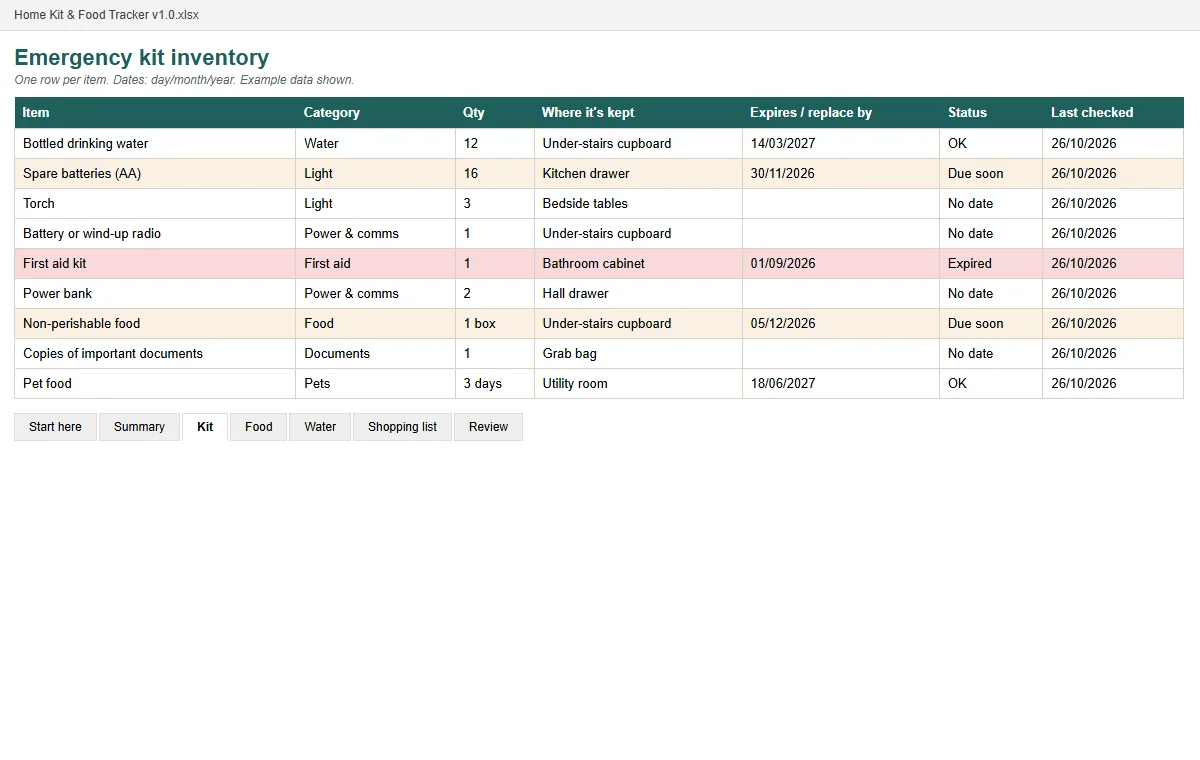 Bundle · £15.97 separatelyPrepared, Not Panicked bundle£9.99
Real pages shown before you buy · instant PDF · one-off price · 30-day refund.
The Power Cut Card for your fridge
Who to call, what to switch off, how long the fridge and freezer stay cold, and how to keep warm. One calm page from official UK advice. Enter your email and we'll take you straight to the download.
We'll also email you when we publish new guides — occasional, never daily. Unsubscribe any time. See our privacy notice.
Frequently asked questions
How long do power cuts last in the UK?
Most are short and local, according to GOV.UK Be Ready. In Great Britain, Ofgem expects power back within 12 hours outside severe weather (24 hours if 5,000 or more properties are affected), 24 hours in storm category 1 and 48 hours in storm category 2. NIE Networks says it fixes nine out of ten cuts in Northern Ireland within three hours.
What should be in a power cut kit?
Based on Be Ready: a battery or wind-up torch and spare batteries, a battery or wind-up FM radio, a charged power bank, blankets and warm clothes, some cash, and the power cut number written down. Keep 3 days of bottled water and no-cook food with a tin opener nearby.
How do I find out when my power will come back?
Check your network operator's website or call 105 free in England, Scotland and Wales. In Northern Ireland, contact NIE Networks on 03457 643643. NIE Networks says its first estimate is usually three hours and is updated once engineers are on site.
What is a rota power cut or load block?
Be Ready says that in the unlikely event of a national energy shortage, power could be cut area by area on a rota, each cut lasting about three hours. Your load block letter shows your area's place in that rota; you can find it at powercut105.com or on your electricity bill.
Can I use a camping stove or generator indoors in a power cut?
No. The UK Chief Medical Officers say not to use camping stoves, barbecues, or petrol or diesel generators indoors, because of the risk of carbon monoxide poisoning. A generator should be outdoors at least 6 metres (20 feet) away, with the exhaust pointing away from windows and doors.
Sources
- GOV.UK Be Ready: Power cuts (checked 28 Oct 2026)
- GOV.UK Be Ready: Checklist PDF (checked 28 Oct 2026)
- Ofgem: Plan for a power cut (checked 28 Oct 2026)
- Ofgem: Check if you can get a payment for a power cut (checked 28 Oct 2026)
- NIE Networks: Why has the estimated restoration time for my power changed? (checked 28 Oct 2026)
- NIE Networks: Customer standards (checked 28 Oct 2026)
- NESO: British electricity supplies secure this winter (checked 28 Oct 2026)
- UK Chief Medical Officers (GOV.UK): Keeping warm or cool in extreme weather (checked 28 Oct 2026)
- Food Standards Agency (GOV.UK): Food safety in a power cut (checked 28 Oct 2026)
- British Red Cross: Prepare an emergency kit (checked 28 Oct 2026)