In short: A ready-made prepper or emergency kit can save time, but no kit on sale is the official standard. GOV.UK's Be Ready checklist asks households to be ready for 3 days, with bottled water (3 litres per person per day for drinking), non-perishable food, a torch and spare batteries, an FM radio, a charged power bank, cash, copies of documents, a first aid kit and essential medication. Before buying, check what you already own, then judge any kit on water, dates, batteries, first aid contents and what it leaves out, such as your own medicines and documents.
Key facts
- GOV.UK's Be Ready checklist says being ready for 3 days helps you manage while support reaches those most in need. Source
- The checklist suggests bottled water for 3 days: 3 litres per person per day for drinking, with more needed for cooking and washing. Source
- Be Ready's first step is to check your cupboards to see what essentials you already keep at home. Source
- Be Ready lists first aid items such as waterproof plasters, bandages, a thermometer, antiseptic, eyewash solution, sterile dressings, gloves, medical tape and tweezers. Source
- The checklist suggests a reminder every six months to check expiry dates and swap out items that need replacing. Source
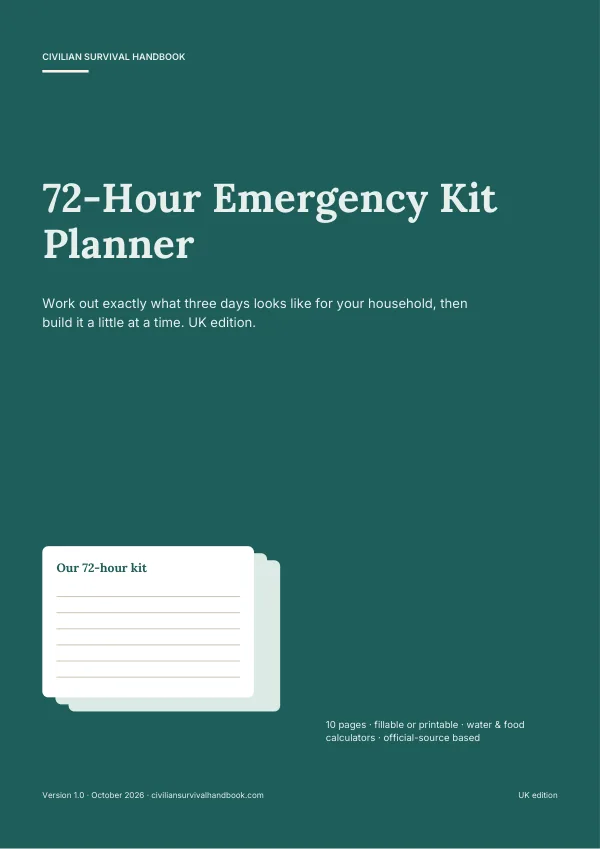 Want this written down for your home? 72-Hour Emergency Kit Planner — printable, £3.99.
Search for a "prepper kit" in the UK and you'll find everything from small grab bags to large boxed sets. Some are useful. None of them is the official standard. The UK government's Be Ready checklist is a list of everyday items, not a product, and it starts by asking you to look at what you already own. This guide helps you decide whether a ready-made kit is worth buying, and how to judge one if you do. We don't recommend brands, and we haven't tested any kits.
What the official checklist actually asks for
GOV.UK's checklist says being ready for 3 days helps you manage while support reaches those most in need. It groups the items like this:
| Group | What Be Ready lists |
|---|---|
| Water | Bottled water for 3 days: 3 litres per person per day for drinking, more for cooking and washing |
| Food | Non-perishable food for 3 days that needs no fridge or cooking, ideally food you'd usually eat |
| Light and warmth | Torch and spare batteries; blankets, sleeping bags and warm clothing |
| Communication | FM radio (battery or wind-up); charged power bank |
| Money and documents | Cash (coins and notes) and cards; copies of IDs and documents; important numbers and medication details |
| Medical | First aid kit or first aid items; essential medication and medical supplies |
| Hygiene | Hand sanitiser, wet wipes, hygiene and bathroom products |
| Babies and pets | Ready-to-feed formula, nappies and wipes; pet food and bottled water |
Our Be Ready checklist explained goes through each line in detail.
What most homes already have
Be Ready's first step is to check your cupboards. Before you buy anything, it's worth a ten-minute look. Many homes already have:
- a torch, and batteries somewhere in a drawer
- blankets, sleeping bags and warm clothes
- tins and dried food in the cupboard
- plasters, painkillers and other basic first aid items
- hand sanitiser, wipes and toiletries
- a phone charger, and perhaps a power bank
Items you're less likely to have lying around are bottled water for three days, an FM radio, a stash of cash, and paper copies of documents and phone numbers. If those are your gaps, they're worth filling first, whether or not you buy a kit. You can tick off what you have on our Be Ready kit list.
Ready-made kit or build your own?
Be Ready's own approach is to build up gradually, picking up an extra item or two during regular shopping to spread the cost. That suits most households.
A ready-made kit can still make sense if you're short of time, if you're setting up a kit for someone else, or if you want a packed bag by the door. The trade-off is that a kit is built for a generic household, not yours. It's a starting point, not the finished job.
How to judge a ready-made kit: questions to ask
Read the full contents list before you buy, not just the headline. These questions are our own suggestions, based on what the official checklist asks for.
Water
- Does it include water at all, or only a way to carry it?
- How much per person? Be Ready suggests 3 litres per person per day for drinking, so 9 litres per person for three days. Check how much water a kit includes against that figure.
- If it's short, where will you keep the rest? Bottled water from the supermarket is fine.
Dates
- Does the listing give expiry or best-before dates for food, water and first aid items?
- Will those dates suit a check every six months, as the checklist suggests?
- Is the food something your household would actually eat? Be Ready says it's best to buy food you'd usually eat.
Batteries and power
- What powers the torch and radio: standard batteries, a built-in rechargeable battery, a wind-up handle, or a mix?
- If they take standard batteries, which size, and are spares included?
- Does it include an FM radio, which is what the checklist names? A torch alone won't give you news.
- Is there a power bank, and does it come charged? Be Ready lists a "charged power bank".
First aid contents
- Is there a contents list for the first aid kit, or just "first aid kit"?
- How does it compare with a home list? Be Ready suggests items such as waterproof plasters, bandages, a thermometer, antiseptic, eyewash solution, sterile dressings, gloves, medical tape and tweezers.
- What's missing that you'd add anyway? Our home first aid kit guide has a fuller list.
Light, warmth and hygiene
- Does it include blankets or a sleeping bag for each person, or only a thin emergency blanket?
- Does it include hand sanitiser, wipes and basic toiletries?
What it leaves out
- Medication: no kit can include your prescriptions.
- Documents and phone numbers on paper.
- Cash.
- Baby, pet or special-diet items.
If a kit fails several of these, you may get more from spending the same money on the gaps in your own cupboards.
Extras that aren't on the official list
Many kits add items such as a whistle, light sticks or a multi-tool. Some are useful. The British Red Cross list includes a whistle and spare keys, for example. But extras don't make up for missing water, a radio or first aid basics. Judge a kit on the checklist items first and the extras second.
Avoid paying for things you couldn't safely use at home. Camping stoves and fuel-burning heaters aren't on the Be Ready list, and our 72-hour kit guide explains why they don't belong indoors.
Finishing the job
Whatever you choose, the steps from the checklist are the same:
- Add the personal items: medication, document copies, a written contact list, cash, and food your family eats.
- Work out your water: our emergency supplies calculator gives the amounts for your household.
- Keep it together somewhere everyone can reach, ideally in the dark.
- Check it every six months. The checklist suggests a reminder every six months to check expiry dates and swap out items.
For the full room-by-room picture, see our 72-hour emergency kit guide.
Limitations
This is general information based on GOV.UK Be Ready and British Red Cross guidance, checked on 29 October 2026. We don't review or recommend specific kits or brands, and the government doesn't endorse any. Advice differs slightly in Scotland, Wales and Northern Ireland, so check the guidance for where you live.
Turn this guide into a written plan
Reading helps. Writing it down is what makes it work when the phones are flat. Start with the free plan builder, or get the full printable version:
For this topic72-Hour Emergency Kit Planner£3.99 Your whole household planHousehold Emergency Plan Pack£6.99
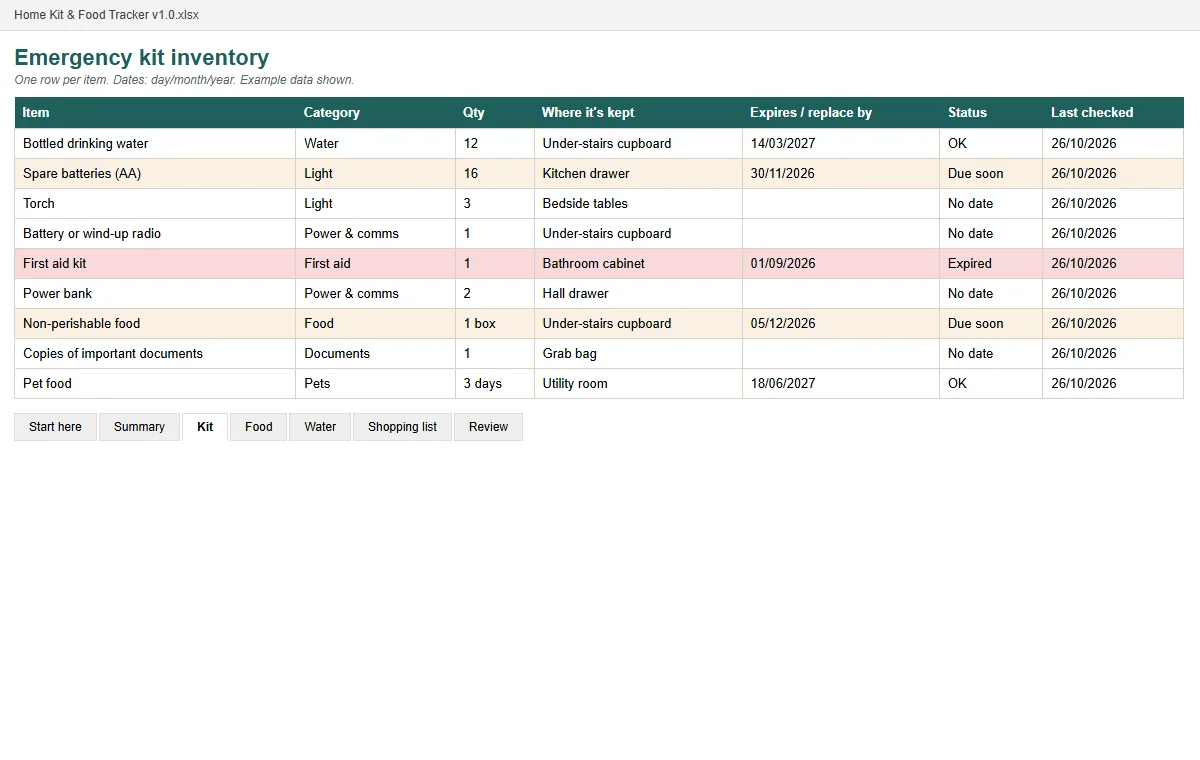 Bundle · £15.97 separatelyPrepared, Not Panicked bundle£9.99
Real pages shown before you buy · instant PDF · one-off price · 30-day refund.
Get the free 72-hour UK household checklist
Tick-box lists for each part of a UK home emergency kit, plus the key numbers on one page. Enter your email and we'll take you straight to the download.
That email address doesn't look right — please check it and try again.
We'll also email you when we publish new guides — occasional, never daily. Unsubscribe any time. See our privacy notice.
Frequently asked questions
Do I need to buy a prepper kit?
No. GOV.UK's Be Ready checklist starts with checking your cupboards, then picking up missing items during regular shopping. A ready-made kit is one option if you're short of time, not a requirement.
Does any ready-made kit meet the government checklist?
The government doesn't approve or endorse kits. The only way to know is to compare the kit's contents list with the Be Ready checklist yourself, item by item.
How much water should a 72-hour kit have?
Be Ready suggests 3 litres per person per day for drinking, for 3 days. That's 9 litres per person, before cooking, washing, pets or baby formula. Many grab bags can't hold that much, so plan to keep bottled water separately.
What won't a ready-made kit include?
Anything personal to your household: your prescribed medicines, copies of your documents, your contact list, food your family actually eats, and baby or pet supplies. You'll need to add these yourself.
How often should I check a bought kit?
The Be Ready checklist suggests every six months: check expiry dates, swap out items that need replacing, and update the kit if your household's needs have changed.
Sources
- GOV.UK Be Ready: Checklist (PDF, October 2026) (checked 29 Oct 2026)
- GOV.UK Be Ready: Be ready for emergencies (checked 29 Oct 2026)
- British Red Cross: Prepare an emergency kit (checked 29 Oct 2026)