In short: GOV.UK's Be Ready checklist says to keep baby formula, nappies and wipes in your 3-day kit, and that ready-to-feed formula is best because you may not be able to boil water to make up powdered formula safely. In a power cut, the NHS and The Lullaby Trust advise keeping a baby's room at 16 to 20°C where possible, adding a layer rather than a hat or duvet, and never using a hot water bottle or electric blanket with a baby. Call 999 in an emergency and NHS 111 for urgent advice.
Key facts
- The Be Ready checklist lists baby formula, nappies and wipes, and says ready-made or ready-to-feed formula is best, as you may not be able to boil water to make up powdered formula safely. Source
- The NHS says to make up powdered formula with freshly boiled tap water left for no more than 30 minutes, so it stays at 70°C or above. Source
- The NHS says to keep sterilising feeding equipment until your baby is at least 12 months old. Source
- The Lullaby Trust recommends a room temperature of 16 to 20°C for babies, and says to check whether a baby is too hot by feeling their chest or the back of their neck. Source
- Ofgem says people who are pregnant or have young children can join their energy supplier's Priority Services Register. Source
 Want this written down for your home? Household Emergency Plan Pack — printable, £6.99.
A baby changes what "three days without power or water" looks like. Bottles need making up and sterilising, the room needs to stay a safe temperature, and the things you'd normally pop out for become harder to get. None of it needs much space or money. This guide covers the baby-specific parts of an emergency plan; for the rest of the household, start with our Be Ready checklist guide and the 72-hour kit.
What goes in a baby emergency kit?
The government's Be Ready checklist has a baby products section: baby formula, plus nappies and wipes. It says ready-made or "ready-to-feed" formula is best, because you may not be able to boil water to make up powdered formula safely.
Add these to your household kit:
- Ready-to-feed formula for 3 days, if your baby has formula
- Nappies and wipes for 3 days
- Extra bottled water for any formula you make up. Be Ready's water page says to plan for extra water for making formula on top of 3 litres per person per day
- Clean bottles and teats, and a way to sterilise them (see below)
- A sleep bag or light layers, and a room thermometer
- Your baby's medicines, with names and doses written on paper
- Your baby's red book, or a note of what's in it
Our free emergency supplies calculator works out water and food for your household, and the Be Ready kit list lets you tick off what you already have. Check dates on formula when you check the rest of your kit.
Feeding when you can't boil water
Be Ready calls ready-to-feed formula the safest option in an emergency, since you may not be able to boil water or sterilise bottles. It also says powdered formula isn't sterile, so only mix it with freshly boiled water.
When you can boil water, the NHS says:
- Wash your hands, clean the surface, and use sterilised bottles and teats.
- Use tap water that has just been boiled, left in the kettle for no more than 30 minutes so it stays at 70°C or above.
- Pour the water in first, then add the powder with the scoop that comes with it.
- Cool the bottle under cold running water and test it on the inside of your wrist.
- Make feeds one at a time, and throw away any formula left after a feed.
What about bottled water? The NHS says bottled water isn't generally recommended for formula, as it isn't sterile and may be high in sodium or sulphate. It can be used in rare cases, such as when tap water is unavailable or contaminated. Be Ready says to use still bottled water within the sodium and sulphate limits on the label, and to boil it first. If your area has a boil water notice, follow your water company's instructions too: see our boil water notice guide.
Sterilising bottles in an outage
The NHS says to keep sterilising feeding equipment until your baby is at least 12 months old. It describes three methods:
| Method | What the NHS says | Needs power? |
|---|---|---|
| Cold-water sterilising solution | Follow the maker's instructions, soak for at least 30 minutes, change the solution every 24 hours | No, but you need clean water |
| Steam (electric or microwave) | Follow the maker's instructions | Yes |
| Boiling | Only items labelled safe to boil; keep them under water in a pan for at least 10 minutes | Needs a hob |
Wash bottles and teats in hot soapy water and rinse them in cold running water before sterilising. A dishwasher cleans but does not sterilise. If you usually use a steam steriliser, it can help to know about the cold-water option in case the power goes off.
Keeping a baby warm in a power cut
Safe-sleep advice still applies when the heating is off. The Lullaby Trust recommends a room temperature of 16 to 20°C and says a room thermometer helps, because temperature is hard to judge by feel.
From The Lullaby Trust and the NHS:
- In cold weather, adding a layer usually helps.
- Use light bedding or a well-fitting baby sleep bag, not a duvet or quilt.
- No hats indoors. Take off hats and extra layers when you come inside.
- Check warmth by feeling your baby's chest or the back of the neck. Hands and feet often feel cool, which is normal. If the skin feels hot or sweaty, remove a layer.
- Never use a hot water bottle or electric blanket with your baby, and keep them away from heaters, radiators and fires.
- Lay your baby on their back, in their own sleep space, in your room.
- Never fall asleep with your baby on a sofa or armchair. That's worth remembering if the family gathers in one warm room.
If you use any other way to heat the home, never use a barbecue or camping stove indoors: see our carbon monoxide guide. For the power cut itself, our power cuts guide covers what to do and the 105 number.
And in a heatwave
The NHS suggests light layers, a room of 16 to 20°C, and not pointing a fan directly at your baby. Formula-fed babies can have a little cooled boiled water alongside their usual feeds. Never leave a baby in a parked car. Our heatwave guide covers the rest of the home.
Medicines and the red book
Be Ready's checklist asks you to keep important phone numbers and information, such as regular medication and doses, on paper. For a baby, write down each medicine, the dose and when it's given, plus your GP, health visitor and pharmacy.
The red book is your baby's personal child health record. The NHS says it records weight, height, vaccinations and other key information, and suggests taking it to every baby clinic or GP visit. Keep it somewhere you could grab it quickly, and consider a photo of the vaccination pages on your phone and a copy with your important documents.
If you run out of a repeat medicine, our emergency prescription guide explains the options.
Join the Priority Services Register
Ofgem lists people who are pregnant or have young children as eligible for their energy supplier's Priority Services Register. It's free, and water companies run one too. See our Priority Services Register guide.
Who to call
The NHS says to call 999 or go to A&E for a child under 5 who, for example:
- is breathing very fast or with difficulty
- has blue, grey, pale or blotchy skin, lips or tongue
- is hard to wake, or is having a seizure
- feels cold, or has a temperature below 36°C
- is under 3 months with a temperature of 38°C or higher
| Situation | Who |
|---|---|
| Emergency | 999 |
| Worried, or not sure what to do | NHS 111 |
| Power cut (England, Scotland, Wales) | 105 |
| No water | Your water company |
Call 999 in an emergency, and 111 for urgent advice.
Write it down
Agree who would collect your baby if you can't get home, and which relative or neighbour could take you in if your home gets too cold. Our free household plan builder turns this into a one-page plan. For older children, the Our Family Plan kids' pack helps them learn the plan too.
Limitations
This is general information based on GOV.UK Be Ready, NHS, The Lullaby Trust and Ofgem advice, checked on 29 October 2026. It isn't medical advice. Ask your health visitor, GP or pharmacist about your own baby, call 999 in an emergency and NHS 111 for urgent advice. Some services and numbers differ in Scotland, Wales and Northern Ireland; in Northern Ireland, report power cuts to NIE Networks on 03457 643643.
Turn this guide into a written plan
Reading helps. Writing it down is what makes it work when the phones are flat. Start with the free plan builder, or get the full printable version:
Your whole household planHousehold Emergency Plan Pack£6.99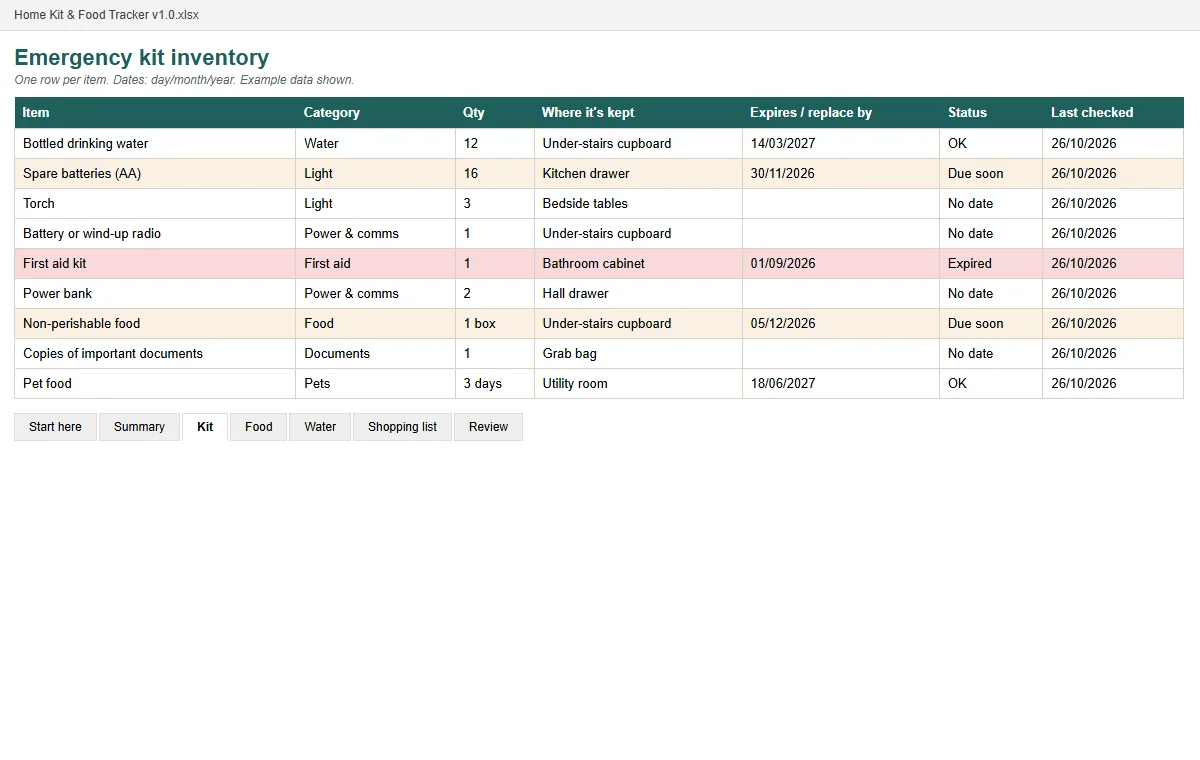 Bundle · £15.97 separatelyPrepared, Not Panicked bundle£9.99
Real pages shown before you buy · instant PDF · one-off price · 30-day refund.
Get the free 72-hour UK household checklist
Tick-box lists for each part of a UK home emergency kit, plus the key numbers on one page. Enter your email and we'll take you straight to the download.
That email address doesn't look right — please check it and try again.
We'll also email you when we publish new guides — occasional, never daily. Unsubscribe any time. See our privacy notice.
Frequently asked questions
What should be in a baby emergency kit?
The Be Ready checklist lists baby formula (ready-to-feed is best), nappies and wipes. Add extra bottled water for any formula you make up, your baby's medicines and doses written down, and your baby's red book or a note of what's in it.
Why ready-to-feed formula rather than powder?
Be Ready says you may not be able to boil water to make up powdered formula safely in an emergency. Powdered formula isn't sterile, so the NHS says to make it up with freshly boiled tap water at 70°C or above.
Can I use bottled water to make up formula?
The NHS says bottled water isn't generally recommended, but it can be used in rare cases when tap water is unavailable or contaminated. Be Ready says to use still bottled water within the sodium and sulphate limits on the label, and to boil it first.
How do I keep a baby warm in a power cut?
The Lullaby Trust and NHS advise a room temperature of 16 to 20°C where possible, adding a layer, using light bedding or a well-fitting sleep bag, and checking warmth at the chest or back of the neck. Don't use hats indoors, duvets, hot water bottles or electric blankets.
When should I call 999 for a baby?
The NHS says to call 999 or go to A&E if a baby is struggling to breathe, has blue, grey or pale skin, is hard to wake, has a seizure, or a baby under 3 months has a temperature of 38°C or higher. For other worries, call NHS 111.
Can I join the Priority Services Register with a baby?
Yes. Ofgem lists people who are pregnant or have young children as eligible to join their energy supplier's register. Water companies also run one.
Sources
- GOV.UK Be Ready: Checklist, PDF (checked 29 Oct 2026)
- GOV.UK Be Ready: Water supply interruptions or outages (checked 29 Oct 2026)
- GOV.UK Be Ready: Be ready for emergencies (checked 29 Oct 2026)
- NHS: How to make up baby formula (checked 29 Oct 2026)
- NHS: Sterilising baby bottles (checked 29 Oct 2026)
- The Lullaby Trust: Room temperature (checked 29 Oct 2026)
- NHS: Sudden infant death syndrome (SIDS) (checked 29 Oct 2026)
- NHS: Safety in the sun for babies (checked 29 Oct 2026)
- NHS: Your baby's health and development reviews (checked 29 Oct 2026)
- NHS: Is your baby or toddler seriously ill? (checked 29 Oct 2026)
- Ofgem: Join your supplier's Priority Services Register (checked 29 Oct 2026)