What is the first step in an emergency plan for a disabled person?
Tell 3 your support network, your suppliers, your care team
Be Ready says tell friends, family, carers and neighbours what support you'd need, register with your energy and water suppliers' Priority Services Register, and plan with your care provider or clinical team now if you rely on powered equipment.
Source: GOV.UK Be Ready: Advice for disabled people and carers (checked 31 October 2026)
In short: GOV.UK Be Ready's advice for disabled people is to tell your support network what you'd need in an emergency, join the Priority Services Register, check whether telecare and landlines work in a power cut, plan with your care provider or clinical team for powered equipment such as wheelchairs, stairlifts or oxygen machines, and keep a written personal plan with contacts, medicines, equipment instructions and charged back-up batteries. Deaf people can use the free 999 BSL service.
Key facts
- Be Ready advises disabled people to register with their water, gas and electricity suppliers' Priority Services Register, directly or at thepsr.co.uk. Source
- If you rely on an electric wheelchair, stairlift, oxygen machine or other vital equipment, Be Ready says plan now with your care provider and/or clinical team. Source
- Be Ready says ask your provider whether a landline or telecare device works in a power cut; providers may offer a free back-up battery unit lasting at least one hour. Source
- Be Ready points D/deaf people and BSL users to the 999 BSL service and app, and advises keeping spare batteries for hearing and communication devices. Source
- Be Ready says building owners or managers have fire safety duties for emergency routes and evacuation, and a Personal Emergency Evacuation Plan (PEEP) can help people with mobility or other needs at work. Source
The government's Be Ready campaign has a page written for disabled people and carers. Its message is practical: many of the steps cost nothing, take little time, and make a real difference when the power, phones or water are off. This guide sets out that advice in plain English, with a checklist at the end.
We're an independent site, not part of the campaign. If you need advice about your own care or equipment, your care provider, clinical team or GP is the right first contact.
Let people know you may need support
Be Ready suggests:
- Tell friends, family, carers, neighbours and your support network what you'd need in an emergency, and how your needs might change.
- Register with your water, gas and electricity suppliers' Priority Services Register. It's free. See our Priority Services Register guide. In Northern Ireland it's the Customer Care Registers.
- If you move house, tell the organisations that support you as soon as possible.
- Consider a medical alert tag or bracelet, and add medical information to your phone (ICE or Medical ID).
- Arrange for a neighbour or trusted person to check on you if they haven't heard from you.
Write a personal plan
Be Ready says keep the plan somewhere easy to reach and tell your support network where it is. Include:
| Section | What to write |
|---|---|
| Contacts | Support network, carer, GP, pharmacy, hospital specialist, mental health support worker |
| Medicines | What you take, where it's kept, enough for several days, ideally in a waterproof container |
| Equipment | Instructions for medical devices, with back-up batteries kept charged |
| Treatment | Details of any ongoing treatment |
| Your home | How to switch off gas, electricity and water; see how to turn them off |
Powered equipment and power cuts
If you rely on an electric wheelchair, stairlift, oxygen machine or other vital equipment, Be Ready says plan now with your care provider and/or clinical team. Find out how your equipment behaves when the power goes off, and ask your provider or supplier what to do in an emergency.
Be Ready's power cut page adds: keep a charged power bank for phones or compatible medical devices, and report power cuts on 105 (03457 643643 in Northern Ireland).
Telecare and landlines
If you can only call 999 by landline, or your telecare alarm uses a landline, ask your provider whether it works in a power cut. Providers may offer a free back-up, such as a battery unit lasting at least one hour. Landlines are moving to digital, which doesn't work in a power cut without a back-up; see our digital landline switchover guide.
Extra steps by need
Mobility
- Think about how a power cut affects a powered wheelchair or stairlift.
- Keep your mobile phone with you.
- Arrange a way for someone you trust to get in, such as a spare key.
- At work, ask about a Personal Emergency Evacuation Plan (PEEP). Be Ready says building owners and managers have fire safety duties for emergency routes and evacuation.
Sensory and communication
- Decide how you'll be alerted, and ask family or your support network to keep you updated.
- Carry a card (or a note on your phone) explaining how responders can communicate with you.
- Sign up for Emergency Alerts, which use sound and vibration.
- Deaf and BSL users: know the 999 BSL service and download its app. Keep spare batteries for hearing and communication devices, and a spare charged battery pack if your device uses one.
- Blind or partially sighted: keep a long cane or other mobility aid in a familiar place.
Learning disabilities and autism
Be Ready points to Mencap, the National Autistic Society and the Down's Syndrome Association for support and advice.
Assistance animals
Be Ready suggests a grab bag for your animal (documents, vet records, food and water, lead or harness, medicines, a blanket), giving your carer the contacts for your vet and the organisation that provided the animal, and making sure the animal can be identified.
For carers
- Keep a list of emergency contacts who may need to be reached.
- Ask your council whether it offers a carer's card, which shows that someone depends on you.
- Agree how you'll contact the person you care for. If you can't reach them, or it isn't safe to visit, Be Ready says call the emergency services and tell them someone who relies on you may be at risk.
- Carers UK can help you make an emergency plan for the person you look after.
Checklist
- Priority Services Register
- Support network told what you'd need
- Personal plan written, and people know where it is
- Equipment plan agreed with care provider or clinical team
- Telecare or landline back-up checked
- Spare batteries charged; power bank charged
- Someone to check on you, and a way for them to get in
- 999 BSL app, if you use BSL
- 3 days of water, food and medicines, as in the Be Ready checklist
Limitations
This is general information based on GOV.UK Be Ready, not medical, legal or care advice. Plan powered equipment and medicines with your care provider, clinical team, GP or pharmacist. In an emergency, call 999 (or use 999 BSL). Registers and numbers differ in Northern Ireland, Scotland and Wales.
Turn this guide into a written plan
Reading helps. Writing it down is what makes it work when the phones are flat. Start with the free plan builder, or get the full printable version:
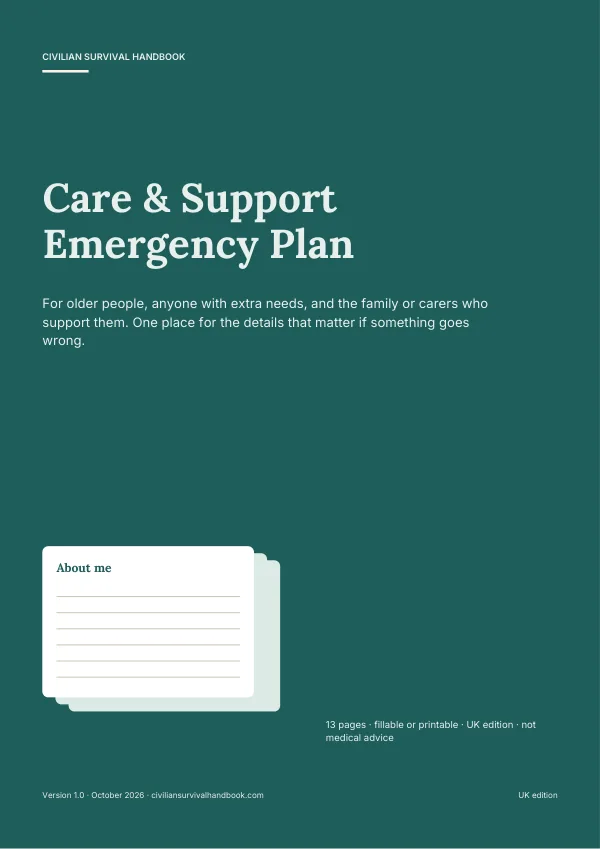 For this topicCare & Support Emergency Plan£4.99
 Your whole household planHousehold Emergency Plan Pack£6.99
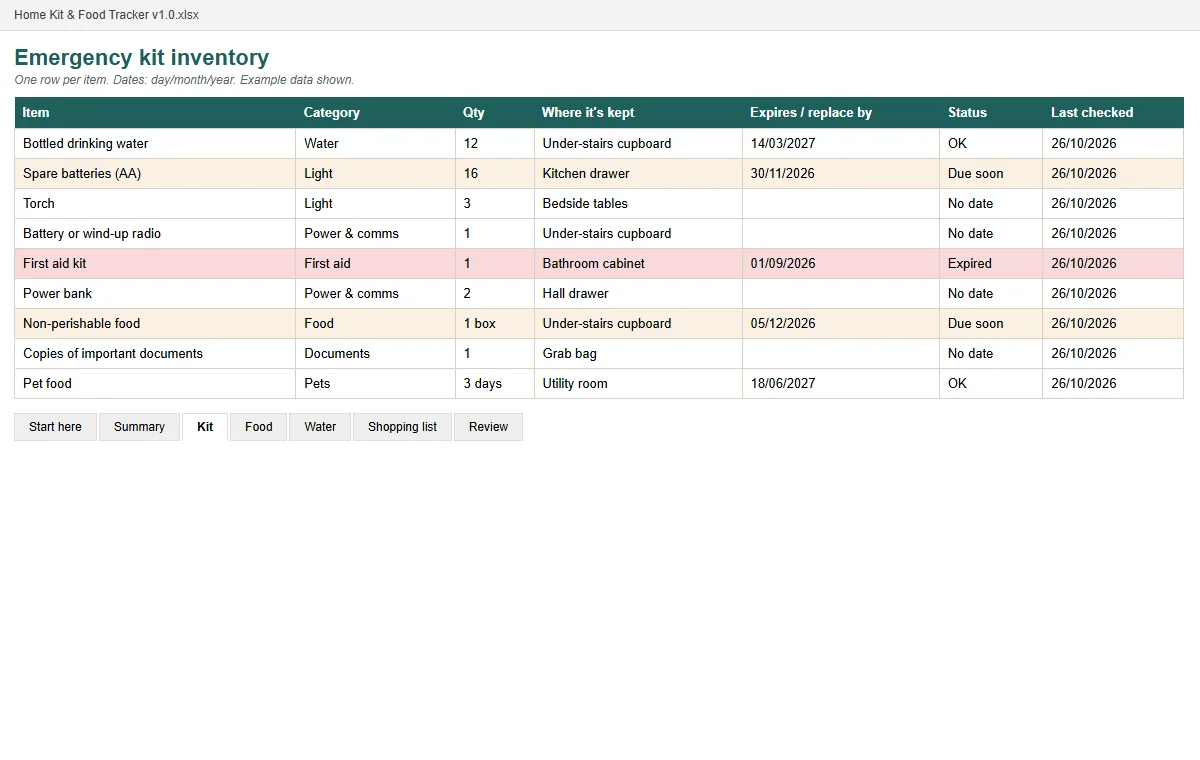 Bundle · £15.97 separatelyPrepared, Not Panicked bundle£9.99
Real pages shown before you buy · instant PDF · one-off price · 30-day refund.
Get the free 72-hour UK household checklist
Tick-box lists for each part of a UK home emergency kit, plus the key numbers on one page. Enter your email and we'll take you straight to the download.
That email address doesn't look right — please check it and try again.
We'll also email you when we publish new guides — occasional, never daily. Unsubscribe any time. See our privacy notice.
Frequently asked questions
What should a disabled person's emergency plan include?
Be Ready lists: written contacts (support network, carer, GP, pharmacy, specialist, mental health worker), your regular medicines and where they're kept, enough for several days, instructions for medical equipment with charged back-up batteries, details of ongoing treatment, and how to turn off gas, electricity and water.
What happens to my medical equipment in a power cut?
It depends on the equipment. Be Ready says plan now with your care provider, clinical team or equipment supplier, and understand how your equipment works during a power disruption. Join the Priority Services Register too.
How do Deaf people contact 999?
Be Ready points to the 999 BSL service, which has an app for phones and tablets. It also advises signing up for Emergency Alerts, which use sound and vibration.
Is there help for carers?
Be Ready says your council may offer a carer's card showing that someone depends on you, and points to Carers UK, which can help you make an emergency plan for the person you care for.
Who checks on me if the phones are down?
Be Ready suggests arranging for a neighbour or trusted person to check on you if they haven't heard from you, and, for people with mobility needs, giving someone you trust a way into your home, such as a spare key.
Sources
- GOV.UK Be Ready: Advice for disabled people and carers (checked 31 Oct 2026)
- GOV.UK Be Ready: Power cuts (checked 31 Oct 2026)
- Priority Services Register (checked 31 Oct 2026)
- 999 BSL (linked from Be Ready, checked 31 Oct 2026)
- Carers UK: Getting help in an emergency (linked from Be Ready, checked 31 Oct 2026)