What should children know for an emergency?
2 things their home address and a parent's mobile number
Be Ready says talk to children about when and how to call 999, and practise their home address and a parent or guardian's mobile number with them. Make sure their school or childcare has your correct numbers.
Source: GOV.UK Be Ready: Be ready for emergencies (checked 31 October 2026)
In short: GOV.UK Be Ready asks parents to talk to children about emergencies, including when and how to call 999, to practise their home address and a parent's mobile number, and to make sure their school or childcare has the right contact numbers. Keep it short, practical and matter-of-fact, give children a job in the family plan, and use free resources such as StayWise, which brings together safety materials from UK emergency services.
Key facts
- Be Ready asks parents to talk to children about emergencies, including when and how to call emergency services, and to practise their home address and a parent or guardian's mobile number. Source
- Be Ready advises making sure your child's school or childcare provider has your correct contact numbers, and knowing their emergency procedures. Source
- Be Ready points to the StayWise website for child-friendly safety resources. StayWise says its free materials come from UK fire and rescue services, police, paramedics, the RNLI and HM Coastguard. Source
- The Be Ready household plan's rules are: for an emergency outside the home, go in, stay in, tune in; for one inside the home, get out, stay out, ring 999. Source
- Be Ready's coping with trauma page links to an NHS leaflet with advice on supporting children after a major incident, and says to speak to a GP if strong feelings last beyond about 2 to 4 weeks. Source
Children notice when adults talk about something new, and since 22 October the Be Ready campaign has been on the radio, on TV and in the news. Some will ask questions. The calm answer is a practical one: every family is being asked to have a torch, some water and a plan, in the same way every home has a first aid kit. Children cope best when they know what to do and have a job of their own.
GOV.UK Be Ready asks parents to talk to children about emergencies. Here's how to do it simply.
What Be Ready asks parents to do
Under "talk to others", Be Ready says:
- Talk to children about emergencies, including when and how to call emergency services.
- Practise your child's home address and a parent or guardian's mobile number.
- Make sure your child's school or childcare has your correct contact numbers, and that you know their emergency procedures.
- Use child-friendly resources such as StayWise.
How to start the conversation
Keep it short and ordinary. A few ideas:
- Link it to something they know. "You know how we have plasters in the cupboard in case someone cuts their knee? We're doing the same for when the power goes off."
- Talk about what you'll do, not what might happen. The plan, the torch, the meeting point.
- Answer the question they asked, then stop. If they want more, they'll ask.
- Be honest and calm. "Most power cuts are short. If one happens, we know what to do."
The three things every child can learn
1. Their address and a parent's mobile number
Practise like a times table: in the car, at bath time, on the walk to school. Be Ready asks for both. Write them on a card in their school bag too.
2. When and how to call 999
Children need to know when as well as how: someone is badly hurt or won't wake up, there's a fire, or someone needs help right now. Practise what to say with a pretend phone: their name, the address, and what has happened. Explain that the call handler will help them and that they should stay on the line.
3. Two short rules
The Be Ready household plan has two rules children can remember:
| If the problem is... | The rule |
|---|---|
| Inside the home (for example a fire) | Get out, stay out, ring 999 |
| Outside the home | Go in, stay in, tune in |
Practise your fire escape route together, as Be Ready suggests. Our home fire escape plan guide shows how.
Give them a job
Children feel safer when they have a part to play. Ideas by age:
| Age | A job they can own |
|---|---|
| 3 to 5 | Know where the torch lives. Choose a comfort toy for the kit. |
| 6 to 9 | Keeper of the torch: test it every six months. Learn the meeting point. |
| 10 to 13 | Help check dates on the food and water. Learn where the stopcock is. |
| Teenagers | Save ICE numbers on their phone. Help an older neighbour with the plan. |
A small comfort bag helps younger children: a book, a card game, a snack they like and a soft toy. A power cut by torchlight can feel like an adventure.
Our free Be Ready Together activity sheet turns the plan into a family activity.
If your child is worried
- Listen first. Ask what they've heard.
- Keep routines. Meals, bedtime and school as normal.
- Limit the news for younger children, and watch it with older ones.
- Get help if it lasts. Be Ready's coping with trauma page links to NHS advice on supporting children after a major incident, and says to speak to your GP if strong feelings last beyond about 2 to 4 weeks.
Free resources
- StayWise: free safety activities for ages 3 to 11 and 11 to 18, made by UK fire and rescue services, police, paramedics, the RNLI and HM Coastguard.
- Be Ready Together: our free printable family sheet.
- Household emergency plan: fill it in as a family.
Limitations
This is general information, not professional advice on children's health or wellbeing. If you're worried about your child, speak to your GP, health visitor or school. In an emergency, call 999.
Turn this guide into a written plan
Reading helps. Writing it down is what makes it work when the phones are flat. Start with the free plan builder, or get the full printable version:
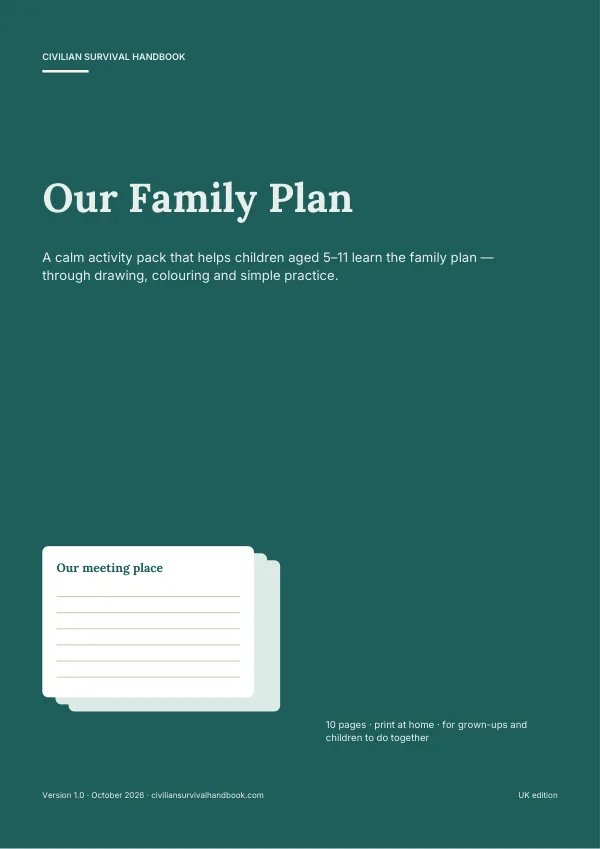 For this topicOur Family Plan — kids' activity pack£2.99
 Your whole household planHousehold Emergency Plan Pack£6.99
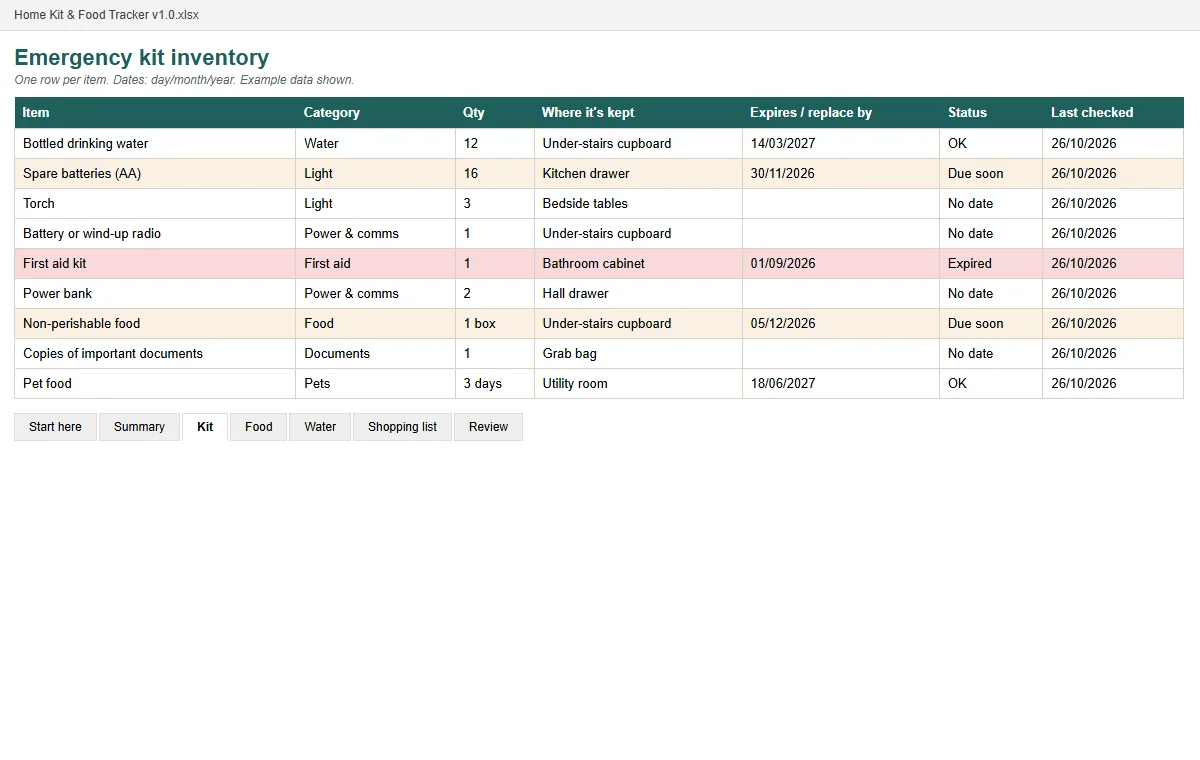 Bundle · £15.97 separatelyPrepared, Not Panicked bundle£9.99
Real pages shown before you buy · instant PDF · one-off price · 30-day refund.
Get the free 72-hour UK household checklist
Tick-box lists for each part of a UK home emergency kit, plus the key numbers on one page. Enter your email and we'll take you straight to the download.
That email address doesn't look right — please check it and try again.
We'll also email you when we publish new guides — occasional, never daily. Unsubscribe any time. See our privacy notice.
Frequently asked questions
At what age should I teach my child to call 999?
Be Ready doesn't give an age. A good time to start is when your child can say their address and use a phone. Teach when to call (someone is badly hurt, there's a fire, or someone needs help right now) as well as how.
How do I talk to my child about the Be Ready campaign without worrying them?
Keep it short and practical, like learning to cross the road. Explain that the government is asking every family to have a torch, water and a plan, the same as a first aid kit, and give your child a small job in it.
What can children do to help?
Look after the torch, check the batteries every six months, pack a small comfort bag, learn the meeting point, and remember the family's address and a parent's mobile number.
What if my child is upset after an emergency or something on the news?
Listen, answer simply and keep normal routines. Be Ready links to NHS advice on supporting children after a major incident. If worries last beyond a few weeks, speak to your GP.
Are there free resources for children?
Yes. Be Ready points to StayWise, which has free activities for ages 3 to 11 and 11 to 18 from UK emergency services. We also have a free Be Ready Together activity sheet.
Sources
- GOV.UK Be Ready: Be ready for emergencies, talk to others (checked 31 Oct 2026)
- GOV.UK Be Ready: Household emergency plan, PDF (read 31 Oct 2026)
- GOV.UK Be Ready: Coping with trauma (checked 31 Oct 2026)
- StayWise (checked 31 Oct 2026)