In short: In the UK, watch Met Office weather warnings (yellow, amber, red), which cover rain, thunderstorms, wind, snow, lightning, ice, extreme heat and fog up to seven days ahead. In England, UKHSA also issues heat-health alerts from 1 June to 30 September. Sign up for free flood warnings, call 999 for any wildfire, and keep a simple household plan and kit.
Key facts
- Met Office warnings cover rain, thunderstorms, wind, snow, lightning, ice, extreme heat and fog, up to seven days ahead. Source
- A red warning means dangerous weather is expected and, if you haven't already done so, you should take action now. Source
- UKHSA's Weather-Health Alerting System is run in partnership with the Met Office; the core heat-health alert season runs from 1 June to 30 September. Source
- A storm is named when it is expected to cause disruption or damage significant enough to warrant an amber or red warning. Source
- Floodline (0345 988 1188) is a 24-hour service for England, Scotland and Wales; you cannot get flood warnings for surface water flooding. Source
- If you see a wildfire, call 999 immediately and do not assume someone else has already reported it. Source
 Want this written down for your home? Storm & Flood Plan — printable, £4.99.
If heatwaves, storms or wildfire news have you wondering how to prepare, the most useful thing is to know which warnings to watch and what each one asks you to do. This guide brings together the official UK advice on heatwaves, storms, floods and wildfires, then turns it into one simple household plan. Prepared, not panicked.
How do UK weather warnings work?
The Met Office issues National Severe Weather Warnings at any time of day or night, up to seven days ahead, for eight types of weather: rain, thunderstorms, wind, snow, lightning, ice, extreme heat and fog. Each warning has a headline, a "What to expect" section and a "What should I do" section.
The colour is not just about how bad the weather will be. It combines the likely impact with how likely those impacts are, shown as a tick on an impact matrix in the warning's "Further details" section. The Met Office updated its matrix and impact wording in October 2026, so always read the warning text rather than relying on the colour alone.
| Colour | What the Met Office says | What to do |
|---|---|---|
| Yellow | Often issued when there is a high likelihood of some moderate impacts; some cover bigger impacts that are less certain | Read the details and check whether it affects your plans |
| Amber | An increased likelihood of impacts from severe weather that could disrupt your plans | Think about changing plans and protecting yourself and your property |
| Red | Dangerous weather is expected — take action now if you haven't already | Follow the advice of emergency services and local authorities |
When two types of weather combine, such as rain and wind, the Met Office issues one warning covering both. In the most serious, life-threatening situations, you may also get a government Emergency Alert on your phone.
Heatwaves: what is a heat-health alert?
Alongside Met Office warnings, the UK Health Security Agency runs the Weather-Health Alerting System in partnership with the Met Office. It has heat-health alerts and cold-health alerts. The core heat-health alert season runs from 1 June to 30 September, with "extraordinary" alerts possible outside those dates. Alerts are issued for regions of England, and anyone can register on GOV.UK to receive them by email.
According to UKHSA's user guide:
- Yellow alerts can be issued when heat is unlikely to affect most people but those who are particularly vulnerable are likely to struggle.
- Amber means impacts are likely across the whole health service, with potential for the whole population to be at risk.
- Red indicates significant risk to life even for healthy people.
How do I keep my home and family cool?
- Close windows, curtains and blinds in the day, especially in sun-facing rooms, and open them when it's cooler at night.
- Stay in the shade, especially between 11am and 3pm, and avoid activity that makes you hotter.
- Drink plenty of fluids and take water with you on journeys. Avoid alcohol, caffeine and hot drinks.
- Electric fans can help if the temperature is below 35°C.
- Check on people at higher risk, including those aged 65 and over, babies and children aged 5 and under, pregnant people, people with long-term conditions and people who live alone.
When is heat exhaustion an emergency?
The NHS says someone with heat exhaustion should start to feel better within 30 minutes of cooling down. Call 999 if they are still unwell after 30 minutes resting in a cool place, or have signs of heatstroke such as a very high temperature, hot skin that isn't sweating, fast breathing, confusion, a seizure or loss of consciousness. For other worries, contact a pharmacist, your GP or NHS 111.
Storms: how do I prepare?
The Met Office says a storm is named when it is expected to cause disruption or damage significant enough to warrant an amber or red warning. Names are chosen jointly by the Met Office, Met Éireann and the Dutch weather service KNMI.
Be Ready's storm advice in short:
- Before: charge phones, power banks and backup batteries for medical equipment; secure ladders, trampolines and garden furniture; close and fasten doors and windows; park away from trees and walls if you can.
- During: stay indoors unless you really have to go out; don't try to repair your property mid-storm; slow down and watch for side winds if you must drive.
- After: keep well away from fallen or hanging power and phone lines. High-voltage electricity can jump gaps without warning. Report damaged lines and power cuts to 105 (England, Scotland and Wales) or 03457 643643 (Northern Ireland).
The government's National Risk Register 2025 says a regional failure of the electricity network would most likely be caused by extreme weather, so read our power cuts guide and the detailed storm and flood preparation guide.
Floods: how do I get warnings?
Sign up for free flood warnings by phone, text or email. They cover flooding from rivers, the sea and groundwater, but you cannot get flood warnings for surface water flooding, so watch Met Office rain warnings too.
| Where you live | How to get warnings or report flooding |
|---|---|
| England | Sign up on GOV.UK or call Floodline on 0345 988 1188 (24 hours) |
| Scotland | Register with SEPA's MyFloodline, or call Floodline |
| Wales | Sign up with Natural Resources Wales, or call Floodline |
| Northern Ireland | Report flooding to the Flooding Incident Line on 0300 2000 100 |
Be Ready says never walk through flood water, as it may contain sewage and hide debris or open drain covers. If you meet a flooded road while driving, turn around and find another route. Make a personal flood plan, and keep a flood kit with insurance documents, a torch, a battery or wind-up radio, warm waterproof clothes, medicines, bottled water and food.
Wildfires: what should I do?
Wildfires are not just a hot-country problem. In August 2026 the government sent an Emergency Alert to phones across England and Wales asking people not to light anything that could start a fire, and announced a temporary ban on the sale of disposable barbecues while the heightened risk continued. Check GOV.UK for whether any restrictions still apply.
If you see a wildfire (Be Ready):
- Get yourself to safety, away from the flames.
- Call 999 immediately. Don't assume someone else has reported it.
- Give an exact location, for example using the Ordnance Survey app or what3words.
- Don't try to fight it, and don't travel to the area.
- If smoke affects you, keep windows and doors shut and follow any evacuation or stay-indoors instructions.
To help prevent one:
- Only use barbecues where they are permitted, never leave one unattended, and make sure ashes are cold before disposal.
- Don't light fires in the countryside, parks, moorland or woods.
- Stub out cigarettes fully, and never throw them from vehicles.
- Take rubbish home, especially glass, which can focus the sun's rays and start a fire.
In Scotland, the Scottish Fire and Rescue Service asks people to follow the Scottish Outdoor Access Code and not to light fires during prolonged dry spells or when a wildfire danger assessment is in place.
A household plan for extreme weather
One plan covers most weather emergencies:
- Know where to check warnings: Met Office, UKHSA heat-health alerts, flood warnings
- Sign up for flood warnings if you're in a risk area
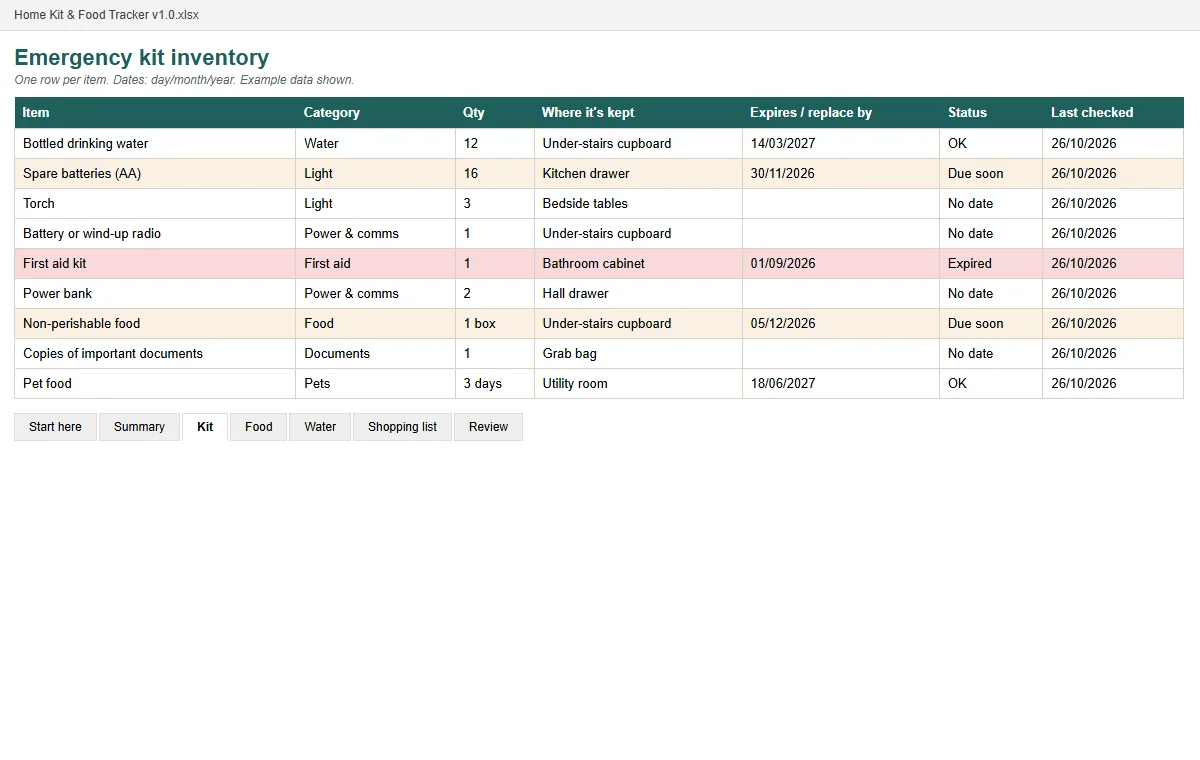
- Keep a 72-hour kit: water, food, torch, battery or wind-up radio, power bank, medicines, cash
- Know how to turn off gas, electricity and water at the mains
- Write down key numbers: 105, Floodline, your water company, GP, family
- Have a way to keep one room cool in summer and warm in winter
- Agree who checks on older relatives and neighbours
- Keep insurance documents and medicines list in a waterproof bag
For longer disruption, such as a multi-day power cut after a storm, see our guides to two weeks of emergency supplies and keeping going in a long blackout.
Limitations
This page is general information, not professional or medical advice. Always follow Met Office warnings, instructions from emergency services and your local authority, and call 999 in an emergency. Flood warning services, public health alerts and some phone numbers differ between England, Scotland, Wales and Northern Ireland.
Turn this guide into a written plan
Reading helps. Writing it down is what makes it work when the phones are flat. Start with the free plan builder, or get the full printable version:
For this topicStorm & Flood Plan£4.99 Your whole household planHousehold Emergency Plan Pack£6.99
 Bundle · £15.97 separatelyPrepared, Not Panicked bundle£9.99
Real pages shown before you buy · instant PDF · one-off price · 30-day refund.
Get the free 72-hour UK household checklist
Tick-box lists for each part of a UK home emergency kit, plus the key numbers on one page. Enter your email and we'll take you straight to the download.
That email address doesn't look right — please check it and try again.
We'll also email you when we publish new guides — occasional, never daily. Unsubscribe any time. See our privacy notice.
Frequently asked questions
What do yellow, amber and red weather warnings mean?
The Met Office says yellow warnings are often issued when there is a high likelihood of some moderate impacts, amber means an increased likelihood of impacts that could disrupt your plans, and red means dangerous weather is expected and you should take action now.
What is a heat-health alert?
Heat-health alerts are issued by the UK Health Security Agency with the Met Office for regions of England. The core season runs from 1 June to 30 September, and anyone can register to receive alerts by email.
When does a storm get a name?
The Met Office says a storm is named when it is expected to cause disruption or damage significant enough to warrant an amber or red warning. Names are chosen jointly by the Met Office, Met Éireann and the Dutch weather service KNMI.
How do I get flood warnings?
In England, sign up free on GOV.UK or by calling Floodline on 0345 988 1188. In Scotland, use SEPA's MyFloodline; in Wales, Natural Resources Wales. In Northern Ireland, report flooding to the Flooding Incident Line on 0300 2000 100.
What should I do if I see a wildfire?
Get to safety away from the flames and call 999 straight away. Give an exact location, for example using what3words or the Ordnance Survey app, and don't try to fight the fire or travel towards it.
When is heat exhaustion an emergency?
The NHS says to call 999 if someone is still unwell after 30 minutes resting in a cool place, or has signs of heatstroke such as hot skin that isn't sweating, confusion, a seizure or loss of consciousness.
Sources
- Met Office — Weather warnings guide
- Met Office — What does it take for a storm to be named?
- GOV.UK (UKHSA) — Weather-Health Alerting System
- UKHSA — Weather-health alerting system user guide (PDF)
- UKHSA data dashboard — Heat health alerts
- GOV.UK Be Ready — Hot weather and heatwaves
- NHS — Heatwave: how to cope in hot weather
- NHS — Heat exhaustion and heatstroke
- GOV.UK Be Ready — Storms
- GOV.UK Be Ready — Flooding
- GOV.UK — Sign up for flood warnings
- nidirect — Preparing for a flood
- GOV.UK Be Ready — Wildfires
- Scottish Fire and Rescue Service — Wildfire prevention
- GOV.UK — Emergency Alert to be sent to England and Wales as Government steps up wildfire response (14 August 2026)
- Cabinet Office — National Risk Register 2025 (PDF)