Grab bag and emergency kit: how to prep
How to start prepping without spending a fortune: a grab bag you can leave with, 3 days of supplies at home, then two weeks.
Told to leave: the first 10 minutes
- Leave straight away if your home is on fire (call 999) or flooding is a danger to life. Otherwise, in most emergencies, stay put unless the police, fire service or council tell you to go.
- When told to go, go promptly by the route you're given.
- Take your grab bag: medicines, first aid kit, documents, torch, water, warm waterproof clothes, phone and charger, cash.
- Turn off gas, electricity and water if it's safe and you know how. Never touch a switch while standing in water.
- Take your pets, and tell your out-of-area contact where you're going.
In danger? Call 999. Follow instructions from the emergency services, radio and GOV.UK: they come first.
From our guide We have to leave now: the first 10 minutes. Official sources: GOV.UK Be Ready: be ready for emergencies (grab bag) · GOV.UK Be Ready: flooding
Start here: the core guides
In reading order.
- How to start prepping in one weekendA step-by-step UK weekend plan to get from nothing to the official 3-day emergency kit: Friday night check, Saturday shop, Sunday grab bag and plan.…
- How to make a go bag: a UK checklist you can printA printable UK go bag checklist built from GOV.UK Be Ready, the Environment Agency flood plan and Sweden's evacuation list: what to pack, where to…
- Bug out bag UK: what to pack, and when leaving makes senseA UK bug out bag (officially a grab bag) packed from GOV.UK Be Ready, the Environment Agency, Sweden's evacuation list and Ready.gov: what goes in,…
- Go bag, bug out bag or 72-hour kit: which one you need, and in what orderThere are really two kits: one that keeps you going at home for 3 days and one you carry if you're told to leave. What Be Ready, the Environment…
- The 3-day government kit: what Be Ready actually asks for, and what it missesWhat the UK's Be Ready advice asks you to keep at home for 3 days, item by item, and the gaps: heat, toilets, cooking and a longer stay. Compared…
- Prepping essentials: a 25-item UK starter list, by budgetWhat to buy first, in order, for about £25, £75 and £150, with real UK prices checked on 1 November 2026. Starts with free steps and things from your…
- Two weeks of emergency supplies: a sensible extended planThe UK's official baseline is 3 days of supplies, including 3 litres of drinking water per person per day. Sweden and Norway suggest a week and…
- First-aid kit: buy one or build your own?Ready-made or DIY first-aid kit for a UK home: what Be Ready and HSE lists include, what a basic shop kit contains and misses, adding big dressings…
Buy only what helps, and free tools
- Be Ready kit tick list
- Go bag shopping list
- 72-hour home kit shopping list
- Water and food calculator
- Emergency cash calculator
- 2-minute readiness check
- Long-life food compared
Our kit lists use plain links to ordinary shops. We may earn from some links in future; we don't now. If that changes, links will be marked and the page will say "Ad". How we make money
Our matching plan
A printable plan to write down what your household will do. Then buy only what the plan says you're missing.
 Our plan · instant PDFGrab Bag Planner£3.99
 Our plan · instant PDF72-Hour Emergency Kit Planner£3.99
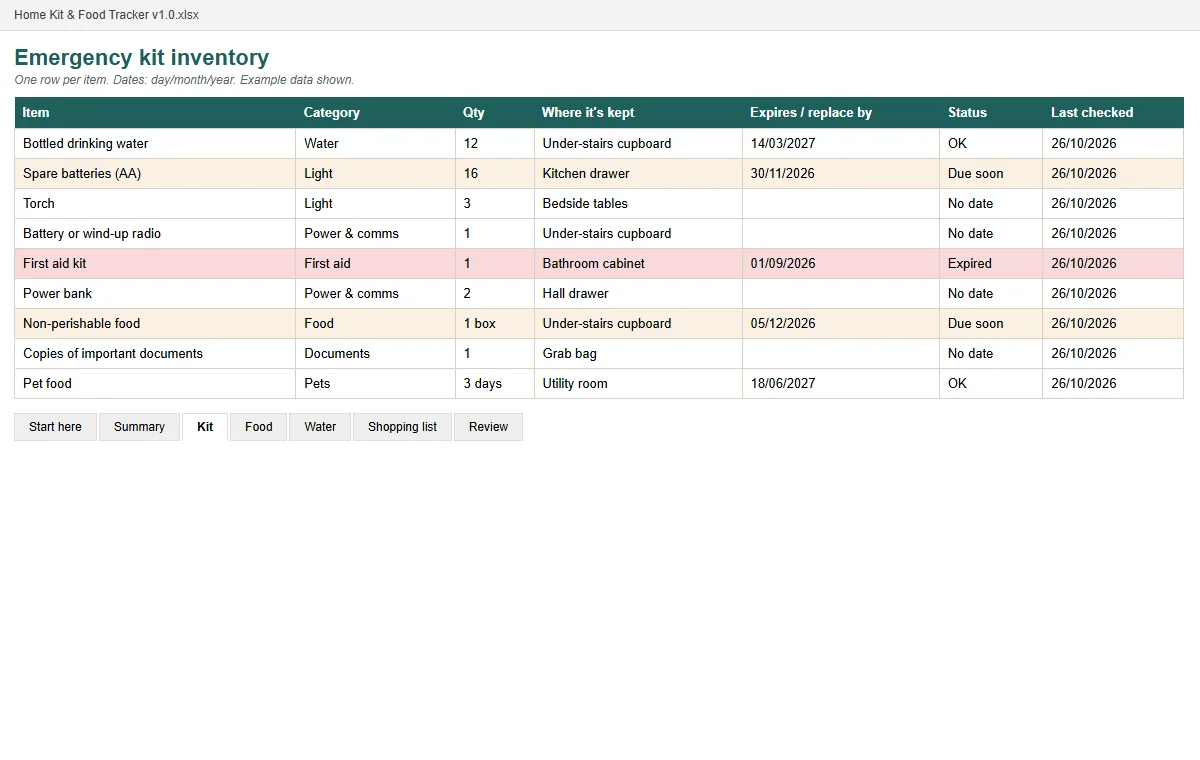 Our plan · instant PDFHome Kit & Food Tracker (spreadsheet)£3.99
Instant PDF, 30-day refund. All plans
Everything else in grab bag & kit
- Is prepping worth it? A basic kit vs one bad weekSimple sums on real events: Storm Arwen left about 40,000 homes without power for more than 3 days, and Spain's 2025 blackout ran into the next…
- What to stock up on for winter: a calm UK listWhat to keep at home this winter for snow, storms and power cuts: the GOV.UK Be Ready 3-day basics, a short winter add-on, how to build it with…
- Emergency kit or first aid kit? What each one is forA household emergency kit keeps you going for 3 days without power, water or shops. A first aid kit treats injuries. What goes in each, where…
- Food storage containers, labels and rotation: a simple system for your emergency cupboardHow to store emergency food at home: which containers the Food Standards Agency mentions, what to write on labels, how first in, first out rotation…
- The Be Ready 72-hour list, costed for one person and ready to printEvery item on the GOV.UK Be Ready checklist for one person for 3 days, with prices we actually saw at Aldi on 3 November 2026 and on Amazon UK on 1…
- How to open a tin without a tin openerThree ways to open a tin with no tin opener: a metal spoon, a sturdy kitchen knife, or a rough stone or concrete step. Step by step, with the cut…
- Grab bag list UK: what to pack if you have to leave homeA grab bag is a spare bag of essentials you can pick up if you have to leave home quickly, for example because of flooding. The government's Be Ready…
- Where to buy a ready-made grab bag in the UK, and when to build your ownReady-made grab bags and survival kits sold in the UK, with prices we saw on 2 November 2026, compared against the GOV.UK Be Ready checklist. Plus a…
- 30 days of emergency food for a family of four: a UK shopping list with real average pricesA month's food store for two adults and two children, built from ordinary supermarket tins and dry food, costed with the ONS average prices for…
- Does the UK government give out free emergency kits?No kits are being posted to homes. What the GOV.UK Be Ready campaign (launched 22 October 2026) actually asks for, what the list costs to build, the…
- Doomsday prepping vs sensible prepping: what a UK home really needsTV-style prepping is bunkers and stockpiles. UK official advice is 3 days of water and food, a radio, a torch and a plan. A side-by-side table, why…
- Is prepping scaremongering? A calm, sensible way to startWhy the UK government, Sweden and Norway now ask every household to keep a few days of supplies, why that isn't a prediction, and a calm first week…
- Prepping in a small flat on a small budgetStart prepping in a small UK flat without spending much: the free steps from GOV.UK Be Ready, the Priority Services Register, what to buy first, and…
- The 7-day no-cook food box: tins that actually taste OKA ready-made UK shopping list for a week of food that needs no fridge, no cooker and no kettle, a 7-day menu, and how to rotate it without changing…
- Long-term food storage in the UK: mylar bags, buckets or tins?How mylar bags and oxygen absorbers work, which foods suit them and which don't, why '25-year' and 'one-year supply' lists are mostly American, and…
- What should be in a home medicine cabinet?The Royal Pharmaceutical Society's home medicine list, as published by the NHS, plus what to add for an emergency: repeat prescriptions, a written…
- Building a medicine buffer legally: repeat prescriptions and pharmacy rulesHow to keep a few days' spare of your regular medicines without breaking any rules: ordering repeats on time, what to ask your GP, NHS 111 and…
- Cash in an emergency: how much, which notes, and where to keep itWhat GOV.UK Be Ready says about emergency cash, why small notes and coins help, whether shops must take cash, old notes that are no longer legal…
- A small emergency kit for your child's school bagA small, school-friendly emergency kit by age: a contact card, a snack and water, a foil blanket, a poncho and more. What schools already plan for,…
- The car emergency kit for UK wintersWhat to keep in the car for a UK winter, from GOV.UK Be Ready and National Highways: torch, charger, blankets, hi-vis, jump leads, food, water,…
- British Gas's winter emergency kit advice, checked against the government's Be Ready listBritish Gas tells households to keep 3 days of food, water, medicines, blankets, a torch and a phone charger for winter. Here's what that list…
- The 72-hour emergency kit for UK householdsA UK 72-hour emergency kit is a small store of everyday supplies that lets your household manage for three days if power, water or phones are…
- UK emergency kit checklist (printable)A UK household emergency kit should help you manage at home for 3 days. The government's Be Ready checklist lists bottled water (3 litres per person…
- The Be Ready checklist, explained for your homeBe Ready is the UK Government's household preparedness campaign, launched by the Cabinet Office on 22 October 2026. Its checklist asks households to…
- Prepper kits in the UK: how to judge a ready-made emergency kitA ready-made prepper or emergency kit can save time, but no kit on sale is the official standard. GOV.UK's Be Ready checklist asks households to be…
- Prepping in the UK: a calm beginner's guidePrepping in the UK doesn't need bunkers or stockpiles — it means being able to manage for about three days if power, water or phones are disrupted,…
- UK stockpile shopping list: the Be Ready list, aisle by aisleGOV.UK's Be Ready advice is to keep 3 days of non-perishable food that needs no fridge or cooking (such as tinned meat, fish or vegetables, dried…
- Emergency food at home: a 72-hour UK cupboardGOV.UK recommends keeping 3 days of non-perishable food that doesn't need refrigeration or cooking, such as tinned meat, fish or vegetables, dried…
- Stock rotation at home: first in, first outFirst in, first out means you eat the oldest food first and put new shopping behind it. The Food Standards Agency says a use-by date is about safety…
- Home first aid kit and medicine cabinet: a UK checklistGOV.UK Be Ready's emergency kit list includes first aid items such as waterproof plasters, bandages, a thermometer, antiseptic, eyewash solution,…
- How much cash should I keep at home?The government's Be Ready advice is to keep some cash at home, a mix of coins and notes, plus cards, in case card payments or cash machines stop…
- Car emergency kit UK: what to keep in your car (and a winter list)The government's Be Ready advice is to keep a torch, an in-car phone charger, warm clothes and blankets, high-visibility clothing, jump leads, food…
- A student emergency kit and first flat checklistGOV.UK Be Ready suggests supplies for 3 days, including 3 litres of water per person per day, a torch and a battery or wind-up radio. In a student…
- Which survival handbook does a UK household need?For a UK home, the most useful survival handbook is not a wilderness book. The SAS Survival Handbook by John 'Lofty' Wiseman covers kit, navigation,…
- Run out of your medicine? How to get an emergency supplyIn England, NHS 111 online lets you request a limited emergency supply of a medicine you've completely run out of, if it's one you're prescribed…
Also useful
- Nuclear war survival kit for a UK home: what's useful and what isn'tA nuclear emergency kit built from what official advice asks you to do: get inside, stay in for one to two days, clean off, listen for instructions.…
- First aid after an explosion or serious accident: what to do while you wait for helpCheck for danger, call 999, stop serious bleeding, cool burns, treat shock, protect broken bones and dusty eyes, and what to do if someone isn't…
Official sources
- GOV.UK Be Ready: be ready for emergencies (read 1 Nov 2026 for our guide)
- Environment Agency: Personal flood plan (flood kit) (read 1 Nov 2026 for our guide)
Official advice comes first. If a source says something different now, follow the source.