Missile, blast and shelter: what to do
Taking cover, the safest room in a UK house or flat, and making the home safer after a blast nearby.
Missile or air-raid alert: the first 10 minutes
- Stop and read the alert. Do what it says. If you're driving, pull over somewhere safe and legal first.
- Get inside the nearest solid building. Don't travel home or to school first.
- Go to the middle of the building: a cellar, an inner hallway, a stairwell or a room with no windows. Keep away from outside walls, doors and glass.
- If you can't get inside, lie flat on the ground, ideally in a dip or ditch, and cover your head. Get inside as soon as you can.
- Stay in. Turn on a radio. Keep your phone on for more alerts. Text, don't call: one short text to family to say where you are.
- Stay put until the authorities say it's over. Then check people for injuries before anything else.
In danger? Call 999. Follow instructions from the emergency services, radio and GOV.UK: they come first.
From our guide Missile or air-raid alert: what to do in the first 10 minutes. Official sources: GOV.UK: Emergency Alerts · Sweden MCF: In case of crisis or war
Start here: the core guides
In reading order.
- Missile or air-raid alert: what to do in the first 10 minutesSix calm steps if you get a missile or air attack alert in the UK: read the alert, get inside, go to the middle of the building, lie flat if caught…
- Making your home safer after a missile or drone strike nearbyWhat to check at home after an explosion nearby: people first, then gas, electricity, water, glass and the structure, and when to leave. From UK, US…
- First aid after an explosion or serious accident: what to do while you wait for helpCheck for danger, call 999, stop serious bleeding, cool burns, treat shock, protect broken bones and dusty eyes, and what to do if someone isn't…
- Which room is safest in a UK house or flat?Where to shelter inside a semi, terrace, bungalow or block of flats if you're told to go in and stay in: the middle of the building, away from…
- Set up a shelter room for 48 hours: supplies, layout, air and a toiletHow to turn one inner room of a UK house or flat into a place to stay for two days if you're told to go in and stay in: which room, what to put in…
- Bunkers in the UK: can they survive a nuclear attack, do you need planning permission, and is there a better option?There are no public nuclear bunkers on offer in UK official advice. What official guidance says about sheltering underground, when a home bunker or…
- Smell gas? What to do, step by stepIf you smell gas in Great Britain, the National Gas Emergency Service advises: don't smoke or light matches, don't turn electrical switches on or…
- How to turn off your gas, electricity and waterTo turn off the gas, Cadent says turn the red handle on the pipe by your meter a quarter turn, so it sits across the pipe (not if the meter is in a…
Buy only what helps, and free tools
- Stay-in room shopping list
- What to buy for a war or nuclear warning
- Shelters and safe rooms: UK rules and costs
Our kit lists use plain links to ordinary shops. We may earn from some links in future; we don't now. If that changes, links will be marked and the page will say "Ad". How we make money
Our matching plan
A printable plan to write down what your household will do. Then buy only what the plan says you're missing.
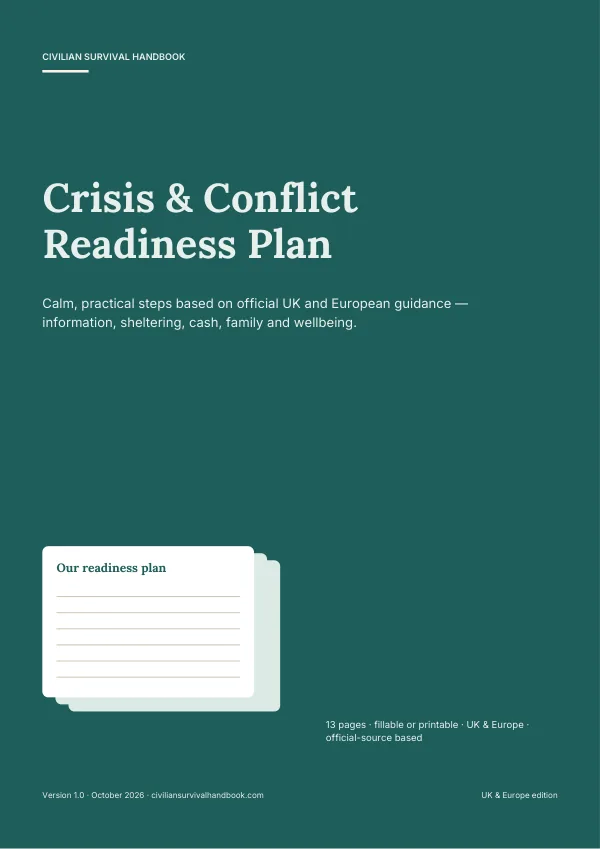
Instant PDF, 30-day refund. All plans
Also useful
- A nuclear explosion nearby: what to do in the first hourMinute-by-minute steps if there's a nuclear flash: don't look, take cover, get inside within about 10 minutes, take off outer clothes, wash, and stay…
- What to do if there's a nuclear or radiation warning in the UKWhat UK official advice says to do if a nuclear or radiation warning comes: go in, stay in, tune in. Six steps, which room to use, what to do if you…
- Radiation emergency in the UK: what official advice says (go in, stay in, tune in)UK Health Security Agency advice for a radiation emergency is to go in, stay in and tune in: get inside the nearest solid building, close doors and…
- Home first aid kit and medicine cabinet: a UK checklistGOV.UK Be Ready's emergency kit list includes first aid items such as waterproof plasters, bandages, a thermometer, antiseptic, eyewash solution,…
Official sources
- Ready.gov: Explosions (read 1 Nov 2026 for our guide)
- National Gas: Emergency contacts and gas safety advice (read 1 Nov 2026 for our guide)
- UKHSA: What to do in a radiation emergency (read 1 Nov 2026 for our guide)
Official advice comes first. If a source says something different now, follow the source.